


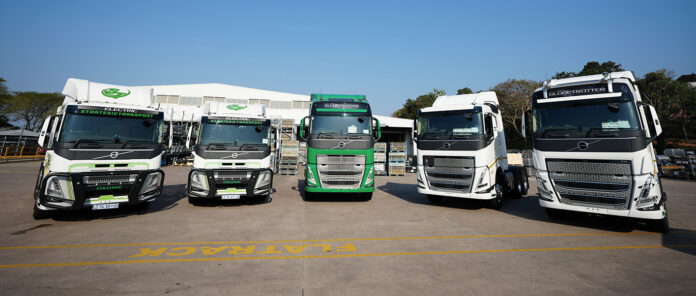
Volvo Trucks South Africa has marked the 20th anniversary of its Durban assembly plant, celebrating two decades in which daily production has tripled and the facility has become an important part of the company’s regional manufacturing operations.
Established in 2006, the plant initially assembled about four trucks a day. It now produces 12 units daily, with a monthly output of about 220 trucks – equivalent to an annual production capacity of about 2 640 units.
The plant employs 142 people and assembles extra-heavy trucks used for long-haul transport, regional distribution and construction. Models currently assembled at the facility include Euro 6 derivatives and the aerodynamically enhanced Volvo FH Aero. According to Naamsa vehicle sales data, Volvo Trucks has recorded 1 253 sales in the year to date. Daimler Truck, which produces vehicles in East London, led the selected competitors with 1 783 units, followed by Scania with 1 333. MAN recorded 957 units during the same period.
MAN’s truck and bus assembly operation in Pinetown, also in KwaZulu-Natal, produces more than 200 chassis a month on a single shift, according to the company’s head of trucks, Philip Kalil-Zackey.
He said production could be increased in line with market requirements.
Against this competitive backdrop, Volvo Trucks South Africa managing director Stuart Potter said the decision to establish local assembly operations was based on the strategic importance of South Africa as a gateway to the Southern African region.
Local assembly allows manufacturers to respond more quickly to customer specifications and market demand. However, imported components mean truck production remains exposed to exchange-rate movements, global supply chains and changing economic conditions.
Potter said fleet operators increasingly expected manufacturers to provide broader transport solutions aimed at improving productivity and vehicle uptime, reducing fuel consumption and enhancing safety.
The Durban plant has also placed emphasis on expanding women’s participation in a manufacturing sector that remains largely male-dominated. Women account for 40% of the plant’s overall workforce and 23% of employees work directly on the assembly line. The operation has also appointed its first female production manager, Mbali Mthethwa.
Plant director Vuyo Sabata said the figures represent progress, but the company recognises that more work is required to improve representation.
The facility has introduced standardised production processes, digital technologies and enhanced quality controls over the past two decades. Environmental measures include solar energy generation, water-harvesting systems, and energy-efficient LED lighting. Electrification is emerging as the next major competitive battleground in the commercial vehicle industry, although the introduction of electric trucks in South Africa is expected to depend on charging infrastructure, operating costs and customer demand.
Volvo Trucks already markets electric heavy trucks internationally, and a couple of them were roaming around at the KZN plant between the assembly line and parts warehouse. Local rival, MAN, has begun its South African electrification programme with electric buses. Kalil-Zackey said MAN had secured its first major local eBus order and was preparing its dealer network to maintain electrified vehicles.
Per-Erik Lindström, senior vice-president of Volvo Trucks International, said the Durban workforce had developed the technical expertise required to adapt to advanced technologies and new product variants.
EThekwini mayor Cyril Xaba described the plant as a contributor to the city’s industrial capabilities and local economy.
“To witness your evolution from a modest operation to a substantial plant that can produce in excess of 2 000 units a year is a powerful statement of confidence in the future of our city,” Xaba said. For Volvo Trucks, sustaining the plant’s next phase will depend on maintaining production quality and competitiveness while responding to technological changes reshaping the industry..
- Volvo Trucks South Africa's Durban plant, established in 2006, now produces 12 trucks daily, tripling its initial output of four trucks a day.
- The plant assembles extra-heavy trucks including Euro 6 derivatives and the Volvo FH Aero, with a monthly output of about 220 trucks and annual capacity of around 2,640 units.
- Women constitute 40% of the workforce at the Durban plant, with 23% working on the assembly line, and the facility has appointed its first female production manager, Mbali Mthethwa.
- The plant has implemented environmental measures like solar energy generation, water harvesting, and energy-efficient LED lighting, and electric trucks are expected to depend on infrastructure and demand in South Africa.
- Volvo Trucks South Africa recorded 1,253 truck sales to date, with competitors Daimler Truck leading at 1,783 units and Scania at 1,333 units, according to Naamsa vehicle sales data.


