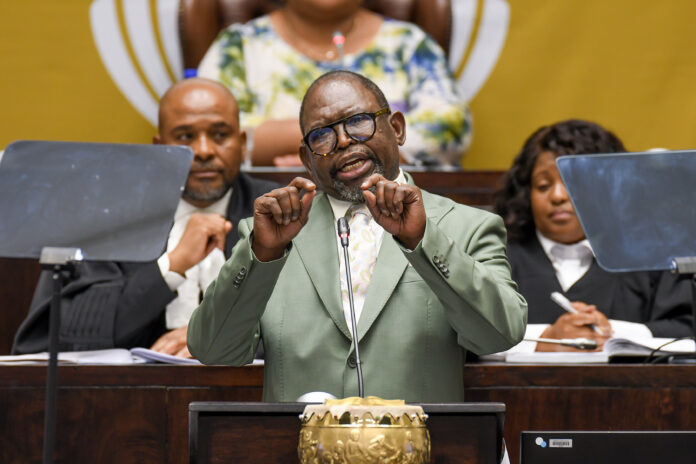
The country’s financial future was on the agenda on Wednesday when Finance Minister Enoch Godongwana delivered the 2026 Budget Speech in parliament.
Godongwana noted that this year’s Budget Speech comes at a critical juncture for the public purse.
State capture, Covid-19 era
“We have reached an important turning point in the management of our public finances. Five years ago, the outlook was stark. State Capture had hollowed out critical institutions and weakened state-owned-entities. South Africa had been downgraded to junk status by the last of the three major credit rating agencies in 2020.
“The devastation of the Corona virus pandemic coupled with the Russia-Ukraine conflict had dealt a blow to global growth. And in 2023, the Financial Action Task Force had placed South Africa on its grey list.
“The warning lights were flashing. Public finances were under severe strain and growth had stalled. Faced with this crisis, we chose not to be defined by it. Instead, we turned it into a catalyst for change,” he said.
Reforms yield stability
As a result of a long-standing commitment to change through a clear reform agenda and a disciplined fiscal strategy, South Africa’s public debt is expected to stabilise this financial year – growth is on the cards with a decline forecasted in the medium term.
“Today, that commitment has delivered tangible results. For the first time in 17 years, debt will stabilise. And it will continue to fall in the coming years. The budget deficit has narrowed significantly, and debt-service costs are also falling.
“The world has taken notice: South Africa has been removed from the FATF [Financial Action Task Force] grey list. We secured our first credit rating upgrade in 16 years. And borrowing costs have eased, creating space for growth and development.
“These are signals of restored credibility. Of renewed resilience. And of a nation regaining its footing. The lesson is a simple but powerful one. That steady structural reform and responsible public finances are the bedrock of a prosperous and more inclusive South Africa,” the minister noted.
Budget deficit R12.4bn lower than forecasted
The numbers crunched by National Treasury in the 2026 Budget Review concur with Godongwana’s optimism.
The review reports that the main budget deficit comes in R12.4-billion lower than forecasted in last year’s budget. This is due to “strong fiscal outcomes for the first 10 months of 2025/26”.
Since the 2021/22 financial year, the main budget deficit has narrowed from 5.1% of Gross Domestic Product (GDP) to a projected 4.5% in 2025/26.
It is further projected to decline to 2.9% in 2028/29.
“In 2023/24, the primary balance swung from deficit to surplus for the first time since the 2008 global financial crisis. It will grow to 2.3 % of GDP in 2028/29.
Debt set to decline over next three years
“As a result, debt as a share of GDP will decline over the next three years. And the cost of servicing that debt will reduce from 21.3% of revenue in 2025/26 to 20.2% in 2028/29.
“These developments reflect a determined approach to repair the public finances. This while creating a foundation for stronger and sustainable economic growth,” said the Treasury.
The consolidated budget deficit also continues to decline over the medium-term expenditure framework (MTEF) period.
It is expected to narrow from 4.5% of GDP in 2025/26 to 3.1% in 2028/29.
“Gross loan debt stabilises this year at 78.9% of GDP. Debt-service costs continue to rise in nominal terms, from R420.6-billion in 2025/26 to R469.3-billion in 2028/29. But as a percentage of revenue, they also peak in the current financial year and then decline,” Treasury noted.
Reflecting on the progress made, National Treasury stated that government is “delivering on its pledge to rebuild the health of the public finances”.
Supportive environment for private investment
“After a long stretch of rising debt that began in the wake of the 2008 global financial crisis, government debt peaks as a share of economic output in the current fiscal year.
“Government is working to ensure a steady decline in debt as a share of GDP for the rest of the decade. It is reducing the cost of servicing debt and creating a more supportive environment for private investment.
“For the first time this decade, government is tabling a fiscal framework in which debt service costs grow more slowly than overall expenditure. Over the next three years, principal and interest payments are expected to be R21-billion lower than estimated in the 2025 Medium Term Budget Policy Statement (MTBPS).”
The shift towards improvement has been anchored on three principles. These are: stabilise debt, invest in infrastructure and spend better.
Credit rating upgrade
“The benefits of this strategy have started to become evident. Enhancing monetary policy certainty and consistent delivery on the fiscal strategy have prompted a virtuous cycle, especially in the period following the tabling of the 2025 MTBPS.
“South Africa received its first sovereign credit rating upgrade by one of the major agencies since 2009. Lower inflation and stronger public finances have boosted confidence and reduced risk. Thus leading to lower borrowing costs and stronger investment conditions.
“Much work is needed to improve the delivery of public goods. But the recent removal of South Africa from the Financial Action Task Force grey list illustrates the depth of capacity that can be assembled. Government will build on this success in other areas.”
SAnews.gov.za
- The country’s financial future was on the agenda on Wednesday when Finance Minister Enoch Godongwana delivered the 2026 Budget Speech in parliament.
- Godongwana noted that this year’s Budget Speech comes at a critical juncture for the public purse.
- State capture, Covid-19 era “We have reached an important turning point in the management of our public finances.
- Five years ago, the outlook was stark.
- State Capture had hollowed out critical institutions and weakened state-owned-entities.