
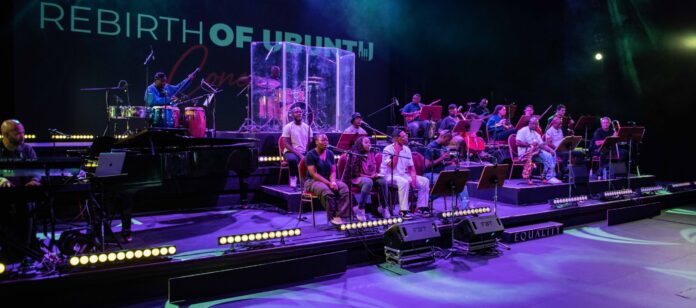
For five years, guitarist and composer Billy Monama has been building a stage that he calls The Rebirth of Ubuntu. For him, it is not merely a concert but two nights at the Joburg Theatre, a 20‑piece orchestra, and a lineup that reads like a roll call of South African jazz and soul royalty. It is a thesis on heritage, a negotiation between preservation and inclusion, and, in his words, “a cultural statement”.
This year is the fifth edition, themed “50 Years of Youth Legacy,” a commemoration of half a century since the 1976 Soweto Youth Uprising.
Saving a legacy
Monama sees the concert’s timing as deliberate: a moment to reflect on a nation still deeply divided. The four‑hour production, conducted by Grammy‑winning arranger Joe “JB” Arthur, brings together Lira, Zoë Modiga, Vusi Nova, Tutu Puoane, Monama himself, and legendary guitarist Jimmy Dludlu as the honorary artist. Organisers describe it as a celebration of unity, heritage, and the enduring spirit of ubuntu, blending jazz, soul and African musical traditions.
Monama spoke to Sunday World about a legacy he watched starting to fade.
“The music they made [Hugh Masekela, Abdullah Ibrahim, Jonas Gwangwa] conscientised people and gave hope,” Monama said, recalling the artists who soundtracked South Africa’s struggle and its early freedom. “It looked like the legacy was kind of fading away. I was privileged to hear those musical stories first-hand, working with them. This concert was a need.”
Tributes across generations
That need, he explains, is rooted in a sobering observation: “The nation is divided. As artists, giving hope is necessary.” For Monama, music is not entertainment but a form of social repair. The Rebirth of Ubuntu is his attempt to revive the consciencising power of an earlier generation while making space for the artists who carry those traditions forward today.
Monama’s lineup it is not random. He has carefully mapped each featured artist to a specific legend, an act of curatorial storytelling.
Vusi Nova, with his soul‑deep Xhosa storytelling, pays tribute to Hugh Masekela. Lira, whose voice bridges pop and spiritual jazz, channels Miriam Makeba. Tutu Puoane, the globally refined jazz vocalist, honours Sibongile Khumalo, a Soweto‑born artist who belonged to the generation immediately after Makeba, whose career blossomed in the wake of the 1976 uprising.
Vessel for diversity
“Heritage needs to be preserved, like a compass and a map,” Monama says. “It needs to be observed.” He sees cultural work as the vessel for diversity in all its forms – food, language, music and music, he believes is doing that work well.
Yet even as he builds tributes to the past, he looks towards a broader sonic future. Maskandi, he notes, is on his radar, “bringing maskandi like Phuzekhemisi next year. It speaks to culture.” This acknowledges that while this edition leans heavily on jazz and soul, the definition of heritage he is building is intended to expand.
Youth legacy
The theme “50 Years of Youth Legacy” could easily remain a commemorative tagline. Monama, however, points to concrete structures he has built around the concert. Yearly masterclasses bring talented youngsters onto the stage alongside the icons not merely as observers, but for their own growth. “Employment for the youth is there by default,” he notes, pointing to the young technicians, stagehands, and support staff employed by the production.
But the lesson he most wants young musicians to absorb is one of discipline. “Discipline is currency,” he says. “You can be talented, but without discipline, the talent will be short‑lived.” The presence of Joe Arthur, a Grammy‑winning arranger, and the rigour of a 20‑piece orchestra serve as a living classroom. For Monama, watching these artists prepare – the focus, the rehearsal etiquette, and the respect for craft – is itself a form of mentorship.
Sponsorship and employment
Capitec is the sponsor of the 5th edition, which according to Monama, enables something essential. “Job creation is secured, especially with the unemployment rate in South Africa,” he says. The sponsorship, in his view, translates directly into livelihoods for musicians, for orchestral players, for the crew who make a production of this scale possible.
And if he had unlimited resources? Monama reveals with excitement his scale of ambition. “A stadium. A hundred musicians. A full harmonic orchestra with international artists as well. A three‑day concert or five with a mixture of everything.”
The concert will be at the Joburg Theatre on 29 – 30 May. Monama describes it as “classic music and good vibes”, but also “nostalgic moments” – the kind that connect a listener to a parent, a history, a struggle survived. In a divided nation, those moments of collective memory may be as close as art can come to healing.