


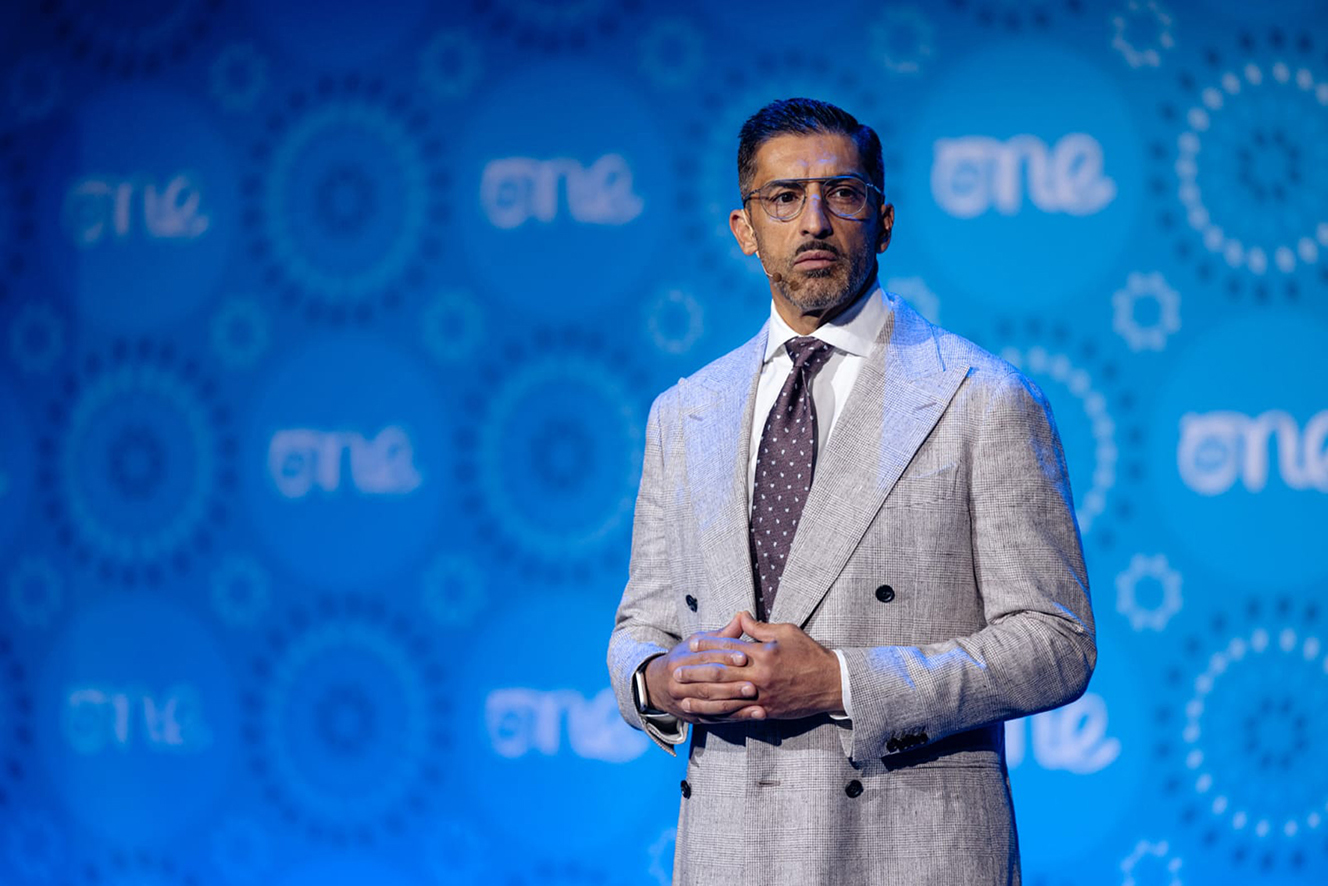
Standard Bank chief economist Goolam Ballim has urged young leaders to invest in Africa’s development, saying the continent is best placed to advance global prosperity.
Speaking at the first One Young World Summit, a gathering of more than 2 200 changemakers, in Cape Town last week, Ballim said: “A more developed Africa would also mean the potential for greater international food security. A more developed Africa means that Africa can converge its abundance of renewable resources for the benefit of the industrial world and elsewhere, but it also means that Africa can become, as a developed economy, a substantial consumer market — now 1.5-billion people and, in 2050, 2.5-billion people.”
Ideal trade partner
Addressing the main plenary at the Cape Town International Convention Centre on Friday, Ballim said Africa’s location between East and West made it an ideal partner for trade and global supply chains.
“In terms of commodities, Africa has an abundant amount of cobalt, platinum, lithium and a variety of other critical and rare earth minerals that are going to be essential for this century’s energy and advanced manufacturing build-out. In terms of food security, 60% of the world’s still-available arable land is on the continent. In so many respects, Africa has an enormous amount of relevance.”
Structural barriers
However, structural barriers prevented the continent from turning its potential into prosperity.
“Africa is devoid of the substructures that are necessary to monetise — to translate this potential into reality. This potential needs electricity. It needs skills. It needs technology, regulation, the rule of law, policymaking, to make this all into a true transformation that benefits society.”
As a result, a continent that is home to 18% of the world’s population contributes only 4% of global GDP, leaving Africans with a far lower income per person than the rest of the world.
“Africa has a dearth of critical infrastructure that is necessary to convert this potential – for example, mining resources – into beneficiation, into manufacturing and into distribution. Right now, for the most part, it’s simply extracted and exported, with very little value add conducted on the continent,” Ballim said.
Skills development
Canninah Dladla, the cluster president for sub-Saharan Africa at Schneider Electric, told participants that Africa’s next generation should be leading and shaping the continent’s energy future.
“We need to look at skills development and manufacturing together. If we want to localise more of what we produce and build stronger industrial capabilities across Africa, we need the right skills and the right people,” she said.
Eskom board chairperson Mteto Nyati, who addressed the summit on the day of the local government elections, urged young South Africans to make better choices for the country. “Please be conscious of the choices that you make, because they are the ones that will define where you end up in life,” he said.
Star-studded line-up
The summit featured a star-studded line-up of speakers, among them Academy Award winner Forest Whitaker, The X-Files star Gillian Anderson, Terry Crews and Zimbabwean-American actress Danai Gurira.
Also on the panels were former Constitutional Court justice Albie Sachs, former public protector Thuli Madonsela, Irish musician and activist Bob Geldof, former Colombian president Juan Manuel Santos and British-Iranian Nazanin Zaghari-Ratcliffe, who was detained in Iran for six years.
- Standard Bank chief economist Goolam Ballim urged young leaders to invest in Africa’s development at the One Young World Summit in Cape Town.
- Ballim highlighted Africa's potential in food security, renewable resources, rare minerals, and its growing consumer market projected to reach 2.5 billion people by 2050.
- Structural barriers such as lack of electricity, skills, technology, regulation, and infrastructure currently inhibit Africa from converting its potential into prosperity.
- Canninah Dladla emphasized the importance of skills development and manufacturing for building stronger industrial capabilities in Africa.
- The summit featured notable speakers including Forest Whitaker, Gillian Anderson, Terry Crews, Danai Gurira, Albie Sachs, Thuli Madonsela, Bob Geldof, Juan Manuel Santos, and Nazanin Zaghari-Ratcliffe.
Standard Bank chief economist Goolam Ballim has urged young leaders to invest in Africa’s development, saying the continent is best placed to advance global prosperity.
Speaking at the first One Young World Summit, a gathering of more than 2 200 changemakers, in Cape Town last week, Ballim said: “A more developed Africa would also mean the potential for greater international food security. A more developed Africa means that Africa can converge its abundance of renewable resources for the benefit of the industrial world and elsewhere, but it also means that Africa can become, as a developed economy, a substantial consumer market — now 1.5-billion people and, in 2050, 2.5-billion people.”
Addressing the main plenary at the Cape Town International Convention Centre on Friday, Ballim said Africa’s location between East and West made it an ideal partner for trade and global supply chains.
“In terms of commodities, Africa has an abundant amount of cobalt, platinum, lithium and a variety of other critical and rare earth minerals that are going to be essential for this century’s energy and advanced manufacturing build-out. In terms of food security, 60% of the world’s still-available arable land is on the continent. In so many respects, Africa has an enormous amount of relevance.”
However, structural barriers prevented the continent from turning its potential into prosperity.
“Africa is devoid of the substructures that are necessary to monetise — to translate this potential into reality. This potential needs electricity. It needs skills. It needs technology, regulation, the rule of law, policymaking, to make this all into a true transformation that benefits society.”
As a result, a continent that is home to 18% of the world’s population contributes only 4% of global GDP, leaving Africans with a far lower income per person than the rest of the world.
“Africa has a dearth of critical infrastructure that is necessary to convert this potential – for example, mining resources – into beneficiation, into manufacturing and into distribution. Right now, for the most part, it’s simply extracted and exported, with very little value add conducted on the continent,” Ballim said.
Canninah Dladla, the cluster president for sub-Saharan Africa at Schneider Electric, told participants that Africa’s next generation should be leading and shaping the continent’s energy future.
“We need to look at skills development and manufacturing together. If we want to localise more of what we produce and build stronger industrial capabilities across Africa, we need the right skills and the right people,” she said.
Eskom board chairperson Mteto Nyati, who addressed the summit on the day of the local government elections, urged young South Africans to make better choices for the country. “Please be conscious of the choices that you make, because they are the ones that will define where you end up in life,” he said.
The summit featured a star-studded line-up of speakers, among them Academy Award winner Forest Whitaker, The X-Files star Gillian Anderson, Terry Crews and Zimbabwean-American actress Danai Gurira.
Also on the panels were former Constitutional Court justice Albie Sachs, former public protector Thuli Madonsela, Irish musician and activist Bob Geldof, former Colombian president Juan Manuel Santos and British-Iranian Nazanin Zaghari-Ratcliffe, who was detained in Iran for six years.


