


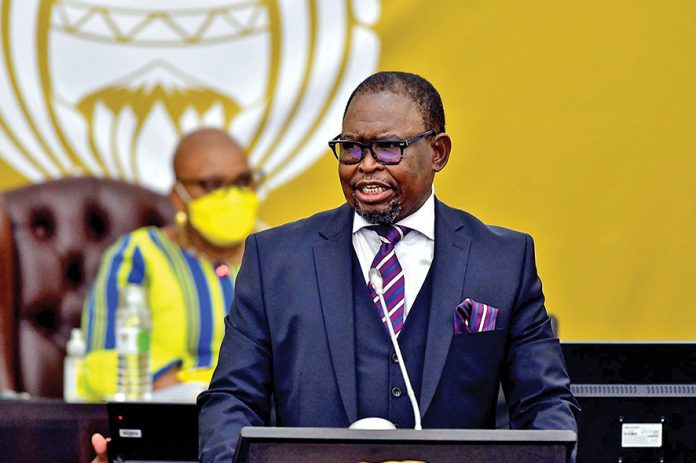
As Finance Minister Enoch Godongwana prepares to table the national Budget, the emphasis is likely to remain on fiscal consolidation, debt stabilisation and expenditure restraint. That focus is understandable. South Africa’s debt trajectory and rising debt-service costs constrain policy space. However, fiscal credibility without a credible growth strategy risks becoming self-limiting.
South Africa’s core macroeconomic challenge is not only the level of debt, but the persistently weak growth rate underpinning the denominator of the debt-to-GDP ratio. With growth rates around 1%, the economy is expanding below its potential and insufficiently to absorb labour market entrants. In such an environment, consolidation alone cannot deliver sustainability.
Scaled private sector participation
The Budget, therefore, needs to do more than reassure bond markets. It must signal structural acceleration. First, infrastructure reform must move from incremental adjustment to scaled private sector participation. The energy, water, ports, rail, logistics sectors determine economy-wide productivity. Operational bottlenecks in freight rail and port performance alone impose measurable GDP costs.
The state’s fiscal constraints make it unrealistic to assume that public capital expenditure can close these gaps unaided. Clear concession frameworks, predictable regulatory timelines and enforceable public-private partnership models would crowd in private capital without materially expanding the sovereign balance sheet. Execution speed and regulatory certainty, rather than funding availability, are now the binding constraints.
Simplify SME policy
Second, SME policy requires simplification rather than expansion. Small and medium enterprises account for a substantial share of employment, yet compliance complexity, licensing delays and payment uncertainty materially raise their cost of operation. Enforced 30-day public sector payment cycles, simplified turnover-based tax regimes for smaller firms and digital licensing platforms would reduce friction more effectively than additional grant schemes.
Third, labour market interventions should be more tightly aligned with demand. Youth unemployment remains structurally high. Time-bound, targeted entry-level flexibility combined with employer-linked apprenticeship incentives could improve absorption without undermining broader labour protections. Policy precision matters more than policy volume. From a fiscal perspective, expenditure quality is now as important as expenditure quantity. Consolidation that reduces productive public investment risks depressing medium-term growth further.
Growth is paramount
Conversely, reprioritisation towards infrastructure maintenance, logistics efficiency and digital administrative reform can raise potential output without increasing aggregate spending. Growth is not an alternative to fiscal discipline; it is its prerequisite. A sustained increase in potential output expands the tax base organically, improves revenue buoyancy and stabilises debt ratios more effectively than repeated revenue measures in a low-growth environment. South Africa has demonstrated renewed reform momentum in selected sectors.
The Budget provides an opportunity to consolidate that progress with measurable, time-bound commitments that signal seriousness to investors and businesses alike. Fiscal consolidation will remain necessary. But without a visible and credible growth pivot — anchored in private sector participation and productivity-enhancing reform — consolidation risks entrenching stagnation rather than resolving vulnerability. The question for Budget 2026 is therefore not only whether the numbers balance, but whether the strategy accelerates.
Maarten van Doesburgh is Head of Economics at the Cape Peninsula University of Technology and a public commentator on economic policy.
- As Finance Minister Enoch Godongwana prepares to table the national Budget, the emphasis is likely to remain on fiscal consolidation, debt stabilisation and expenditure restraint.
- That focus is understandable.
- South Africa’s debt trajectory and rising debt-service costs constrain policy space.
- However, fiscal credibility without a credible growth strategy risks becoming self-limiting.
- South Africa’s core macroeconomic challenge is not only the level of debt, but the persistently weak growth rate underpinning the denominator of the debt-to-GDP ratio.


