


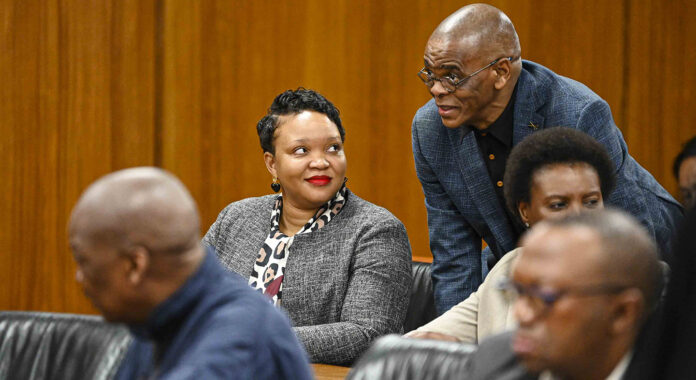
Ace Magashule’s ex-PA, Moroadi Cholota, has filed an appeal application in the Free State High Court challenging her prosecution in the long-running corruption case involving asbestos in the Free State, arguing that fundamental legal errors in the trial court’s judgment could invalidate the prosecution itself.
In the application, Cholota asks the court to reserve several “questions of law” for determination by the Supreme Court of Appeal or the Constitutional Court.
Rather than focusing on factual disputes about the asbestos project itself, the appeal targets the legal foundations of the prosecution, raising arguments that the state may have misapplied the standard of proof, relied on flawed evidence, and possibly proceeded without sufficient grounds when charges were initially laid.
Her main argument is that the trial court failed to properly implement instructions previously issued by the Constitutional Court regarding Cholota’s extradition to South Africa.
According to the filing, the Constitutional Court had directed the High Court to determine whether the conduct of South African officials during the extradition process “brought the administration of justice into disrepute” and constituted “an abuse of process, which amounts to an affront of the public conscience.”
The appeal argues that the High Court judgment delivered in February did not fully address those questions.
“The judgment handed down by this honourable court… is silent on both these questions,” the document states, adding that the court had itself previously indicated that answering those issues was required by the Constitutional Court ruling.
The defence contends that a failure to engage with those constitutional questions amounts to an error of law.
Another pillar of the appeal concerns the legal standard of proof in criminal cases.
The application cites long-standing precedent, including Rex v Blom (1939) and R v Ndhlovu (1945), to argue that the trial court misapplied the requirement that the state must prove its case beyond reasonable doubt.
In the Blom case, the Appellate Division held that criminal inferences must establish a “high probability that leaves no reasonable doubt” and must be consistent with all proven facts.
The defence argues that the trial court’s conclusions do not meet that threshold, particularly given the contradictory testimony of a key state witness, Capt Benjamin Calitz.
The appeal claims that the witness “contradicted his own evidence”.
It further argues that several concessions made by witnesses during testimony were inconsistent with the court’s ultimate finding that the state had disproved Cholota’s special plea beyond reasonable doubt. A third legal question raised in the appeal concerns how the trial court assessed the credibility of witnesses.
Despite acknowledging inconsistencies in the evidence, the court nevertheless found Calitz and Maj-Gen Nico Gerber to be favourable witnesses.
The appeal contends that this evaluation ignored significant contradictions. “Despite the contradictions and inconsistencies in his versions, the court nonetheless found Capt Calitz… to be ‘favourable witnesses’,” the application states.
The defence argues that such inconsistencies would have led the court to draw different conclusions about the reliability of the evidence.
Another legal dispute identified by the defence concerns the information presented to US authorities during the extradition process. The appeal argues that statements made to US authorities about Cholota being a potential flight risk with connections in Kenya may have been misleading.
According to the application, the trial court accepted the state’s version that the flight-risk issue played no role in the extradition proceedings, despite evidence suggesting that the information had been included in sworn affidavits sent to
US authorities.
The defence argues that the court failed to draw the conclusion that this could constitute a misrepresentation in the extradition process.
If a higher court finds that the trial court committed material errors of law, the consequences could include the reversal of key findings in the case or further litigation over the legality of the prosecution.


