


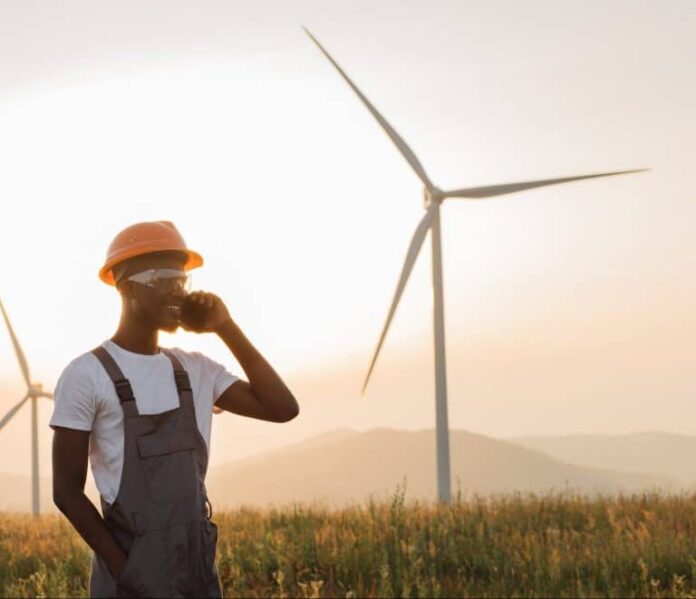
President Cyril Ramaphosa on Friday reaffirmed support for a different energy mix when he officially launched Mpumalanga’s first commercial wind farm.
The project is expected to generate cleaner electricity, create more than 1 000 jobs and cement the province’s role as South Africa’s energy capital even as the country shifts towards renewable power.
The R10-billion Ummbila Emoyeni Wind Farm, developed by Seriti Green among Bethal, Davel and Morgenzon, marks the first time a province historically defined by coal-fired power stations has added utility-scale wind generation to its energy mix.
Turning wind into an engine of economic growth
The development also positions Mpumalanga alongside a growing list of regions across the world that are turning wind into an engine of economic growth rather than simply a source of electricity.
“Today represents far more than the completion of an infrastructure project,” Ramaphosa said during the launch. “It shows that South Africa’s just energy transition is being realised through practical action.”
The president said the project demonstrated that South Africa’s energy transition would not be built on abandoning coal but on combining existing energy sources with new technologies to secure reliable and affordable electricity.
“South Africa’s future energy system will draw on the strengths and resources we already possess, including coal-fired power, while embracing new opportunities,” he said.
More than 1 000 jobs created during construction
The wind farm has already created more than 1 000 jobs during construction, with around half going to people living within a 10km radius of the project. More than 18,500 people have registered on Seriti Green’s Skills Hub to access employment and training opportunities linked to future projects, with women accounting for more than half of the registrations.
Ramaphosa said the success of South Africa’s just energy transition would ultimately be measured by whether it improved people’s lives.
“The true measure of the success of this just energy transition is the extent to which it creates opportunities for the South African people,” he said.
He said renewable energy projects should leave lasting economic benefits by strengthening local businesses, equipping young people with skills and creating opportunities that extend well beyond construction.
The project comes as South Africa accelerates reforms to diversify electricity generation following more than a decade of debilitating load shedding that constrained economic growth.
Ramaphosa announced that the government had completed the first phase of work towards establishing an independent Transmission System Operator, a key component of electricity market reforms that will allow multiple public and private generators to compete to supply power.
“Energy security underpins economic growth, investment, industrial development and job creation,” he said.
‘A turning point for Mpumalanga’
Premier Mandla Ndlovu described the project as a turning point for Mpumalanga, saying the wind farm represented far more than renewable energy infrastructure.
“I saw hope in the eyes of the people of this community, hope for jobs, hope for development, and hope for a better future,” Ndlovu said.
“Our people are saying we are selling hope for a better tomorrow; they are demanding to live a better life now. This project aims to meet that demand.”
Ndlovu also revealed that detailed wind studies commissioned by Seriti Green had found the Bethal area possessed wind resources stronger than some of South Africa’s coastal regions, overturning assumptions that Mpumalanga lacked sufficient wind potential.
“We are delighted by the vision of Seriti Green, who initiated the wind resources study which found that the Bethal area has the best wind, even better than the coastal winds,” he said.
He argued that the country’s energy transition should not become a choice between coal and renewables.
“It must not simply be about replacing one source of power with another. Rather, it must be about ensuring that different energy sources coexist and complement one another as we build a secure, reliable and sustainable energy future.”
Globally, wind energy has become one of the fastest-growing sources of electricity, with China, the US and several European nations investing hundreds of billions of dollars in wind infrastructure as they pursue lower-carbon economies. Increasingly, researchers are also exploring technologies that use wind to harvest atmospheric moisture for drinking water, highlighting the growing economic value of wind beyond electricity generation.
For Mpumalanga, however, Friday’s launch was less about joining an international trend than redefining its own future.
For decades, the province powered South Africa through coal. With the first turbines now turning across the Highveld, it is signalling that its next chapter will be driven by both coal and clean energy, ensuring it remains the country’s leading energy-producing province while creating new industries, new skills and new jobs.
- President Cyril Ramaphosa launched Mpumalanga's first commercial wind farm, the R10-billion Ummbila Emoyeni Wind Farm, marking a shift to a diversified energy mix combining coal and renewable power.
- The project, developed by Seriti Green, has generated over 1,000 construction jobs, with significant local and female participation, and aims to create lasting economic benefits and skills development.
- Mpumalanga's wind resources, particularly around Bethal, were found to be stronger than some coastal regions, challenging prior assumptions about the province's renewable energy potential.
- South Africa is advancing electricity market reforms, including establishing an independent Transmission System Operator to enable competition between public and private power generators and improve energy security.
- The wind farm signifies a turning point for Mpumalanga, ensuring its continued role as the country's energy capital by integrating coal and wind power to support economic growth and job creation.



Poverty is the inability to italicize the resources that surrounds us.
Following a recent survey re the number of deaths caused by coalmines. it is time to make a landmark case and start suing Ramaphosa and the stupid ANC