
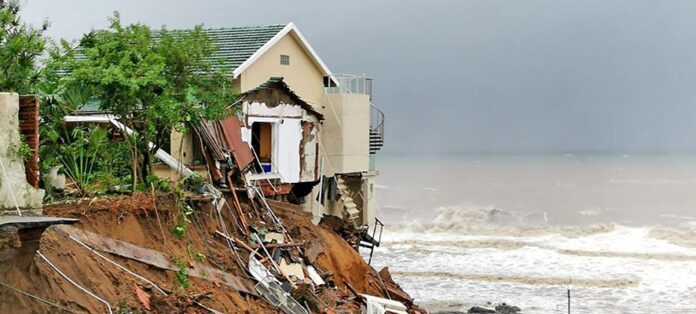
South Africa’s coastline and interior were struck by a series of catastrophic flood events in 2025. These recurring disasters raise the urgency, and agency, of climate adaptation, resilience finance, and the country’s widening insurance protection gap.
They also expose how limited municipal budgets and fragmented risk planning continue to deepen social vulnerability. Thus leaving thousands of households outside formal recovery systems and highlighting the national shortfall in disaster-risk insurance.
2025 saw a surge in floods
As 2025 drew to a close, renewed rainfall events again lashed the South Coast of KwaZulu-Natal. Flash floods affected towns, from Margate through Port Shepstone.
Streets, shopping centres, and residential areas were inundated. Roads were rendered impassable by flooding and sinkholes. And several lives were lost in mudslides and swift water incidents during the peak of the storms.
Earlier in November 2025, storms caused significant flooding in areas such as New Hanover, Mishani, Dalton, and Kamelhoek. This resulted in the destruction of homes and several people being swept away by floodwaters.
In June 2025, the Eastern Cape endured one of the deadliest flooding episodes in recent memory. There were over 100 confirmed fatalities, including many children. In the Eastern Cape alone, more than 6, 869 homes were impacted and destroyed.
Public infrastructure losses have been estimated at R5-billion. There was extensive damages on 229 schools and 63 health facilities.
Disaster management funding
National and provincial authorities have responded with emergency relief funding and long-term reconstruction allocations. Early in the year, the National Disaster Management Centre disbursed over R1.4-billion for disaster response and rebuilding programmes.
Additional budget provisions approaching R1.2-billion were earmarked for recovery efforts in the 2025/26 financial year. The Eastern Cape received the largest share due to the severity of its losses.
However, of the R188-billion raised by the government for climate finance, only 11% is earmarked for climate adaptation and resilience. This is according to the Presidential Climate Commission (PCC).
Disaster losses in Africa uninsured
Beyond the visible wreckage of flooded roads and collapsed homes lies a quieter crisis of most disaster losses in Africa being uninsured. According to a 2025 survey by the SAS Institute on 500 top insurance companies globally, insurance penetration across the continent is still below 3% of GDP. This leaves households and small businesses exposed to permanent income shocks when storms hit.
The urgency of climate insurance is underscored by 2025 data from the World Economic Forum (WEF). This shows that natural disasters caused $162-billion in economic losses in the first half of 2025 alone.
And this is the second-highest half-year figure on record. In many emerging markets and developing economies (EMDEs), including large parts of Africa, where less than 3% of disaster losses are insured, the natural disaster insurance gap exceeded 90%.
For South Africa, narrowing the insurance gap is now part of the climate adaptation strategy. The Durban G20 meeting under the 2025 Presidency explicitly framed catastrophe insurance as a lever for resilience finance and financial literacy. It recognised that extreme weather can wipe out decades of municipal infrastructure investment in a single season.
Disaster-risk financing
Instruments such as municipal green bonds, catastrophe bonds, microinsurance, and parametric cover are emerging as channels to mobilise capital before the storm rather than after it.
The World Bank and the International Association of Insurance Supervisors have stressed that resilience requires multi-stakeholder programmes that integrate disaster-risk financing into national budgets while building products that can scale in emerging markets.
As South Africa enters 2026, policymakers, investors, and corporate leaders are pressed to elevate climate resilience as an operational priority. Strengthening early warning systems, investing in flood-resilient infrastructure, and integrating community-centric recovery plans will be vital to limiting future harm.
- South Africa’s coastline and interior were struck by a series of catastrophic flood events in 2025.
- These recurring disasters raise the urgency, and agency, of climate adaptation, resilience finance, and the country’s widening insurance protection gap.
- They also expose how limited municipal budgets and fragmented risk planning continue to deepen social vulnerability.
- Thus leaving thousands of households outside formal recovery systems and highlighting the national shortfall in disaster-risk insurance.
- 2025 saw a surge in floods As 2025 drew to a close, renewed rainfall events again lashed the South Coast of KwaZulu-Natal.