Cosatu’s newly elected leadership is sharpening its focus on retirement reform, tax relief and wage growth as it seeks to ease mounting financial pressure on working-class households.
This comes as workers are squeezed by rising debt, soaring living costs and generally stagnant wages.
The federation wants to accelerate discussions on the next phase of the two-pot retirement system, arguing that the tax rules reduce the relief available to struggling members while many workers continue to battle high debt levels and economic insecurity.
Declaration
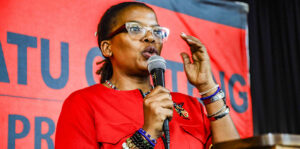
Delivering the declaration at the federation’s reconvened 15th National Congress at Emperors Palace, newly elected general secretary Zingiswa Losi said Cosatu would ramp up its fight for a living wage, defend collective bargaining and push for changes to the retirement system to provide greater relief to highly indebted workers.
“The federation will intensify campaigns to reduce the suffocating tax burden upon the working class and ensure that the rich pay their fair share. Engagements on the next phase of the two-pot tax reforms will be intensified to provide greater relief for highly indebted workers,” said Losi.
The two-pot system allows qualifying members to access a portion of their retirement savings before retirement, subject to applicable rules and tax requirements, while preserving another portion for retirement.
Cosatu is the original architect of the two-pot retirement system, first proposing the reform in 2020. Since the legislation came into effect on September 1, 2024, critics have argued that the system provides less relief than expected because withdrawals are taxed at members’ marginal income tax rates, leaving many workers with significantly less cash than anticipated when accessing their savings during financial hardship.
Tax burden
Critics also contend that the tax burden undermines the system’s purpose at a time when workers are grappling with rising living costs, stagnant wages and high debt levels.
The trade union federation’s demands come as households face intensifying pressure from the cost of basic necessities, including groceries, electricity and transport, while unemployment and insecure employment continue to threaten livelihoods.
“Workers create the wealth of society. Yet those who produce the wealth continue to face unemployment, poverty, insecurity and exploitation. This contradiction cannot be allowed to continue indefinitely.
“The working class must move from resistance to organised power, from defensive struggles to a conscious offensive for social and economic transformation,” said Losi.
Transparency and accountability in retirement funds
Cosatu is also demanding greater transparency and accountability in retirement funds, improved retirement and severance tax thresholds, as well as meaningful worker representation and control in the Public Investment Corporation.
The PIC, which manages investments on behalf of public-sector funds, including the Government Employees Pension Fund (GEPF), is legally allowed to have three representatives of registered trade unions on its board.
The federation said it also wanted to reduce the tax burden on working-class households while ensuring that wealthier South Africans paid what it considered their fair share.
Losi said Cosatu would intensify campaigns against what it described as the “suffocating tax burden upon the working class” and strengthen calls for greater tax justice.
Wages and job security
Beyond pension savings and taxation, Cosatu is placing wages and job security at the centre of its economic programme.
The federation said it would strengthen its Living Wage Campaign, defend and expand collective bargaining, close loopholes that undermined the National Minimum Wage and oppose retrenchments, labour broking and outsourcing.
Cosatu is also calling for stronger organisation of workers in fragmented parts of the economy, including outsourced, precarious, platform-based and other non-standard forms of employment.
The declaration calls for the federation and its affiliates to organise workers in these sectors and, where appropriate, pursue the consolidation of unions in related industries to strengthen bargaining power.
Expanded social protection
At a broader level, the programme includes calls for expanded social protection, increased public investment in energy, rail, water and municipal infrastructure, and measures to address above-inflation increases in electricity, transport and municipal tariffs.
The federation has also committed to developing a workers’ cost-of-living index to strengthen collective bargaining and inform public policy.
Losi said the index could give unions another tool to argue for wage increases based on the costs workers face in their daily lives.
“The 15th National Congress declares that the future of the working class will not be secured through passivity, compromise with exploitation or surrender to the dictates of capital. It will be secured through organisation, unity, class consciousness, militancy and struggle,” Losi said.
- Cosatu's new leadership is prioritizing retirement reform, tax relief, and wage growth to alleviate financial pressure on working-class households amid rising debt and living costs.
- The federation wants to accelerate the next phase of the two-pot retirement system, criticizing current tax rules that reduce relief for highly indebted workers.
- Cosatu demands greater transparency and accountability in retirement funds, improved tax thresholds, and increased worker representation in the Public Investment Corporation.
- The federation aims to strengthen the Living Wage Campaign, expand collective bargaining, and organize workers in precarious employment sectors.
- Cosatu plans to develop a workers’ cost-of-living index to support wage negotiations and advocate for expanded social protection and public infrastructure investment.