
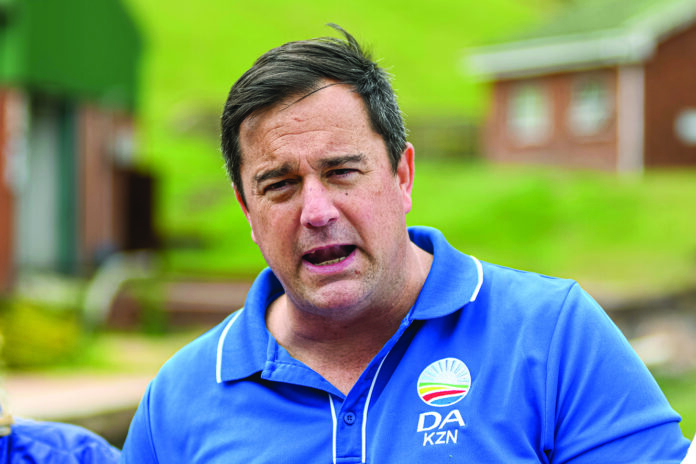
John Steenhuisen has declared that he will not run for the DA’s top leadership position, ending what he has described as a successful political mission but which reports have seen as a departure influenced by mounting pressure.
Speaking in Durban on Wednesday, he confirmed that he will not contest a third term at the upcoming federal congress, formally closing a chapter on his leadership since 2019.
“I today announce that I will not seek re-election for a third term as DA federal leader,” Steenhuisen said.
In a speech rich with symbolism, Steenhuisen presented his exit as the culmination of a long-held ambition: guiding the DA into national government for the first time through the government of national unity (GNU).
He described the breakthrough as the defining achievement of his tenure, declaring simply: “Mission accomplished.”
His withdrawal comes as a surprise to many within the party, particularly after the DA’s rise in influence following the ANC’s loss of its outright parliamentary majority in the 2024 poll.
Heightened scrutiny
Steenhuisen had been widely expected to seek another mandate, especially after negotiating the DA’s entry into the GNU and securing cabinet-level power.
However, the timing of his announcement has heightened speculation that factors other than personal reflection influenced his decision.
The DA is entering an increasingly difficult period, balancing the demands of coalition governance with sharpening debates over the party’s identity, future leadership, and strategic direction.
Recently, Steenhuisen has faced heightened scrutiny, including allegations involving the use of the party’s credit card.
Dion George, the former head of DA finance, caused reputational discomfort for a party determined to project clean governance and accountability.
An internal probe, however, cleared Steenhuisen of abusing the credit card.
There have also been reports of discomfort among parts of the DA’s donor network, with some insiders suggesting that key backers have grown hesitant as questions mounted around Steenhuisen’s long-term viability.
In a party that depends heavily on donor confidence to sustain its election machinery, such signals carry significant weight.
Steenhuisen, however, insisted his focus must now lie elsewhere. As minister of agriculture, he said the country’s worsening foot-and-mouth disease crisis demands his full attention.
“That is not a part-time job,” he said, arguing that the scale of the outbreak leaves no room for the distractions of an internal leadership contest.
DA polling near 30%
Steenhuisen appeared to acknowledge the volatility beneath the surface, warning that internal maneuvering could destabilise both the GNU and the country itself.
“It would be a tragedy too great to contemplate,” he said, cautioning against factional agendas derailing the progress being made.
Reflecting on his years at the helm, Steenhuisen reminded supporters that he inherited a party many believed was in decline.
Now, he argued, the DA is polling near 30% and edging closer to becoming a true contender for national leadership. “I hand over the reins to a fundamentally healthier party,” he declared.
His departure now sets the stage for a fierce succession contest, with the DA’s next leader inheriting both the opportunities of national influence and the turbulence that comes with coalition politics.
Steenhuisen may insist he leaves with “a smile on my face and triumphant peace in my heart”, but his sudden decision will be read by many as a signal that the party is entering a new era, one in which renewal at the top has become inevitable.
Steenhuisen became a central figure in the DA’s national leadership and was elected federal leader in 2019 at a time when the party was facing internal instability and declining support.
Before that, he was the interim leader after the departure of Mmusi Maimane.
- John Steenhuisen has declared that he will not run for the DA’s top leadership position, ending what he has described as a successful political mission but which reports have seen as a departure influenced by mounting pressure.
- Speaking in Durban on Wednesday, he confirmed that he will not contest a third term at the upcoming federal congress, formally closing a chapter on his leadership since 2019.
- “I today announce that I will not seek re-election for a third term as DA federal leader,” Steenhuisen said.
- In a speech rich with symbolism, Steenhuisen presented his exit as the culmination of a long-held ambition: guiding the DA into national government for the first time through the government of national unity (GNU).
- He described the breakthrough as the defining achievement of his tenure, declaring simply: “Mission accomplished.” His withdrawal comes as a surprise to many within the party, particularly after the DA’s rise in influence following the ANC’s loss of its outright parliamentary majority in the 2024 poll.