
Success rates and quality of school mathematics are often cited as a metric when assessing the state of a country’s education system.
Mathematics has a foundational role in cognitive development, shaping how individuals think, reason, and solve problems. Exposure to and engagement with mathematical theories by far supersede the benefits derived from numeracy alone – it is essential for the active development of core mental processes in childhood and the determinant of success later in adult life.
Historical disadvantages
Under the repressive apartheid system, the majority of South Africans were cynically excluded from meaningful participation in mathematics, deemed unable to grasp the complexities of the subject.
The imperative for restorative social justice following the democratic transition in 1994 brought this and other discriminatory practices into sharp relief.
Notwithstanding, prevailing statistics suggest limited relief in this critical area 30 years into democracy. Rather, regression in the quality of mathematics delivery, particularly so for rural communities and township schools, occurred surreptitiously under our watch.
Mathematics a crucial stepping stone
This stymies national aspirations, as mathematics is an essential foundation for future relevant jobs in artificial intelligence, climate change, renewable energy, and sustainable development. At 15% of all graduates, South Africa’s tertiary STEM output is below that of peer economies. The OECD average for tertiary education STEM output is between 20% and 30%, India between 25 and 35% and China between 30% and 40%.
Projections show that production of STEM graduates in South Africa falls way short of the trajectory for 2030 set by the National Development Plan (NDP). The NDP contemplates 450,000 learners per annum to be eligible for Batchelor passes for STEM enrolment by 2030. Realistically this must be weighed against the current 162,947 learners passing (30% pass rate!) pure mathematics.
Maths literacy not helping
Universities do not accept a pass for Mathematics Literacy, accounting for two-thirds of all Mathematics enrolment in Grade 12, as a qualifying criterion.
The preponderance of mathematical literacy in success metrics breeds a dangerous complacency and masks an empirical threat to the developmental agenda of this country.
Unpacking the South African Matric Mathematics pass rates
Pervasive structural constraints, such as low numbers of suitably qualified mathematics teachers frustrate the STEM system. In 2025 25% (162,497) of all matric passes passed pure mathematics, constituting a 64% pass rate. But here in lies the nub – this pass rate is set against a pass mark of 30%.
If a more realistic 40% is used, the pass rate would drop to 41.9% or 106,570 learners. Applying a 50% pass rate for module success at universities, it would collapse to a mind-numbing 63,813 passes or 25.1% success rate. Thus, this unravelling of a house of cards is tantamount to a narrowing of opportunity.
A realistic measure of success is to achieve a quality mathematics pass mark of more than 60% (amounts to between 45,000 and 55,000 learners).
The four out of five high-quality pass rates that emanated from Quintile 5 schools accentuated the exclusion in township and rural schools. Considering excellence in its true sense, only a paltry 4,897 or 2% of learners enrolled for pure Math passed with distinctions.
Impact of mathematics exclusion deepening inequality
A low level of quality in mathematics manifests in the exclusion of vulnerable and disenfranchised learners if one were to consider that entry levels for STEM and accounting disciplines range between 60% and 70% for pure mathematics with some universities requiring up to 80% for engineering.
Exclusion from high-value jobs is not the only malaise triggered by mathematics exclusion. Poor systemics mask an insidious deprivation, denying critical cognitive development in formative years.
Strong mathematical foundations are key to analytical decision-making, adaptability in complex environments and readiness for technology-driven economies. Development of logical and abstract thinking necessary for pattern recognition and enhancement of problem-solving and reasoning skills in formative years provides lifelong cognitive benefits and strengthened neural networks. Engagement with mathematics concepts builds automaticity, freeing cognitive resources for higher-level thinking.
The introduction of mathematical literacy makes South Africa one of the few education systems where majority learners find themselves structurally excluded from mainstream mathematics before completing school.
Low uptake for pure maths
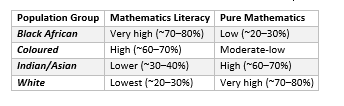
The mathematics literacy stream accounts for two thirds of total mathematics enrolment, severely limiting study choices for the majority. Fewer than 20% of schools, predominantly former Model C, offer pure mathematics. In 2025, mathematics literacy had a pass rate between 82% and 86%, juxtaposed against that of 64% for pure mathematics. Coupled with that is the involuntary steering of learners by schools fixated on pass rates.
The racial demography of learners participating in mathematical literacy mirrors the deep structural inequalities in society. Likelihood demographic distribution of uptake of the two streams of mathematics illustrates this phenomenon, at least directionally.
Systemic and Structural Impediments
The Department of Basic Education identified a severe shortage of qualified mathematics teachers, small or rural schools with low enrolment and timetabling and cost constraints as root causes for the failure of the mathematics ecosystem.
It was announced that South Africa had 435 public schools that do not offer mathematics as a subject at Grade 12. In 2023 South Africa had just short of 455,000 teachers, of which between 30,000 are 60,000 designated as, but not necessarily qualified, mathematics teachers, deployed over 24580 schools (about 2500 private schools).
Shortage of maths teachers
Some studies suggest shortages of between 70% and 90% qualified mathematics teachers in historically disadvantaged schools in South Africa.
Universities over TVETs are regrettably prioritised as a first choice for school leavers. Total first-year university capacity is roughly 235,000 spaces. In 2025, more than 345,000 learners qualified with bachelor passes, excluding more than 100,000. Coupled with the relative stability on offer, it is therefore no wonder that the private university sector is becoming a viable alternative for the middle class.
This analysis suggests that a step change is required in lifting the quality of mathematics teaching in our schools, failing which our developmental aspirations will remain just that.
- Professor Randall Carolissen is an accomplished business leader with years of experience in developing and executing strategy, driving transformation programmes across multiple industries.
- South Africa continues to face significant challenges in mathematics education, with low pass rates and quality issues especially in rural and township schools, despite 30 years of democracy and efforts to address apartheid-era inequalities.
- Only 15% of South African graduates complete tertiary STEM qualifications, well below global peers, and current pass rates in pure mathematics (30% pass mark) mask a more severe reality when higher standards are applied.
- A majority of learners enroll in Mathematics Literacy, which universities do not accept for STEM or accounting courses, limiting access to high-demand fields and deepening social inequalities.
- Structural problems like severe shortages of qualified mathematics teachers, especially in under-resourced schools, and lack of mathematics offerings in many schools hinder improvements in outcomes.
- Without significant improvements in mathematics education quality and access, South Africa risks missing its National Development Plan 2030 STEM goals and widening socio-economic disparities tied to educational exclusion.
Success rates and quality of school mathematics are often cited as a metric when assessing the state of a country’s education system.
Projections show that production of STEM graduates in
Universities do not accept a pass for
Pervasive structural constraints, such as low numbers of suitably qualified mathematics teachers frustrate the STEM system. In 2025 25% (162,497) of all matric passes passed pure mathematics, constituting a 64% pass rate. But here in lies the nub – this pass rate is set against a pass mark of 30%.
If a more realistic 40% is used, the pass rate would drop to 41.9% or 106,570 learners.
A realistic measure of success is to achieve a quality mathematics pass mark of more than 60% (amounts to between 45,000 and 55,000 learners).
A low level of quality in mathematics manifests in the exclusion of vulnerable and disenfranchised learners if one were to consider that entry levels for STEM and accounting disciplines range between 60% and 70% for pure mathematics with some universities requiring up to 80% for engineering.
Exclusion from high-value jobs is not the only malaise triggered by mathematics exclusion. Poor systemics mask an insidious deprivation, denying critical cognitive development in formative years.
It was announced that
Some studies suggest shortages of between 70% and 90% qualified mathematics teachers in historically disadvantaged schools in
Universities over TVETs are regrettably prioritised as a first choice for school leavers. Total first-year university capacity is roughly 235,000 spaces. In 2025, more than 345,000 learners qualified with bachelor passes, excluding more than 100,000. Coupled with the relative stability on offer, it is therefore no wonder that the private university sector is becoming a viable alternative for the middle class.
- Professor
Randall Carolissen is an accomplished business leader with years of experience in developing and executing strategy, driving transformation programmes across multiple industries.