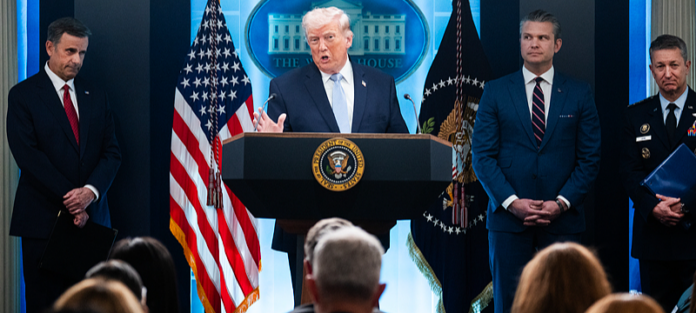

US President Donald Trump said Monday that Iran could be “taken out” in one night if the country fails to make a deal and reopen the Strait of Hormuz before the deadline he set. Meanwhile, Tehran reportedly delivered a 10-point response to a US-proposed 15-point peace plan via Pakistan.
Trump said the 8pm Eastern Time Tuesday deadline – 2am South African time on Wednesday – he has set for Iran is “final”.
However, he has repeatedly changed previous deadlines announced for a ceasefire deal or for the opening of the Strait of Hormuz, the crucial global energy waterway.
Trump renews threats on Iran’s bridges, power plants
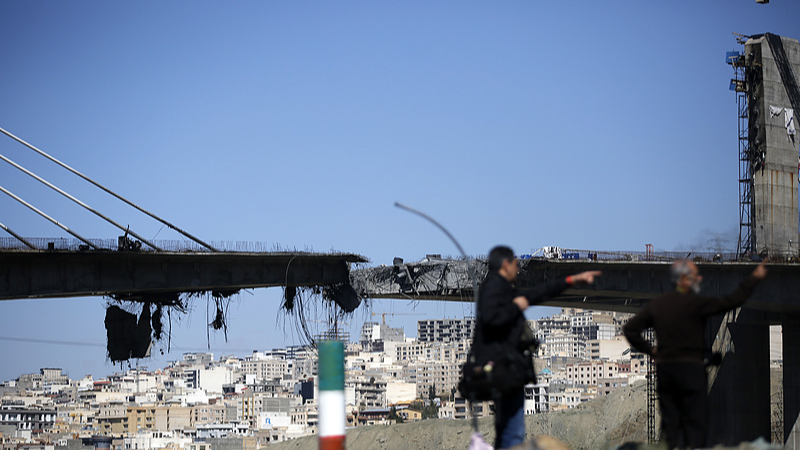
At a press conference at the White House, Trump threatened that Tehran would have no bridges or power plants left beyond the Tuesday deadline.
“The entire country could be taken out in one night, and that night might be tomorrow night,” Trump said on Monday. “This is a critical period,” he said. “They have a period of, well, until tomorrow at 8(pm) o’clock.”
Trump claimed, “We have a plan, because of the power of our military, where every bridge in Iran will be decimated by 12 o’clock tomorrow night, where every power plant in Iran will be out of business – burning, exploding, and never to be used again.” He added, “It will take them 100 years to rebuild.”
“I mean complete demolition by 12 o’clock. And it will happen over a period of four hours if we wanted to. We don’t want that to happen,” Trump added.
Earlier on Monday, Trump told reporters at the White House Easter Egg Roll that he was “not worried about” whether the US air strikes on Iran’s power plants and other civil infrastructure could constitute a war crime.
UN alarmed
The United Nations on Monday said it is alarmed by the US rhetoric. UN Secretary-General Antonio Guterres recalls that civilian infrastructure, including energy infrastructure, may not be attacked, even if specific civilian infrastructure were to qualify as a military objective, said Stephane Dujarric, chief spokesperson for Guterres, at a daily briefing.
Trump also claimed at the press conference that the US should impose tolls on vessels passing through the Strait of Hormuz, stressing that reopening the key global energy chokepoint must be part of a deal to end the war.
The strait has seen a sharp decline in vessel traffic following large-scale military actions launched by the US and Israel against Iran on February 28 and subsequent retaliatory strikes by Iran.
Trump’s bravado
Trump told reporters that he would take the oil from Iran, but US citizens do not want US forces to remain in the country.
He has repeatedly claimed that the US has won the war with Iran, which marked its 38th day on Monday, but many US experts say they believe the president is losing the ongoing war despite the overwhelming military advantage of the US and Israel over Iran.
Conflicting messages on talks
Meanwhile, Trump said at the press conference that Iran is an “active, willing participant” in the negotiations over the deal, claiming the talks via intermediaries are “going well.”
Trump added that his envoy Steve Witkoff and US Vice-President JD Vance are “involved in the dealing” of talks via intermediary countries.
Trump said earlier on Monday that his administration has reviewed a proposal for a 45-day ceasefire in the Iran war, describing it as a “very significant step” but “not good enough.”
The president also reiterated that he is the only person who can determine if there’s a ceasefire.
Iran has rejected a US-proposed 15-point peace plan, calling instead for a permanent end to the conflict, the official news agency IRNA reported Monday.
Iran’s 10-point document
Tehran delivered its response via Pakistan in a 10-point document, citing past experiences as the reason it would not accept a ceasefire.
The response outlines Iran’s demands, including ending regional conflicts, establishing safe passage through the Strait of Hormuz, reconstructing war-affected areas and lifting international sanctions.
Hossein Kanani Moghaddam, a former commander of the Islamic Revolutionary Guard Corps, said Iran’s response differs from the demands put forward by the United States.
In response to a query from China Media Group (CMG), Moghaddam said that Iran is focused on taking the initiative and upholding its own demands.
Should the US reject Iran’s response, Iran will not halt its military operations, nor will it ease its control over the Strait of Hormuz, he said.
Also on Monday, Iran’s Foreign Ministry spokesperson Esmaeil Baghaei said a ceasefire would only give opponents time to regroup and commit further crimes, and “no sane” person would accept it.
In late March, US media reported that Washington sent a 15-point plan to Iran through Pakistan to try to end the war. Iran later rejected the plan, calling it “excessive and disconnected from the realities on the battlefield”.
The Islamic Republic set several preconditions for peace. These include ending US and Israeli aggression, creating mechanisms to prevent future attacks, compensating for war damage, stopping fighting across all fronts in West Asia and recognizing Iran’s sovereignty over the Strait of Hormuz.
Israel warns against rushed ceasefire
An Israeli official said on Monday that Prime Minister Benjamin Netanyahu warned Trump against rushing into a ceasefire with Iran during their Tuesday phone call, according to CMG.
The official revealed that Netanyahu phoned Trump ostensibly to congratulate him on the successful rescue of a missing pilot in Iran, but his real purpose was to warn of serious risks in a rushed ceasefire.
The official added that Trump noted a ceasefire could still be reached if Iran met relevant conditions, stressing Tehran must surrender all enriched uranium and pledge never to resume such activities.
IMF warns ‘all roads’ lead to slower growth
The war in the Middle East will lead to higher inflation and slower global growth, the head of the International Monetary Fund told Reuters on Monday, ahead of a forecast for the world economy planned by the global lender for next week.
The war has triggered the worst-ever disruption in global energy supply, with millions of barrels of oil production shuttered due to Iran’s effective blockage of the Strait of Hormuz, crucial for shipping one-fifth of the world’s oil and gas.
Even if the conflict is swiftly resolved, the IMF is set to reduce its forecast for economic growth and bump up its outlook for inflation, Kristalina Georgieva, managing director of the IMF, said.
Without the war, Georgieva said the IMF had expected a small upgrade in its projection for global growth of 3.3 per cent in 2026 and 3.2 per cent in 2027.
“Instead, all roads now lead to higher prices and slower growth.”
- President Trump set a final deadline for Iran to reopen the Strait of Hormuz and warned that Iran could be "taken out" in one night with targeted strikes on bridges and power plants.
- Iran responded to a US 15-point peace plan with its own 10-point document via Pakistan, rejecting a ceasefire and demanding an end to regional conflicts, lifting sanctions, and recognition of sovereignty over the Strait of Hormuz.
- The UN expressed concern over US threats to civilian infrastructure, emphasizing that attacks on such targets may constitute violations of international law.
- Israeli Prime Minister Netanyahu warned Trump against rushing a ceasefire with Iran, stressing risks and the need for Tehran to meet strict conditions including surrendering enriched uranium.
- The IMF warned that the Middle East conflict will cause higher inflation and slower global economic growth due to disruptions in global energy supplies, especially via the Strait of Hormuz.
US President Donald Trump said
Trump said the 8pm Eastern Time Tuesday deadline – 2am
However, he has repeatedly changed previous deadlines announced for a ceasefire deal or for the opening of the Strait of Hormuz, the crucial global energy waterway.
At a press conference at the White House, Trump threatened that Tehran would have no bridges or power plants left beyond the Tuesday deadline.
"
Trump claimed, "We have a plan, because of the power of our military, where every bridge in Iran will be decimated by 12 o'clock tomorrow night, where every power plant in Iran will be out of business – burning, exploding, and never to be used again." He added, "It will take them 100 years to rebuild."
"I mean complete demolition by 12 o'clock.
Earlier on
Trump also claimed at the press conference that the US should impose tolls on vessels passing through the Strait of Hormuz, stressing that reopening the key global energy chokepoint must be part of a deal to end the war.
Trump told reporters that he would take the oil from Iran, but US citizens do not want US forces to remain in the country.
He has repeatedly claimed that the US has won the war with Iran, which marked its 38th day on
Meanwhile, Trump said at the press conference that Iran is an "active, willing participant" in the negotiations over the deal, claiming the talks via intermediaries are "going well."
Trump added that his envoy Steve Witkoff and US Vice-President JD Vance are "involved in the dealing" of talks via intermediary countries.
Trump said earlier on
Iran has rejected a US-proposed 15-point peace plan, calling instead for a permanent end to the conflict, the official news agency IRNA reported
Tehran delivered its response via Pakistan in a 10-point document, citing past experiences as the reason it would not accept a ceasefire.
Hossein Kanani Moghaddam, a former commander of the Islamic Revolutionary Guard Corps, said Iran's response differs from the demands put forward by the United States.
In response to a query from China Media Group (CMG), Moghaddam said that Iran is focused on taking the initiative and upholding its own demands.
Also on
In late March, US media reported that
An Israeli official said on
Even if the conflict is swiftly resolved, the IMF is set to reduce its forecast for economic growth and bump up its outlook for inflation, Kristalina Georgieva, managing director of the IMF, said.
"Instead, all roads now lead to higher prices and slower growth."