


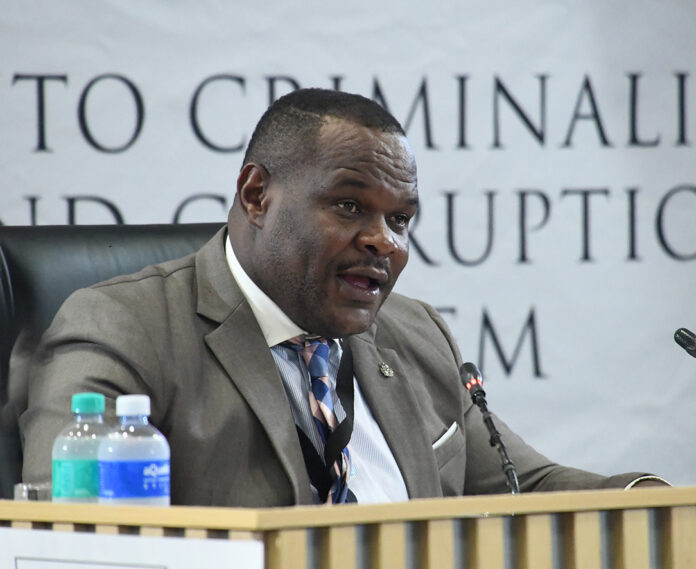
Former Investigating Directorate Against Corruption (Idac) head Advocate Andrea Johnson continued her evidence before the Madlanga commission on Wednesday, with commissioners probing explosive allegations that Idac investigators attempted to persuade a detained police sergeant to implicate some of South Africa’s most senior law enforcement figures.
The issue surfaced dramatically in the closing moments of Tuesday’s proceedings when evidence leader Advocate Mahlape Sello introduced a complaint submitted on behalf of Sergeant Fannie Nkosi.
According to the complaint, nine Idac officials led by Suneel Bellochun visited Nkosi in custody on July 13 and allegedly attempted to recruit him as a witness against National Police Commissioner General Fannie Masemola, Crime Intelligence head Lieutenant General Dumisani Khumalo and businessman Vusimuzi “Cat” Matlala.
Nkosi alleges the investigators encouraged him to cooperate in building a case against the three men and suggested his legal position could improve if he assisted them.
Procuring evidence implicating people, rather than gathering existing evidence
The complaint further alleges the officials were attempting to procure evidence implicating senior figures rather than gathering evidence that already existed.
Johnson did not dismiss the allegations.
Instead, she told the commission that, if proven, they would be extremely serious and would warrant a full investigation.
She also stressed that, as a matter of proper investigative practice, it would be wrong for investigators to interview a suspect in custody without that person’s legal representative being present.
Johnson said that this had been the approach adopted by Idac in its dealings with Matlala, who remains in custody, where investigators ensured that his lawyers were present during engagements.
She told the commission she was hearing the details of Nkosi’s complaint for the first time and undertook that it would have to be investigated before any conclusions could be reached.
The exchange heightened the significance of the complaint because Johnson herself accepted that interviewing a detained suspect without legal representation would not accord with the standards Idac was expected to follow.
Bruising week for Johnson
The latest allegations come after a bruising week for Johnson before the commission, during which she made a series of significant concessions about Idac’s investigation into senior crime intelligence officials.
Johnson admitted that Idac lacked a mandate to investigate Khumalo regarding the original complaint, that investigators solicited Member of Parliament (MP), Fadiel Adams’ Section 27 affidavit, and that she applied the incorrect legal test when authorising aspects of the investigation.
She also acknowledged providing incorrect information to Parliament’s Ad Hoc Committee, apologised for describing Brigadier Dineo Mokwele’s appointment as a “token appointment” after accepting that she possessed the required qualifications, and resigned as head of Idac earlier this week after President Cyril Ramaphosa accepted her resignation.
If Nkosi’s allegations are ultimately proven true, they could lead the commission to scrutinise Idac more closely by raising questions about whether investigators actively sought evidence against specific individuals instead of impartially investigating the existing evidence.
The Madlanga commission has made no findings on Nkosi’s allegations, and they remain untested. Johnson is expected to respond further when her evidence resumes on Wednesday morning.
ALSO READ: Ex-Idac boss can’t remember why PKTT was investigated
- Former Idac head Andrea Johnson testified at the Madlanga commission amid allegations that Idac investigators pressured a detained sergeant, Fannie Nkosi, to implicate senior police and a businessman.
- Nkosi claims nine Idac officials tried to recruit him as a witness against top law enforcement figures, suggesting cooperation could improve his legal situation.
- The complaint alleges Idac officials sought to procure evidence against specific individuals rather than gather existing evidence, a serious claim Johnson said would require full investigation.
- Johnson acknowledged routinely ensuring legal representation during suspect interviews and stressed that interviewing a detained suspect without a lawyer would violate investigative standards.
- The allegations add to recent controversies involving Johnson, including admissions of investigative errors, misleading Parliament, and her recent resignation as Idac head; the commission has made no findings on Nkosi's claims yet.


