
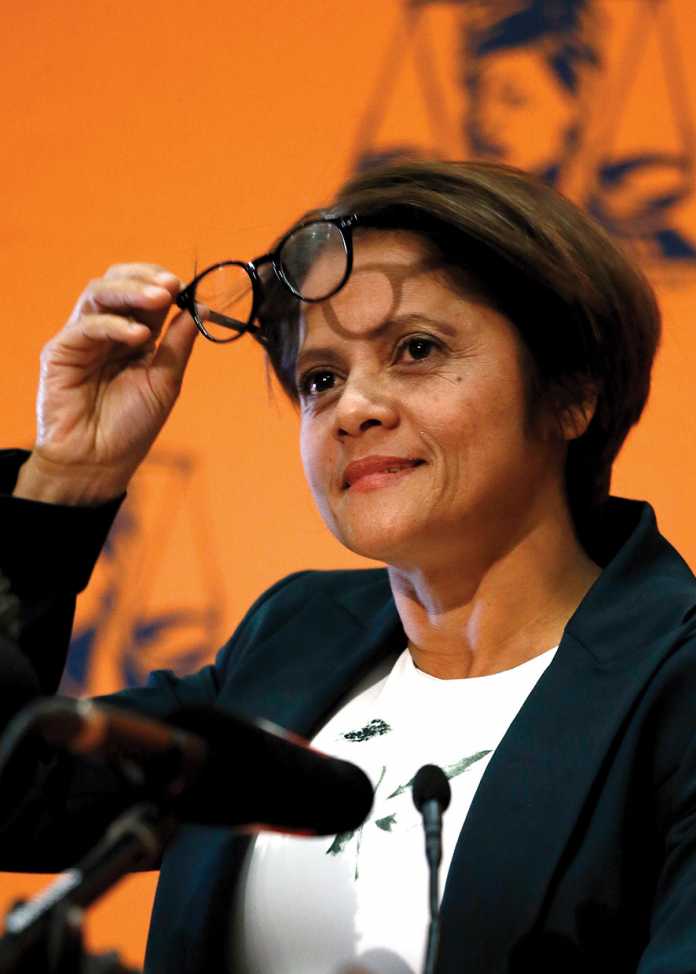
Advocate Hermione Cronje has confirmed in writing that the government-appointed panel tasked with selecting South Africa’s top prosecutor failed to provide her with a formal complaint made against her, before her interview. The error was only identified during live proceedings.
Her account, contained in court papers before the North Gauteng High Court in Pretoria, forms part of an urgent application challenging the appointment of Advocate Andy Mothibi as National Director of Public Prosecutions (NDPP), being heard on Tuesday.
The case, brought by law firm B. Xulu and Partners, seeks to set aside both the advisory panel process and President Cyril Ramaphosa’s final decision to appoint Mothibi, citing procedural irregularities and irrationality.
Cronje did not have sight of objection
Attached to the court papers is an email from Cronje confirming that she was not given access to a detailed objection submitted against her candidacy before her interview.
In the email, included in the applicant’s replying affidavit, Cronje states that during her interview on 11 December 2025, she was asked to respond to an objection she had not seen.
She wrote that she told the panel that she had not seen the complaint when the issue was raised.
Panel admitted it has erred
Cronje also said the panel, chaired by Minister Mamoloko Kubayi, established during the interview that its own administrative processes had failed.
Cronje states that Kubayi confirmed that “the secretariat to the panel had neglected to make available to me the full objection filed by your firm.”
The interview process was conducted publicly, and the issue emerged in real time during proceedings meant to demonstrate transparency.
Cronje claims she was prejudiced
Following the discovery, Cronje says she received the objection during the interview, and was allowed to respond after the session.
She states that she was informed she would be permitted to submit a response by the following day, and that she did so under pressure.
“On 12 December at 15:30, under tremendous time pressure, I provided a response to the objection filed,” she wrote.
‘Breakdown in the fairness and consistency’
However, she adds that she later learned the advisory panel had already completed its work.
“I subsequently learnt from media reports that the panel had submitted its report to the president on the same day,” Cronje states in the email.
The applicant argues that these events demonstrate a breakdown in the fairness and consistency of the selection process, particularly given that the panel had invited public participation and undertook to consider submissions from stakeholders.
‘Panel did not properly consider relevant material’
According to the court papers, the law firm had submitted a detailed objection to Cronje’s candidacy as part of that process.
The failure to provide that objection in advance, the applicant argues, meant that the candidate was not subjected to the same process as others and that the panel did not properly consider relevant material before making its recommendation.
‘Undermines integrity of the entire process’
The application states that the panel allowed Cronje to respond privately after her interview, contrary to the process applied to other candidates.
It further argues that the handling of the objection undermines the integrity of the entire process.
The advisory panel had been tasked with identifying suitable candidates for appointment as NDPP and was expected to follow a transparent and consistent process, including public interviews and the consideration of objections.
The legal challenge contends that the identified irregularities – including the failure to provide the objection, the allowance of a post-interview response, and the timing of the panel’s final report – render the process irrational and procedurally unfair.
‘President and advisory panel only raised points of law’
The matter is further complicated by the procedural stance taken by the respondents.
In the replying affidavit, the applicant states that both the president and the advisory panel chairperson elected not to file answering affidavits, choosing instead to raise points of law only.
As a result, the affidavit argues, all factual allegations set out in the applicant’s founding affidavit stand undisputed and admitted.
‘Cronje’s version is not in dispute’
The applicant contends that this means the court must assess the legal issues on the basis that the factual account of the process, including Cronje’s version, is not in dispute.
The case is part of a broader challenge to Mothibi’s appointment, which the applicant argues was made outside the established process after the panel reportedly found no suitable candidates.
The outcome of this case is expected to have significant implications for the credibility of the NDPP appointment process, and for how future appointments to key law enforcement positions are conducted.
At its core, the matter raises questions about whether the process, intended to ensure transparency and fairness in selecting the country’s top prosecutor, met the required constitutional standards.


