


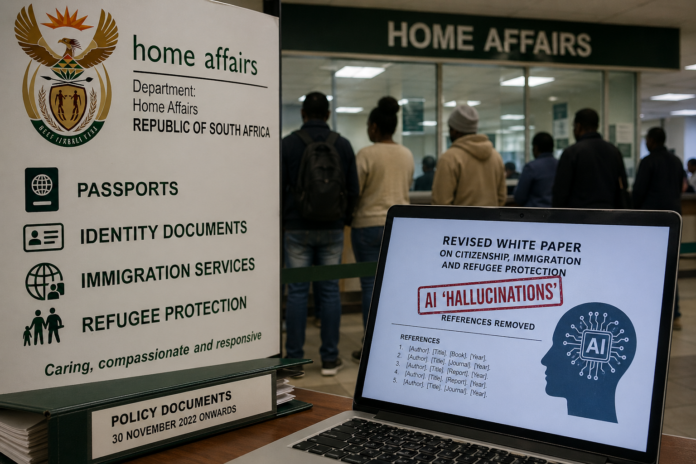
Two senior officials in the Department of Home Affairs have been suspended after artificial intelligence (AI) “hallucinations” slipped into a cabinet-approved white paper that shapes how South Africa deals with foreigners entering, staying, and seeking refuge, triggering embarrassment at the highest levels of government.
The department confirmed on Thursday that it had taken swift action after detecting what it described as fabricated references attached to the Revised White Paper on Citizenship, Immigration and Refugee Protection, a document that guides future law and decisions on immigration control, citizenship, and refugee management.
This is the second AI policy scandal to rock government in recent weeks.
The Minister of Communications and Digital Technologies, Solly Malatsi, had to, over the weekend, withdraw a draft national AI policy following revelations it contained AI-generated citations without proper verification.
The policy, meant to position the country as a continental leader in AI innovation, was pulled after the inclusion of unverified citations raised serious concerns about its credibility and integrity.
Communications Minister Solly Malatsi acknowledged the lapse, warning that the failure went beyond a technical glitch and struck at the heart of policy trust.
He said the “most plausible explanation” was that AI-generated citations were included without proper verification and stressed that stronger human oversight would be enforced going forward, with consequences expected for those involved.
Home Affairs ministerial spokesperson Carli van Wyk did not mince her words, stating the department was acting decisively after the discovery.
“The Department of Home Affairs is suspending two senior officials with immediate effect following the detection of apparent artificial intelligence ‘hallucinations’ cited as references appended to the recently cabinet-approved Revised White Paper,” she said.
One of the officials, a chief director, has already been suspended, while a director involved in drafting the document is expected to follow on Monday.
Disciplinary process
Van Wyk said the department was not taking chances, bringing in outside muscle to clean up the mess.
“In addition to implementing precautionary suspensions, the department has appointed two independent law firms to respectively manage the disciplinary process and review all policy documents produced by the department dating back to 30 November 2022,” she said.
The move effectively casts a wide net over past work, raising questions about how deeply AI may have seeped into official processes.
At the heart of the issue lies a curious contradiction of references that exist and do not exist.
The department’s internal review suggests the sources were never part of the original argument but appeared later like ghosts in the margins.
“Based on the department’s initial internal review, the problem appears to be related to the list of references appended to the Revised White Paper,” Van Wyk said.
“It seems that these references were generated and attached to the document after the fact, as they are not cited in the body of the text.”
In response, the department has moved to surgically remove the suspect material.
“Consequently, the department has withdrawn the reference list, pending the finalisation of the independent probe to determine how the hallucinations came to be added to the list,” she said.
Despite the scandal, officials insist the core of the policy remains intact; the spine stands, even if the scholarly scaffolding has crumbled.
“However, the body of the Revised White Paper continues to accurately reflect the government’s position on the policy reforms required in these domains,” Van Wyk said.
Reputational damage
Still, the department has acknowledged the reputational damage, offering an apology that carries both regret and resolve.
“The Department nonetheless sincerely apologises for this unacceptable oversight,” she said.
Yet in a twist of technological tension, the same tool that triggered the crisis is not being cast out entirely. Instead, it is being cautiously embraced.
“At the same time, the department recognises the benefits of AI and that it is being widely adopted across society,” Van Wyk said.
“It is a transformative but disruptive technology that is changing how organisations operate across the private and public sectors. We must now adapt to keep up.”
In that paradox, precision versus pollution and innovation versus illusion, lies the modern bureaucratic battle. The machine can mimic mastery, but without human vigilance, it may also manufacture mirages.
For Home Affairs, the lesson is costly but clear. In the age of artificial intelligence, even official truth must be double-checked, lest fiction find its way into the footnotes of the state.
- Two senior officials in South Africa's Department of Home Affairs were suspended after AI-generated false references were found in a Cabinet-approved white paper on immigration and refugee policy.
- The fabricated references, described as AI "hallucinations," were appended post-approval, prompting the department to withdraw the reference list and launch an independent investigation.
- This incident follows a recent government scandal involving AI-generated citations in a draft national AI policy, leading to its withdrawal.
- The Department has hired two independent law firms to oversee disciplinary actions and review all policy documents since November 2022 to check for similar issues.
- Despite the controversy, officials maintain the core policy content remains accurate and emphasize cautious, adaptive use of AI technology while committing to stricter oversight.


