


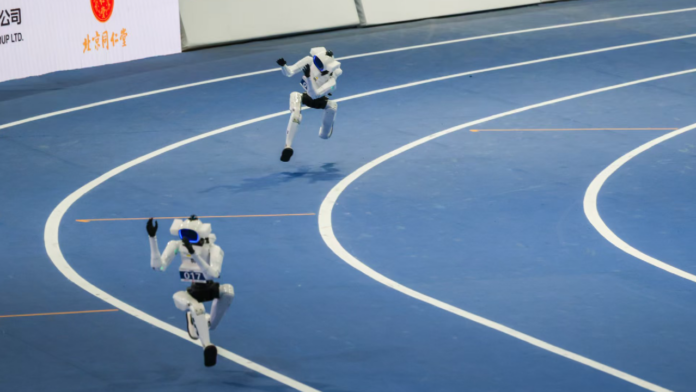
Robots competing at the ongoing 2nd World Humanoid Robot Games have achieved performances surpassing human benchmarks in sprinting and other track-and-field disciplines, showcasing the remarkable pace of progress in humanoid robotics.
Industry observers attending the event say the competition is providing a glimpse into how far the technology has advanced, even as practical, everyday applications remain at an early stage of development.
The games have become a platform for demonstrating the growing capabilities of humanoid robots, which are increasingly moving beyond exhibition-style demonstrations and toward deployment in real-world environments.
Competition results reveal major technological leap
According to industry participants, this year’s competition has introduced several important milestones. For the first time, robot performances are being directly compared against human athletic benchmarks, highlighting instances where machines can outperform people under specific and tightly controlled conditions.
Experts note that previous competitions primarily focused on basic mobility and locomotion. In contrast, this year’s games feature a wider range of autonomous-operation challenges that test adaptability, decision-making and coordination.
The broader scope of the event is viewed as an important step toward future industrial applications, offering developers valuable opportunities to identify weaknesses and refine technologies.
From the arena to everyday life
Despite the impressive results recorded during the games, industry insiders caution that competition success does not necessarily translate into commercially viable consumer products.
Many of the limitations exposed during events provide critical feedback for engineers, helping to guide future iterations and product improvements.
Observers also stress that humanoid robots are not the only technology attracting attention. Alternative robotic solutions, including wheeled platforms equipped with robotic arms and grippers, are already demonstrating significant practical value in a variety of operational environments.
Investors focus on long-term innovation
Kang Yu, general manager of the Capital Markets Department at Shoucheng Holdings, said investor interest in robotics continues to grow rapidly, but many industry players remain focused on long-term technology development rather than short-term market enthusiasm.
Investment activity is spreading across the entire robotics value chain, including hardware, advanced materials, embodied-intelligence models, computing infrastructure and data systems.
A major priority for developers is improving product reliability, durability and consistency. Industry stakeholders believe these qualities will improve further as production volumes increase and technologies mature.
Unitree listing marks industry milestone
The public listing of Unitree Robotics has been widely viewed as a significant moment for the robotics sector and capital markets.
Industry analysts regard the listing as evidence that value-driven technological innovation is increasingly being recognised as a key driver of long-term growth within the robotics industry.
The development is expected to strengthen investor confidence and provide additional momentum for research and commercialisation efforts across the sector.
Real-world deployments accelerating
Experts monitoring real-world robot deployments point to growing testing activity across Beijing. Commercial districts, transport hubs and office complexes are now hosting more than 200 types of intelligent hardware systems.
These deployments span a range of practical applications, including home companionship, education and healthcare services.
Industry forecasts suggest robot costs could decline significantly over the next three years. Combined with continued advances in algorithms and artificial intelligence, lower costs may help transform robots from specialised industrial tools into mass-market consumer products.
As developers, investors and policymakers look to the future, many agree that successful deployment in real-world scenarios will be the defining factor in determining how quickly the robotics industry reaches its next stage of growth.
- Robots at the 2nd World Humanoid Robot Games have surpassed human benchmarks in sprinting and other track-and-field events under specific conditions.
- This year's competition expanded beyond basic mobility to include challenges testing robots' adaptability, decision-making, and coordination.
- Industry experts caution that competition success does not equate to commercially viable products yet but provides crucial feedback for development.
- Investor interest in robotics is growing, focusing on long-term development in hardware, AI models, and reliability rather than short-term gains.
- Real-world robot deployments in Beijing now include more than 200 types of intelligent systems across commercial, educational, healthcare, and home sectors.


