
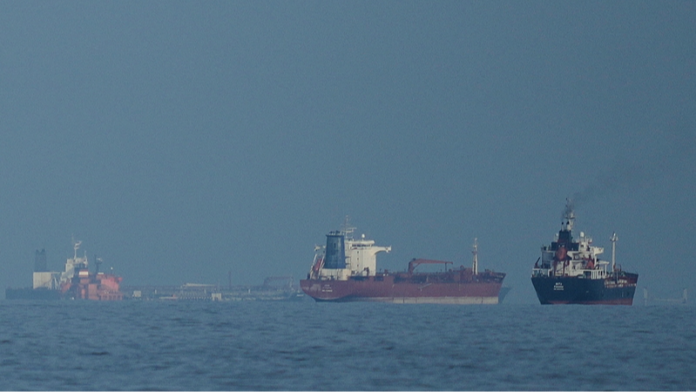
The International Maritime Organization (IMO) opened an extraordinary council session in London on Wednesday to address maritime security in and around the Strait of Hormuz, one of the world’s most strategically critical maritime chokepoints.
The two‑day emergency meeting was convened as escalating tensions stemming from the US-Israel-Iran conflict have severely disrupted commercial shipping along the vital Hormuz Corridor.
Clogged global economic artery
The Strait of Hormuz was officially closed on 3 March, shortly after Iran imposed a navigation ban following joint strikes by the United States and Israel on 28 February.
Flanked by Iran to the north and Oman and the United Arab Emirates to the south, the waterway forms a narrow 50‑kilometre gateway linking the Persian Gulf to the Arabian Sea. It narrows to just 33 kilometres at one point.
The Strait of Hormuz normally carries approximately 20-million barrels of crude oil and refined products each day – roughly one‑quarter of global seaborne oil trade – along with large volumes of liquefied natural gas and fertiliser exports, according to the United Nations Food and Agriculture Organisation (FAO).
Maritime logistics costs spiral upwards
Yet within days of the attack on Iran, tanker traffic through the strait plummeted by more than 90%, severely restricting shipments, the FAO reported.
Major shipping lines, including Maersk, MSC, CMA CGM and Hapag-Lloyd, have suspended all transit through the strait, diverting vessels to safe zones or rerouting them around the Cape of Good Hope, sending maritime logistics costs into an upward spiral.
In a briefing released ahead of the emergency session, the IMO stated that around 3,200 ships and 20,000 seafarers are currently stranded west of the Strait of Hormuz due to the hostilities.
‘Current situation is unacceptable, unsustainable’
Addressing Wednesday’s meeting, IMO Secretary‑General Arsenio Dominguez confirmed that recent attacks on merchant ships have left at least seven seafarers dead and several seriously injured.
He emphasised that seafarers and civilian vessels must not be targeted amid broader geopolitical tensions, describing the current situation as unacceptable and unsustainable.
Dominguez warned that geopolitical frictions are testing the shipping sector to its limit, with far-reaching consequences for the global economy and food security.
Drag on global economy
The benchmark Brent crude oil on Thursday surged to over $116 (R1,974) per barrel, marking a staggering 60% jump from the eve of the conflict when prices sat just below $73.
This rapid escalation has already surpassed the “upside scenario” modeled by Goldman Sachs in its 5 March analysis, with the actual threat to global economic stability likely even more severe.
In that report, economists warned that if disruptions in the Strait of Hormuz were to persist for another five weeks, and oil prices climb to around $100 per barrel, the drag on global GDP growth would reach 0.4 percentage points, while headline inflation would rise by 0.7 percentage points.
Higher energy and input costs threaten crop yields
The FAO separately warned that the conflict poses severe risks to global energy, fertiliser and agri-food systems.
Higher energy and input costs threaten crop yields, the agency said, while lost remittances and potential shifts toward biofuel production could worsen food price volatility, especially in Africa, Asia and other import‑dependent regions.
The disruption extends far beyond energy markets. Around one‑third of the world’s urea exports and nearly half of global sulfur supplies pass through the strait, placing agricultural and chemical supply chains at serious risk.
Cargo being shifted to air transport
Precision manufacturing has also been heavily affected. Analysts caution that because inventory levels cannot compensate for an extra two weeks of transit delay, automobile assembly plants in Germany and the United States could begin experiencing shortages of Asian components within two to three weeks.
With key sea lanes blocked, high-value and time-sensitive cargo is being shifted to air transport. As a result, air freight rates from South Asia to Europe have jumped by 70%, a cost increase that is rapidly squeezing profit margins across global supply chains.
Speaking at the meeting, Li Guanyu, China’s deputy permanent representative to the IMO, stressed that stability in the Strait of Hormuz is essential for global supply chains and serves the common interests of the international community.
Li called on all parties to immediately cease military actions to de-escalate tensions and restore security to the vital waterway.


