
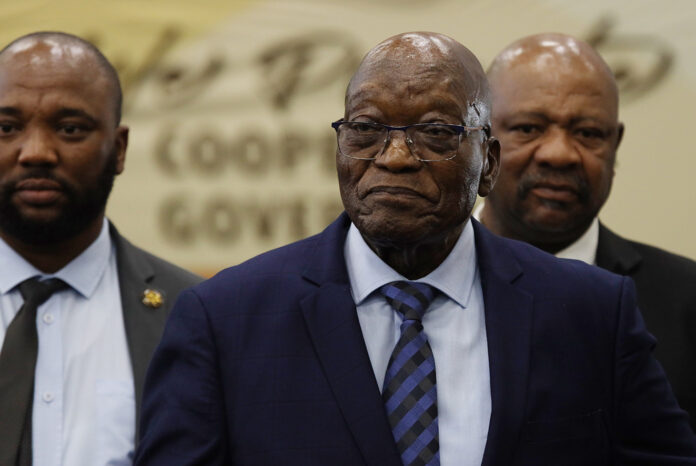

The ANC’s top seven are walking on eggshells over the interdicted Eastern Cape provincial conference that was abandoned last weekend – not out of political calculation, but out of legal fear shaped by the imprisonment of former President Jacob Zuma.
After meeting the province’s top five leaders on Monday at Luthuli House, the ANC top seven resolved not to make a public statement about their wishes for the conference to reconvene soon.
This is because they fear being viewed as defying the High Court in KuGompo, which put the conference on ice.
Zuma, also a former ANC president, was sentenced to 15 months, but served only two months in 2021 following his refusal to appear before the state capture commission, even after the court ordered him to do so.
ANC leaders, including secretary-general Fikile Mbalula, are before the KuGompo High Court for alleged contempt of court after apparently proceeding with preparations for the botched conference even after the court ordered them to stop.
On Monday, lawyers for the applicants who interdicted the Eastern Cape conference and instituted the contempt matter, upped the ante, threatening provincial chairperson Oscar Mabuyane and national executive committee deployees’ head Mmamoloko Kubayi.
“It has since come to our clients’ attention that in the afternoon of Saturday, 28 March 2026, Mr Oscar Mabuyane, the third respondent in the further contempt of the two court orders, delivered a lengthy address at the interdicted conference and convened the delegates to attend the conference at its plenary,” wrote lawyer Sinawo Makangela in a letter dispatched to ANC lawyers, while national officials met their Eastern Cape counterparts on Monday.
“He was accompanied by another respondent, Ms Mmamoloko Kubayi, who also addressed the “delegates”.
“The decision of Mr Mabuyane and Ms Kubayi to address the conference was a calculated and coordinated strategy to undermine the authority and dignity of the courts.
“You are invited to explain the conduct of Mr Mabuyane and Ms Kubayi and why their conduct should not be regarded as an aggravation to the acts of contempt of court.”
At the Monday meeting, the national officials resorted to saying the disputed provincial conference will sit “when the court says so”, which on its own has political implications.
“The Eastern Cape conference will eventually sit. But we cannot go out to say that publicly after it was interdicted by the court of law because there are serious consequences for such things,” said a high-ranking leader who attended the Monday meeting.
“So, it is safe to say the conference will reconvene only when the court that interdicted it says so. We do not want to find ourselves on the wrong side of the law; remember how that ended for Jacob Zuma, who went to jail refusing to follow court orders?”
Another insider who was also in the Monday meeting said there was now a potential for political implications in saying the conference will reconvene after the final determination by the court.
They argued that there was a standing ANC NEC decision saying there would be no conferences convened post the March 30 mark, as April marks the start of the local government elections (LGE) campaign.
On Wednesday, secretary of the ANC electoral committee chief Luvhuwani Matsila was doing a media tour on the “commencement of the 2026 LGE candidate selection process”.
Said the leader: “That is what we are busy with from now until election day. If after the court is satisfied about the Eastern Cape conference and it is ready to convene, the NEC might have to amend its resolution prohibiting internal conferences post-end of March, which will open the floodgates for other provinces that also wish to go to conference to make a case for such.
“I think that it is practical to say the conference must convene only after the municipal elections.”
- The ANC’s top seven leaders are cautiously handling the situation around the halted Eastern Cape provincial conference.
- The conference was abandoned last weekend amid significant tension.
- Their caution is driven more by legal concerns than political strategy.
- This cautiousness is influenced by the imprisonment of former President Jacob Zuma.
- Full details of the story are available in the Sunday World e-edition.