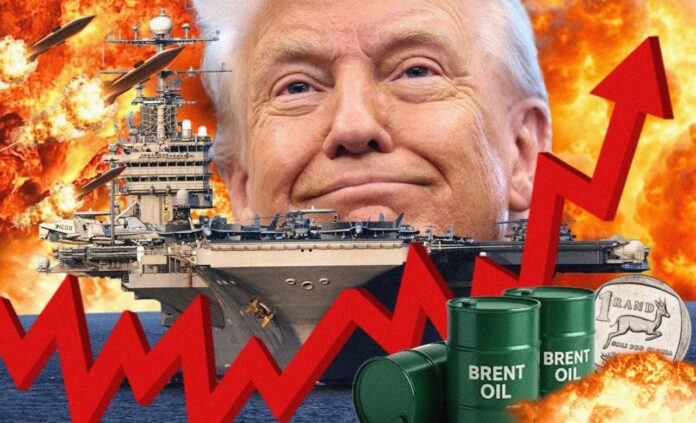
As South Africans reel from a record fuel price hike that took effect on April 1, the ripple effects of escalating tensions in the Middle East are being felt far beyond the region, hitting households, workers and key sectors of the economy with force.
Phila Mzamo, head of communications at the Fuel Industry Association of South Africa, said the link between geopolitical instability and local fuel prices is direct and unavoidable.
Supply disruptions
“The recent spike in fuel prices is strongly correlated with the conflict in the Middle East,” Mzamo said. “We’ve seen crude oil prices increase alongside shipping and freight costs, and that feeds directly into what South Africans are paying.”
Mzamo explained that instability involving countries such as Iran raises fears of supply disruptions, triggering immediate reactions in global oil markets.
“Even the perception of risk is enough to push prices higher. Oil markets are extremely sensitive to geopolitical developments,” he said.
SA’s response
The impact has triggered urgent responses domestically. Cyril Ramaphosa has instructed Finance Minister Enoch Godongwana to develop urgent measures to shield consumers from the April price shock.
Labour federation Congress of South African Trade Unions has described the situation as a national disaster, while the South African National Taxi Council warned that fare increases are now unavoidable.
Sanele Nkosi, head of agriculture at BDO South Africa, warned that the country’s farming sector is uniquely exposed to global shocks of this nature, with fuel costs directly affecting production and food prices.
The Motor Industry Staff Association captured the human cost starkly: “Workers are being crushed between the rising cost of fuel and electricity. Families are forced to choose between commuting to work, putting food on the table, or keeping the lights on.”
No immediate price drops
While hopes remain that a de-escalation could ease pressure, Mzamo cautioned against expecting immediate price drops.
“Even if the conflict were to end tomorrow, we would not see an overnight reduction in fuel prices,” he said. “There is always a lag due to existing supply and the monthly pricing system.”
“It is very difficult to say exactly when prices will drop. But definitely if there is some sort of end to the war, prices will start to respond positively,” he added.
“They will go down because the market cannot sustain these levels, even at a global level. We have seen for a number of years now that the crude oil price has been hovering below $70 per barrel.”
“The higher the fuel prices, the less oil products will be used. There is no way the market can sustain $100 per barrel. If the war were to end, we would not see an immediate fall in prices, but they would gradually move to equilibrium where demand and supply meet.”
South Africa’s fuel prices are adjusted based on global benchmarks such as Brent crude, meaning local consumers remain exposed to international volatility.
Strait of Hormuz strife felt far and wide
Roughly a quarter of the country’s crude oil is transported through routes affected by the Strait of Hormuz, while nearly a third of total fuel supply is sensitive to disruptions in that corridor.
Any instability in the strait, one of the world’s most critical oil arteries, sends shockwaves through global supply chains and pricing.
Mzamo said this exposes a deeper structural weakness.
“More than half of our fuel price is influenced by external factors. That limits what can be done domestically to shield consumers,” he said.
The latest fuel increase is not occurring in isolation. It reflects the global consequences of a conflict far from South Africa’s borders, yet deeply felt within them.
The record fuel increase that took effect is not an act of nature. It is the downstream consequence of a military campaign that has drawn criticism from international bodies and lawmakers alike.
The war has now entered its 34th day. The Strait of Hormuz remains disrupted. Oil prices remain elevated.
- South Africa faces a record fuel price hike starting April 1 due to rising crude oil prices linked to Middle East conflict and supply disruptions, especially around the Strait of Hormuz.
- Geopolitical instability, particularly involving Iran, elevates fears of supply risks, causing immediate increases in global oil prices that directly impact South African fuel costs.
- The government, led by President Ramaphosa, is developing urgent measures to protect consumers, while key sectors like agriculture and transport warn of rising costs and unavoidable fare hikes.
- Fuel prices will not drop immediately even if the Middle East conflict ends, due to lag in supply adjustments and the monthly pricing system; prices are expected to gradually stabilize as demand and supply equilibrate.
- South Africa's fuel prices are heavily influenced by global benchmarks and external factors, limiting domestic ability to shield consumers from international market volatility triggered by ongoing Middle East tensions.