
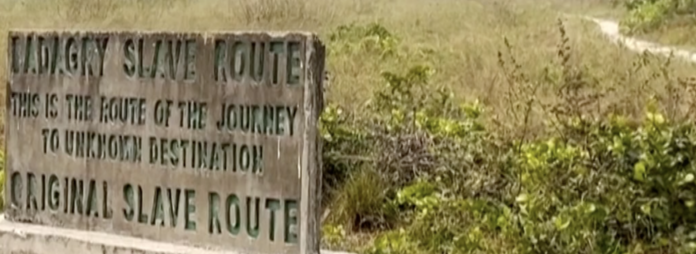
A recent resolution by the United Nations General Assembly declaring the transatlantic slave trade as “the most serious crime against humanity” has renewed attention on calls for reparations, while spotlighting historic sites such as Badagry in Lagos State.
The centuries-long trade, which lasted nearly 400 years, saw millions of Africans forcibly taken to the Americas for labour. While the UN move is not legally binding, it has reignited debate over compensation and historical accountability.
A town shaped by history
Badagry was once one of West Africa’s most prominent slave ports. Today, it serves as a center for tourism and historical research, with several preserved sites offering insight into the realities of the trade.
Among them is the Point of No Return, a route stretching over two kilometers, where enslaved Africans were marched before boarding ships bound for the “New World.” According to tour guides, crossing that point symbolized a final departure from the continent.
Historians describe the journey as one marked by extreme brutality, with captives shackled, silenced and subjected to severe dehumanization.
Another key site is the Spirit Attenuation Well, where enslaved people were forced to drink water believed to weaken memory and resistance, a ritual seen as an “initiation” before their forced journey.
Harsh realities of captivity
Equally harrowing are the barracoons, or slave pens, where captives were held for months awaiting transport. Dozens were confined in cramped, poorly ventilated “dark rooms” under inhumane conditions.
Historical accounts describe how individuals were inspected and selected based on physical strength, underscoring the commodification of human life during the trade.
According to the United Nations Educational, Scientific and Cultural Organization (UNESCO), preserving such sites is vital for documenting the global impact of slavery and promoting historical awareness.
Reparations debate continues
While the UN resolution has drawn global attention, some historians remain cautious about its practical implications. They say recognition alone may not translate into meaningful reparations for African countries.
“I don’t see anything coming out of this resolution. And if they want to do anything, there is always something at the end of it all that Africans do not really eventually benefit from. There is no sincerity,” historian Yemisi Shyllon said.
The UN has long acknowledged the slave trade as a crime against humanity, but efforts to address its lasting consequences, including economic disparities and social inequalities, remain ongoing.
- This series, Injustice Across the Atlantic, examines the harrowing history and enduring legacy of the transatlantic slave trade. Over four centuries, millions of Africans were forcibly uprooted, subjected to unimaginable brutality, and transported across continents to fuel European colonial economies. The consequences of this history continue to shape social, economic, and political inequalities today.
- The UN General Assembly recently declared the transatlantic slave trade as “the most serious crime against humanity,” reigniting calls for reparations and accountability.
- Badagry in Lagos State, a former major West African slave port, houses historic sites like the Point of No Return and the Spirit Attenuation Well, important for understanding the brutal realities of the trade.
- Enslaved Africans endured horrific conditions in barracoons (slave pens), were dehumanized and commodified, highlighting the extreme cruelty embedded in the trade.
- UNESCO emphasizes the importance of preserving such historic sites to document slavery’s global impact and raise historical awareness.
- Despite the UN resolution, historians remain skeptical about the prospects for meaningful reparations, pointing to a continued lack of sincere action benefiting African countries.
A recent resolution by the United Nations General
Badagry was once one of West Africa's most prominent slave ports. Today, it serves as a center for tourism and historical research, with several preserved sites offering insight into the realities of the trade.
Historians describe the journey as one marked by extreme brutality, with captives shackled, silenced and subjected to severe dehumanization.
Equally harrowing are the barracoons, or slave pens, where captives were held for months awaiting transport. Dozens were confined in cramped, poorly ventilated “dark rooms” under inhumane conditions.
Historical accounts describe how individuals were inspected and selected based on physical strength, underscoring the commodification of human life during the trade.
While the UN resolution has drawn global attention, some historians remain cautious about its practical implications.
"I don't see anything coming out of this resolution.
This series, Injustice Across the Atlantic, examines the harrowing history and enduring legacy of the transatlantic slave trade. Over four centuries, millions of Africans were forcibly uprooted, subjected to unimaginable brutality, and transported across continents to fuel European colonial economies.The