


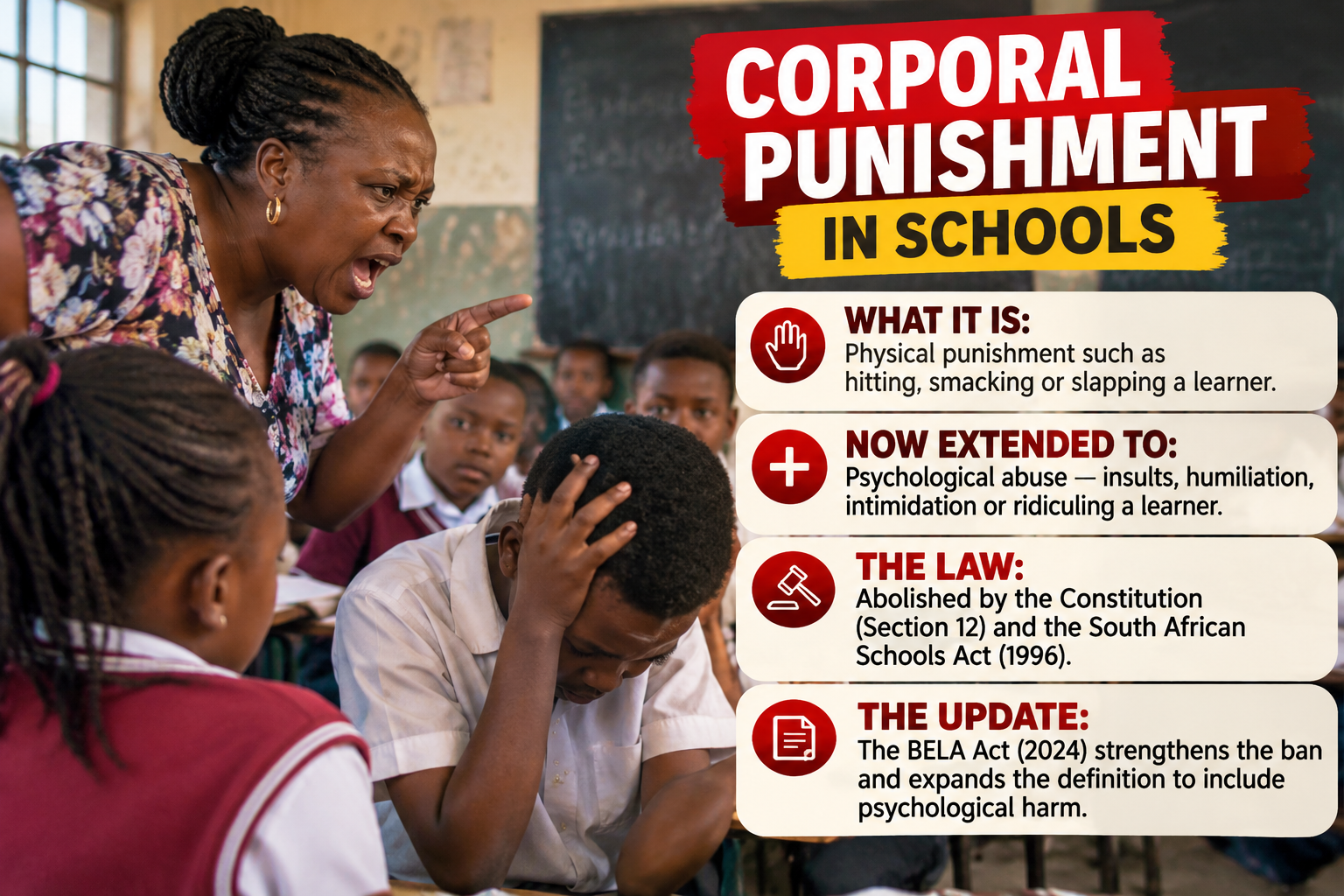
Teachers who insult, humiliate or ridicule learners could find themselves facing disciplinary action for corporal punishment, even without lifting a finger against a child.
This emerged during Basic Education Minister Siviwe Gwarube’s presentation to Parliament on the implementation of the Basic Education Laws Amendment (BELA) Act, which has broadened the definition of corporal punishment beyond physical violence.
The development adds a controversial dimension to South Africa’s decades-old debate over classroom discipline, with the law now extending its reach beyond the stick to the tongue.
Explaining the changes during Gwarube’s presentation, Department of Basic Education chief director James Ndlebe told MPs that corporal punishment was no longer confined to hitting, smacking or slapping learners.
However, he explained that the expanded definition now covered psychological harm, including verbal abuse.
“But this definition extended the definition which was only focusing on hitting, smacking, slapping,” Ndlebe said, adding that it now included “even the psychological effect, including insults”.
He said the expanded definition was already being implemented, although corporal punishment remained a stubborn problem in South African schools.
“It’s not a battle that we can say 100% we have eradicated this corporal punishment,” Ndlebe admitted.
“It’s still continuing, especially in few schools in rural areas, in particular.”
READ MORE: Gauteng principal in hot water over corporal punishment
He warned that education authorities were taking action against offenders.
“We’re talking of a number of teachers that are beginning to lose their jobs because of corporal punishment.”
Ndlebe acknowledged that teachers and unions had questioned how educators were expected to maintain discipline without physical punishment.
“When you take away the stick, what are you replacing with?” he recalled them asking.
The department has consequently finalised a roughly 110-page manual titled Doing Discipline Differently, providing teachers with step-by-step guidance on positive discipline.
Ndlebe said the manual would soon be circulated to schools as part of the implementation of the BELA Act.
Hundreds of misconduct complaints
The tougher approach comes against a troubling backdrop of misconduct complaints involving educators, including assault of students, which is also a criminal offence.
According to the South African Council for Educators’ (SACE) 2025/26 annual report, the professional regulatory body received 831 misconduct complaints, compared with 606 in the previous financial year.
The council processed 384 cases against a target of 600 and finalised 91 disciplinary hearings against a target of 120.
Seventeen educators were struck off the professional register for serious misconduct.
READ MORE: WATCH | Teacher slapped with suspension for corporal punishment
The previous year’s report recorded 257 assault complaints involving learners, highlighting the continuing challenge of violence in schools.
However, assault complaints are not necessarily all cases of corporal punishment, and allegations do not automatically amount to proven misconduct.
The expanded BELA definition means teachers must now confront another reality: discipline that humiliates or psychologically harms learners can carry consequences even without physical contact.
RELATED: Nasaret Ruswa | BELA protects learner dignity, but who protects the teacher?
- The Basic Education Laws Amendment (BELA) Act in South Africa has expanded the definition of corporal punishment to include psychological harm such as insults, not just physical violence.
- Basic Education chief director James Ndlebe acknowledged that corporal punishment persists, particularly in some rural schools, despite efforts to eradicate it.
- Teachers found guilty of corporal punishment, including verbal abuse, risk disciplinary actions and job loss.
- The Department of Basic Education has developed a 110-page manual titled Doing Discipline Differently to guide teachers in positive discipline methods.
- The South African Council for Educators (SACE) received 831 misconduct complaints in 2025/26, with 17 educators struck off for serious misconduct, including assault cases involving learners.
Teachers who insult, humiliate or ridicule learners could find themselves facing disciplinary action for corporal punishment, even without lifting a finger against a child.
This emerged during Basic Education Minister Siviwe Gwarube's presentation to Parliament on the implementation of the Basic Education Laws Amendment (BELA) Act, which has broadened the definition of corporal punishment beyond physical violence.
The development adds a controversial dimension to South Africa's decades-old debate over classroom discipline, with the law now extending its reach beyond the stick to the tongue.
Explaining the changes during Gwarube's presentation, Department of Basic Education chief director James Ndlebe told MPs that corporal punishment was no longer confined to hitting, smacking or slapping learners.
However, he explained that the expanded definition now covered psychological harm, including verbal abuse.
"But this definition extended the definition which was only focusing on hitting, smacking, slapping," Ndlebe said, adding that it now included "even the psychological effect, including insults".
He said the expanded definition was already being implemented, although corporal punishment remained a stubborn problem in South African schools.
"It's not a battle that we can say 100% we have eradicated this corporal punishment," Ndlebe admitted.
"It's still continuing, especially in few schools in rural areas, in particular."
READ MORE: Gauteng principal in hot water over corporal punishment
He warned that education authorities were taking action against offenders.
"We're talking of a number of teachers that are beginning to lose their jobs because of corporal punishment."
Ndlebe acknowledged that teachers and unions had questioned how educators were expected to maintain discipline without physical punishment.
"When you take away the stick, what are you replacing with?" he recalled them asking.
The department has consequently finalised a roughly 110-page manual titled Doing Discipline Differently, providing teachers with step-by-step guidance on positive discipline.
Ndlebe said the manual would soon be circulated to schools as part of the implementation of the BELA Act.
The tougher approach comes against a troubling backdrop of misconduct complaints involving educators, including assault of students, which is also a criminal offence.
According to the South African Council for Educators' (SACE) 2025/26 annual report, the professional regulatory body received 831 misconduct complaints, compared with 606 in the previous financial year.
The council processed 384 cases against a target of 600 and finalised 91 disciplinary hearings against a target of 120.
Seventeen educators were struck off the professional register for serious misconduct.
READ MORE: WATCH | Teacher slapped with suspension for corporal punishment
The previous year's report recorded 257 assault complaints involving learners, highlighting the continuing challenge of violence in schools.
However, assault complaints are not necessarily all cases of corporal punishment, and allegations do not automatically amount to proven misconduct.
The expanded BELA definition means teachers must now confront another reality: discipline that humiliates or psychologically harms learners can carry consequences even without physical contact.
RELATED: Nasaret Ruswa | BELA protects learner dignity, but who protects the teacher?


