


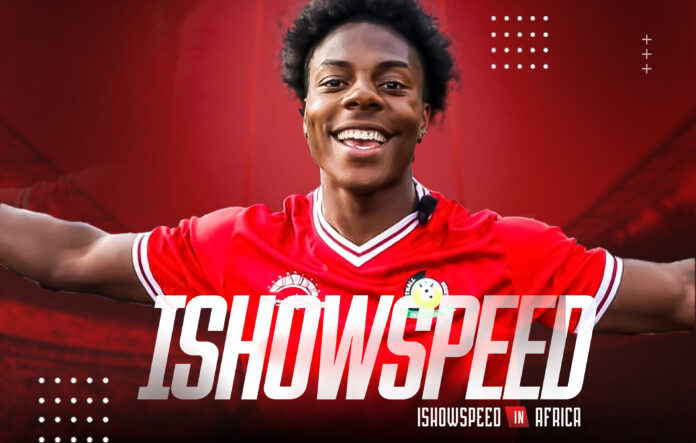
Under the bronze gaze of the African Renaissance Monument in Dakar, the American content creator and travel influencer IShowSpeed laughed into his lapel mic as a tide of live viewers watched him trace the shoreline where the Gate of No Return on Senegal’s Goree Island stands, a place once marking an outward journey of violence and erasure.
At first, his crew filmed the sites. Then, he asked his viewers to imagine the history beneath his feet. It was symbolic. Tens of millions of his livestream followers took a moment to reflect in real time.
Darren Jason Watkins Jr., known online as IShowSpeed or simply Speed, is a 21-year-old streamer from Cincinnati, Ohio.
He rose to prominence on YouTube with high-energy gaming and reaction livestreams, building a massive audience through unscripted content before taking his streams into real-world locations.
Narrative-changing effect
His Africa tour, announced via a trailer titled “Speed does Africa”, outlined a 20-country, 28-day itinerary and framed the trip as a non-stop livestream experiment.
For much of the livestream, IShowSpeed did what he always does: reacting to food, music, and crowds.
But at Goree Island, the stream became a powerful teaching opportunity, showing millions of people a layered Africa that textbooks and headlines rarely convey.
With hundreds of thousands watching live and millions replaying clips, IShowSpeed’s Africa tour has produced a rapid perception reset across platforms.
“Africa’s portrayal in Western media has long oscillated between exoticization and catastrophization—a continent reduced to safaris and suffering, its 54 nations flattened into a monolithic narrative,” remarked investment manager Mark-Anthony Johnson in an op-ed for The Habari Network.
Johnson, whose 30 years of business in Africa span mining, power, shipping, fisheries and agriculture, commented that IShowSpeed’s narrative-changing effect may or may not have been intentional. Nevertheless, it’s working.
According to Valentine Waswa, a communications strategist at the Admedia Communications Group: “For decades, global images of Africa have been narrow.
“The African image has mainly been shaped and dominated by either charity frames or wildlife postcards. Those frames flatten diverse cities, economies, and everyday lives into a single, misleading script.”
That script is breaking. A generation of creators and platform mechanics now amplifies unscripted moments directly to global audiences, bypassing curated campaigns and institutional gatekeepers.
“Without traditional campaigns or scripted advertisements, entire cultures are being introduced to global audiences one livestream, one post, and one moment at a time,” said Edgar Sungai, a strategic communications practitioner who tracked Speed’s tour and its tourism implications.
IShowSpeed’s multi-country tour turned those mechanics into a spectacle. Local reporting indicated his Nairobi stream drew roughly 200 000 concurrent viewers, while his channel saw sharp subscriber gains.
Africa presented as lived spaces
Clips and reaction videos spread rapidly, magnifying the moment.
Those numbers matter because scale rewires credibility. Instead of polished travel ads, viewers saw city streets, commutes, café life, and stadium crowds, updating old assumptions midstream.
“Live streams collapse distance and force rapid belief-updating, because viewers see unscripted, unedited reality,” Waswa noted.
The format resonates strongly with Gen Z audiences, who value immediacy and presence.
IShowSpeed’s Nigeria tour marked a milestone as he reached 50-million subscribers on his 21st birthday. Behind the scenes, the tour resembled a coordinated showcase more than casual travel content.
Yonaiel Tadiwos Belete, operations director at Boston Partners, which runs Kuriftu Resorts that hosted Speed in Ethiopia, said it took over two months of planning the visit.
“What most people see in the final video is a few hours of high energy… What they don’t see is two-plus months of planning, countless late nights, site visits, rehearsals, security briefings, cultural coordination, and alignment across multiple public and private sector stakeholders to make it happen,” Yonaiel told bird.
IShowSpeed’s tour also reflects a wider 2025 trend of high-profile visits presenting African cities as lived spaces rather than symbolic destinations.
Ghanaian media reported that American actor Michael Jai White’s December visit to Accra included a public traditional enstoolment ceremony, widely circulated online, framing Ghanaian culture as contemporary and active.
In Lagos, the Detty December season drew international performers and creators, including rapper Saweetie, whose real-time posts highlighted infrastructure, production scale, and audience density often absent from global portrayals of African cities.
Challenging misconceptions
African digital influencers have been central to this shift. Ghanaian travel vlogger Wode Maya continued documenting urban life, entrepreneurship, and mobility across multiple countries in 2025, reaching non-African audiences curious about everyday realities rather than curated narratives.
The Nigerian content creator, Charity Ekezie, uses humuor to challenge misconceptions about Africa to her 3.5-million TikTok followers.
In Nairobi, a helicopter flyover and street segments produced viral clips that repeatedly contradicted rural-focused perceptions of Africa. Some streams generated millions of single-day views.
IShowSpeed crossed 48-million subscribers live while flying above Nairobi, with peak concurrent viewership exceeding 240 000.
Egline Samoei, a digital communications strategist, cited Brand Moran’s social listening analysis, estimating a 99.7-million social reach for the Kenya leg, with narratives framing the city as a standout moment in the tour.
Platform metrics cited in local media indicate Speed’s Africa streams generated hundreds of millions of watch minutes, compressing years of image-building into weeks of live exposure.
“Who controls the image of Africa is changing,” Waswa said. “Those who once shaped that image from afar now share influence with creators who command real-time attention.
“That shift will not replace old frames overnight, but it accelerates how perceptions move and who benefits when they do.”
- Under the bronze gaze of the African Renaissance Monument in Dakar, the American content creator and travel influencer IShowSpeed laughed into his lapel mic as a tide of live viewers watched him trace the shoreline where the Gate of No Return on Senegal’s Goree Island stands, a place once marking an outward journey of violence and erasure.
- At first, his crew filmed the sites.
- Then, he asked his viewers to imagine the history beneath his feet.
- It was symbolic.
- Tens of millions of his livestream followers took a moment to reflect in real time.


