


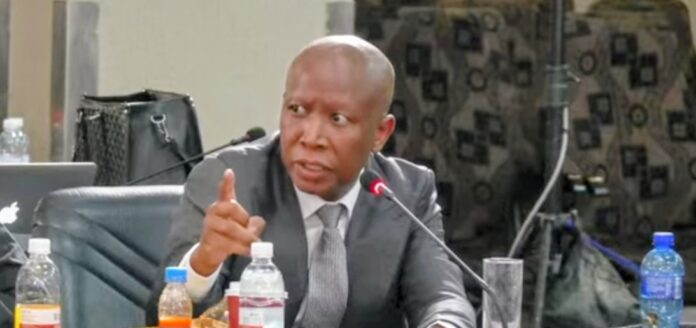
EFF leader Julius Malema has formally written to Chief Justice Mandisa Maya, demanding that the Constitutional Court urgently deliver judgment in the long-running Phala Phala matter, or explain the delay. He warned that justice “cannot be indefinitely deferred”.
In a sharply worded letter dated 24 March, Malema describes the delay in Economic Freedom Fighters v Speaker of the National Assembly and Others as “unacceptable”, placing the judiciary under rare political scrutiny.
‘No judgment after 480 days’
The Constitutional Court heard the case on 24 November 2024. It stems from Parliament’s handling of President Cyril Ramaphosa’s Phala Phala scandal. More than 480 days later, no judgment has been delivered.
Malema sets out a stark timeline, arguing the delay has stretched far beyond acceptable limits for a matter of such national importance.
“This delay must also be understood within a broader constitutional timeline. The matter arises from a decision of the National Assembly taken on 13 December 2022. It has now been 1,197 days since that decision, without final judicial determination by the Constitutional Court.”
‘One of the most delayed judgments in Constitutional Court history’
He argues that the case has now become one of the most delayed judgments in the modern history of the Constitutional Court, particularly given that it implicates the conduct of the sitting head of state.
Citing the court’s own precedent in EFF v Speaker of the National Assembly (2016), Malema reminded the Chief Justice that the president is “the first citizen” and the “personification of this nation’s constitutional project”, making any delay in adjudicating matters involving that office deeply troubling.
‘Delay falls far outside prescribed norms’
He further invoked the judiciary’s own performance standards, warning that the delay now falls far outside prescribed norms.
“The present delay, now exceeding 480 days post-hearing, is not merely beyond the prescribed three-month period. It is more than five times the maximum standard contemplated by the Norms and Standards. No explanation has been provided that could reasonably sustain a claim of ‘exceptional circumstances’ of this magnitude.”
‘Concerns about judicial accountability’
Malema also raised concerns about judicial accountability, pointing to the obligations placed on judges to act diligently and efficiently.
“This delay far exceeds not only ordinary judicial timelines but also binding judicial norms governing the performance of judicial functions.”
His letter also references the Code of Judicial Conduct, which obliges judges to deliver judgments without undue delay, warning that failure to comply with these standards may amount to misconduct.
Tension between judicial independence and accountability
The Phala Phala case centres on whether Parliament properly discharged its constitutional duties in dealing with allegations surrounding foreign currency stolen from Ramaphosa’s Limpopo farm.
With the clock ticking and constitutional questions hanging, Malema’s intervention sharpens the tension between judicial independence and accountability, where delay risks dulling the blade of justice itself.


