
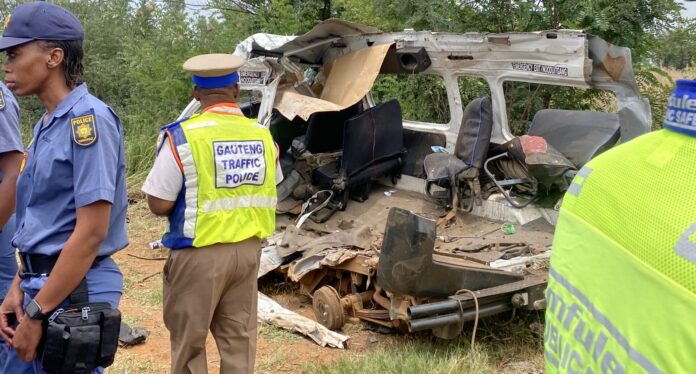
The scholar transport accident in Vanderbijlpark has sent shockwaves across the country. The tragic loss of 14 young lives is almost too painful to comprehend. One can only imagine the unbearable anguish faced by the parents of those children.
Visuals of a mother running and wailing uncontrollably tore at the nation’s heartstrings, leaving many grappling with the sheer scale of the tragedy.
Yet, painful as it is to admit, this was not an isolated incident.
On July 10, 2024, another devastating scholar transport accident reportedly claimed the lives of 11 children when the minibus they were travelling in was struck by a bakkie in Carletonville. The driver also lost his life.
In KwaZulu-Natal, nine children were injured when the vehicle transporting them lost control and collided with a tree.
Last year, in the same province, five pupils died when a minibus reportedly lost control, struck a tree, rolled, and plunged into a preschool building in Pietermaritzburg.
If we go back nearly two decades, to August 2010, we recall the horrific level-crossing accident in the Western Cape where a minibus was struck by a train, killing 10 pupils and injuring several others.
It was alleged that the driver, Jacob Humphreys, failed to stop at the crossing. He was later convicted and sentenced to 20 years’ imprisonment, reduced to eight years on appeal. Evidence suggested that Humphreys jumped a queue of waiting vehicles and attempted to cross while the booms were down.
Returning to the Vanderbijlpark tragedy, dashcam footage shows the minibus driver attempting to overtake several vehicles before colliding with a truck. Humphreys was 55 years old at the time of his conviction. Ayanda Dludla, the driver implicated in the Vanderbijlpark crash, is reportedly just 22.
Two men. Two different eras.
Was one driven by the exuberance of youth and the other by the arrogance of age? Did either truly consider the consequences of their actions? Or had reckless behaviour become routine, dicing with death, chasing time at any cost?
These horrors are not confined to scholar transport alone. On a regular basis, South Africans witness fatal crashes involving taxis, buses, trucks and private vehicles. On 2 June, 2023, 15 people died on the N10 near Middelburg when a minibus taxi collided head-on with a truck. The list goes on.
Road deaths in South Africa average approximately 13 000 annually. According to preliminary data released by the Department of Transport, between December 11, 2025, and January 11 alone, 1 427 people lost their lives on our roads.
This carnage persists despite the fact that South Africa has a robust legislative framework governing road transport.
The National Road Traffic Act of 1996 and the National Land Transport Act of 2009 provide extensive powers to the transport minister, provincial MECs, municipalities, and other authorities.
Specifically regarding scholar transport, section 72(1) of the National Land Transport Act empowers the minister to “…prescribe regulations on special requirements for such services, including supervision of learners, special driver requirements, and insurance provisions…”
Provincial MECs are equally empowered to intervene where operators fail to comply with legal requirements.
The question, then, is not whether we have laws, but whether we enforce them.
So what must be done?
First, the rule of law must prevail. When there is no fear of consequences, recklessness becomes normalised. Traffic laws must be enforced consistently and proactively, not reactively after lives have been lost.
Second, the issuing of driver’s licences must be cleaned up. The system has been deeply compromised, with deadly consequences. Unqualified drivers have been unleashed onto our roads, turning vehicles into weapons.
Third, operating licences must be strictly monitored. Authorities must ensure that all public transport operators, including scholar transport providers, are properly licensed and compliant.
Fourth, vehicle testing stations require urgent oversight. It is unacceptable that visibly unroadworthy vehicles continue to receive roadworthy certificates through corruption or negligence.
This painful incident must serve as a turning point. We cannot continue to cut corners when it comes to road safety.


