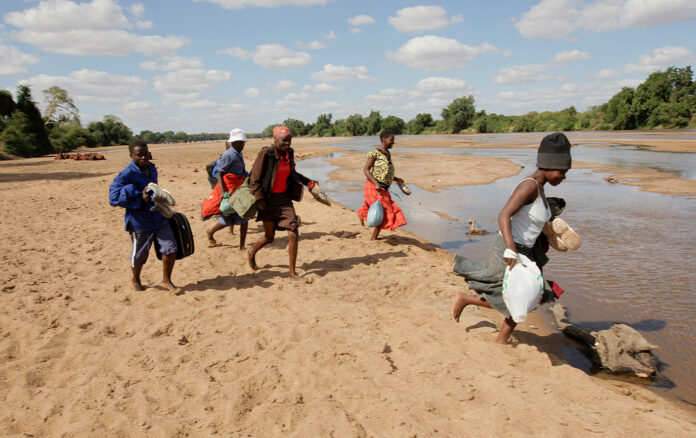
Illegal immigration continues to be a pressure point in Limpopo, with communities increasingly raising concerns about the impact on already stretched public resources.
The issue came into sharp focus last weekend at the Limpopo ANC elective conference when provincial secretary Reuben Madadzhe delivered the organisational report behind closed doors, warning that undocumented migration is fast becoming a flashpoint at the grassroots level.
According to the report, the presence of undocumented foreign nationals is described as a “thorny issue” in many communities, particularly in relation to access to services and crime prevention.
“Communities are raising serious concerns about undocumented foreign nationals and the pressure these place on basic services, as well as the challenges it creates in fighting crime,” the report states.
The document paints a picture of a province grappling with competing pressures.
Limpopo’s position as South Africa’s northern gateway, bordering Zimbabwe, Botswana and Mozambique, makes it a key hub for regional trade and movement, but also exposes it to illegal crossings.
Madadzhe cautioned that weak and porous borders are creating conditions that can be exploited by criminal networks.
“Poorly controlled borders create an enabling environment for organised crime, smuggling and other illegal activities, which undermine both community safety and investor confidence,” the report notes.
“The sharing of scarce public resources with undocumented migrants is becoming a source of tension in communities,” the report says, adding that the situation complicates efforts by law enforcement agencies.
The concerns around illegal immigration also link to broader economic discussions captured in the report. Ahead of the party’s national general council in December 2025, the provincial leadership is recorded as having taken a position on township economies.
The report states that the provincial general council resolved to place South Africans at the centre of the township economy.
Spaza shops operated by foreign nationals are flagged as a concern, with the report noting that a sector once central to black economic activity has increasingly been dominated by traders able to offer cheaper goods.
At the same time, the report acknowledges that Limpopo’s strategic role in regional integration makes the issue complex and difficult to resolve without affecting economic activity.
The ANC in the province has called for the urgent implementation of internal recommendations to deal with undocumented migration and its impact.
While Limpopo remains relatively stable overall, the report warns that failure to act decisively could deepen social and economic pressures in vulnerable communities.
Water shortages and unreliable supply are also flagged in the organisational report as one of the most pressing service delivery challenges facing communities in Limpopo, with residents in several areas experiencing ongoing disruptions.
The report notes that while a number of water projects have been initiated across the province, progress on the ground has been uneven. “Communities continue to raise concerns about unreliable access to water, which affects daily life and undermines confidence in local government,” the report states.
“There are ongoing concerns regarding the pace of implementation of water infrastructure projects in various parts of the province.”
The report points to infrastructure constraints and maintenance failures as key contributors to the problem. “Aging infrastructure and delays in maintenance and repairs are worsening the water supply situation in a number of municipalities,” the document notes.
The report cautions that failure to act decisively could deepen tensions on the ground.
- Illegal immigration remains a significant issue in Limpopo.
- Local communities are increasingly concerned about the impact.
- The pressure is mainly on already strained public resources.
- The situation is causing growing tension in affected areas.
- Full details are available in the e-edition of Sunday World.