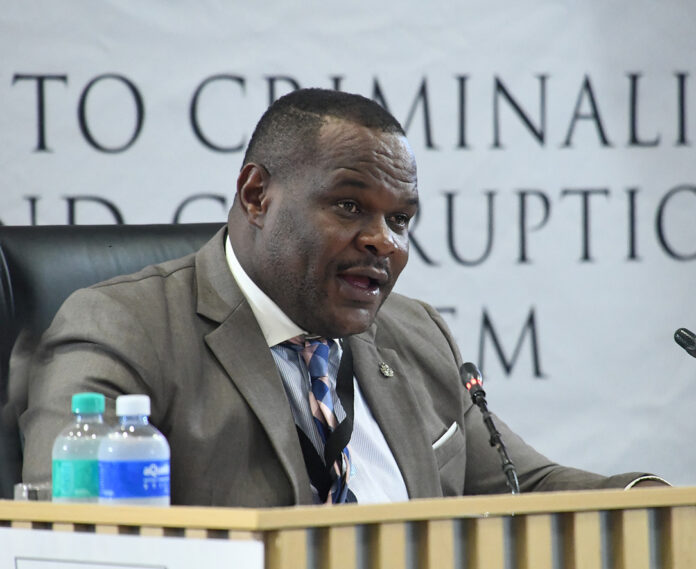
The credibility of language interpretation in South Africa’s justice system has again come under the spotlight after repeated translation lapses at the Madlanga Commission of Inquiry, where the chairperson, retired Justice Mbuyiseli Madlanga, was even forced to intervene to correct isiZulu interpretations.
The issue surfaced during the testimony of suspended police sergeant Fannie Nkosi, who openly challenged the accuracy of translations, telling the commission that interpreters were not conveying his meaning correctly.
Proceedings were interrupted multiple times as errors were identified and corrected.
Language interpreters play a crucial role in the administration of justice. Last year, during the launch of a court interpreters’ robe programme, Justice and Constitutional Development Minister Mmamoloko Kubayi admitted that court interpreters are not merely linguistic
facilitators.
“They are guardians of constitutional rights, ensuring that every person, regardless of language, background, or ability, has meaningful access to justice. Your services are an integral part of the functioning of our courts without which justice would not be served,” she said
in October.
It’s not the first time that interpretation of events at a court sitting has sparked debate. Every once in a while, the matter will be thrust into the public sphere, sparking social debates about the importance of accurate and reliable translations.
In 2022, the issue of court interpretations was flagged during the Senzo Meyiwa trial, highlighting concerns about the potential impact of inaccurate translations on the fairness of the trial and the rights of the defendants and witnesses. Last year, the Justice and Constitutional Development Department confirmed there was a shortage of interpreters in some courts.
The provinces most affected by the shortages are Gauteng, Limpopo, the Eastern Cape, the Western Cape, the Free State, and KwaZulu-Natal. Furthermore, demand for interpreting services has also increased due to a growing number of foreign nationals in the country, with interpreters now required to provide translations outside South Africa’s 12 official languages.
When asked about the interpretation lapses at the Madlanga commission, the Department of Justice and Constitutional Development acknowledged the incident but insisted that existing quality control systems were robust. Speaking to Sunday World, departmental media liaison director Samuel Modipane said interpreters are sourced from an accredited pool, selected for their experience, credentials and proven track record in demanding legal environments.
“All four isiZulu interpreters were specifically sourced for the commission, with full consideration of the magnitude of the work. They are experienced professionals, most operating at court level, and had no prior complaints against them,” said Modipane.
He said training is conducted across all official languages and is aimed at standardising professional interpreting practice.
“While this approach promotes consistency, it also presents limitations, particularly in light of the linguistic complexity, idiomatic richness, and dialectal variation within Nguni languages,” he added.
The department requested detailed written accounts from the four isiZulu interpreters involved, asking them to outline the challenges they encountered and the factors that may have contributed to the lapses.
“The interpreters attributed the difficulties to the nature of interpreting requested by the commission, which involved selective or partial interpreting. They indicated that the commission expected them to interpret only portions of the proceedings rather than the full session, a practice that poses concentration challenges, as interpreters are not continuously engaged but are nevertheless required to render accurate interpretation when called upon.”
However, the department has initiated an internal review and intends to convene interpreters on its database for a professional briefing, using recordings from the commission as a reflective learning tool.
The matter has also drawn a firm response from the Pan South African Language Board (PanSALB), which cautioned that the issue points to deeper structural concerns.
Acting CEO Julius Dantile said, “What we need are adequately skilled and sufficiently resourced interpreters who go beyond literal translation to message-based interpreting that fully appreciates cultural nuances,” Dantile said.
PanSALB has highlighted a persistent shortfall in training, noting that some court interpreters lack formal qualifications in the discipline. The board continues to advocate for the full implementation of the South African Language Practitioners’ Council Act, aimed at regulating and professionalising the field.
South Africa’s longstanding reliance on fluent speakers, rather than formally trained interpreters, has further complicated matters, Dantile observed.
While ultimate accountability for interpretation failures rests with the Department of Justice and the judiciary, PanSALB remains an advisory voice, one that may yet shape corrective steps where language capacity proves insufficient.
The Madlanga commission is on recess and is scheduled to resume hearings on April 7.
- The credibility of language interpretation in South Africa’s justice system has again come under the spotlight after repeated translation lapses at the Madlanga Commission of Inquiry, where the chairperson, retired Justice Mbuyiseli Madlanga, was even forced to intervene to correct isiZulu interpretations.
- The issue surfaced during the testimony of suspended police sergeant Fannie Nkosi, who openly challenged the accuracy of translations, telling the commission that interpreters were not conveying his meaning correctly.
- Proceedings were interrupted multiple times as errors were identified and corrected.
- Language interpreters play a crucial role in the administration of justice.
- Last year, during the launch of a court interpreters’ robe programme, Justice and Constitutional Development Minister Mmamoloko Kubayi admitted that court interpreters are not merely linguistic facilitators.