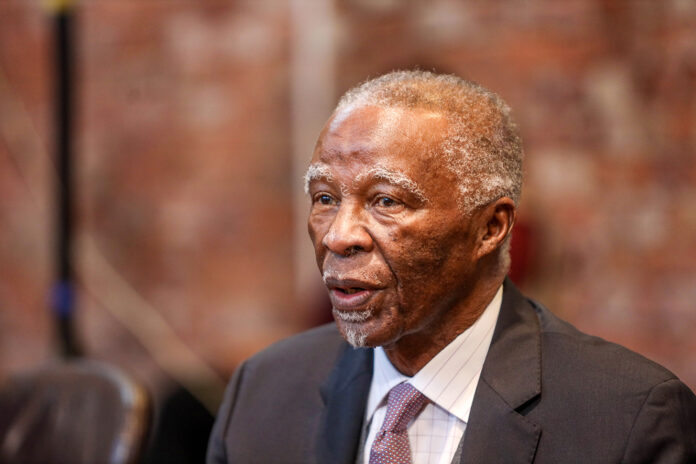

Former president Thabo Mbeki is in the firing line of the South African Communist Party (SACP), which accuses him of being the mastermind behind a hostile ideological line against the party that could split the ANC-led alliance partners.
The criticism in SACP general secretary Solly Mapaila’s article, published in the party’s official discussion pamphlet, Bua Komanisi, released on Friday, links Mbeki to the contested “Crossroads” document discussing the alliance.
The document, a political paper first circulated in 2025, sets out arguments on the future of the ANC’s alliance with the SACP and Cosatu, including proposals on how power and leadership within the alliance should be structured.
In the article, Mapaila identifies Mbeki as the “principal architect” of the positions contained in the document, although he is not listed among its authors. Mapaila writes that the arguments advanced in the document reflect positions Mbeki has put forward in public engagements, around the time of its circulation.
According to Mapaila, the document advances a position that separates the National Democratic Revolution (NDR) from the pursuit of socialism and places the leadership of the NDR within the ANC.
He states that this approach removes the SACP from a leadership role in the NDR and limits its political participation within the alliance.
Mapaila further writes that the document raises the prospect of a “clash” or “confrontation” between the ANC and the SACP if the party proceeds with plans to contest elections.
He rejects claims in the document that the SACP seeks to “capture the ANC” or advance positions aligned with counter-revolutionary interests, describing these as unfounded.
The article also criticises the method used in the Crossroads document, stating that it relies heavily on extensive quotations, including material associated with Mbeki, and does not provide an independent analysis of the issues it raises.
Mapaila writes that the positions contained in the document do not reflect outcomes of alliance processes, including discussions on the reconfiguration of the alliance.
He maintains that the NDR is a shared programme of all alliance partners and cannot be assigned to a single organisation.
While raising concerns about the document, Mapaila describes Mbeki as an “honourable and eminent person”, and states that engagement with the issues raised remains necessary.
The dispute centres on the structure and direction of the alliance, with differences focused on the role of its partners and the approach to participation.
Mapaila writes that the Crossroads document “serves as the entry point or launch pad” for what he describes as a broader polemic against the SACP, adding that its opposition to the reconfiguration of the alliance frames its overall argument.
He states that the document contains sections, including one on “ANC policy on the Alliance” and an “Epilogue”, which reinforce its position on the role of alliance partners.
Mapaila argues that the text advances “the argument of the ‘clash’ or ‘confrontation’” based on a separation of the NDR from socialism and the removal of the SACP from that programme, which he says is not supported by alliance history or practice.
He writes that the suggestion of a confrontation ignores the SACP’s long-standing position within the alliance, stating that the party’s decision to contest elections follows years of engagement on reconfiguration and is not aimed at undermining the ANC.
Mapaila further states that the Crossroads document advances what he calls “scaremongering”, including allegations that the SACP seeks to capture the ANC, which he says exist “only in the minds” of those promoting the argument.
Mapaila also writes that the Crossroads paper “relies too heavily on quotation mining and copy and paste”, rather than offering what he describes as an “accurate account” or original analysis of the material it cites.
He says the document is “emotionally charged rather than demonstrating analytical clear-headedness”.
According to Mapaila, this approach portrays the SACP as a threat within the alliance, rather than engaging with its positions on policy and strategy.
Mapaila writes that attempts to assign leadership of the NDR exclusively to one partner are “authoritarian” and risk deepening divisions within the alliance.
He maintains that the alliance has historically been built through collective struggle and engagement and that its future direction should be determined through joint processes rather than unilateral positions.
The article forms part of a broader intervention by the SACP on alliance relations, as debates continue over its reconfiguration and the role of its constituent organisations ahead of upcoming elections.
Visit SW YouTube Channel for our video content
- The South African Communist Party (SACP) accuses former president Thabo Mbeki of masterminding a divisive ideological stance against the party, linked to the controversial 2025 “Crossroads” document on the ANC-led alliance’s future.
- SACP general secretary Solly Mapaila identifies Mbeki as the principal architect of the document’s position, which separates the National Democratic Revolution (NDR) from socialism and centralizes its leadership within the ANC, sidelining the SACP.
- The Crossroads document is criticized for lacking original analysis, relying heavily on quotations, and promoting unfounded fears of the SACP seeking to “capture the ANC” or causing a confrontation.
- Mapaila insists the NDR is a shared project among alliance partners, rejecting exclusive leadership claims as authoritarian and warning against alliance divisions caused by such positions.
- Despite the criticism, Mapaila acknowledges Mbeki’s stature and calls for continued engagement on alliance direction, amidst ongoing debates over alliance reconfiguration and partner roles ahead of elections.