
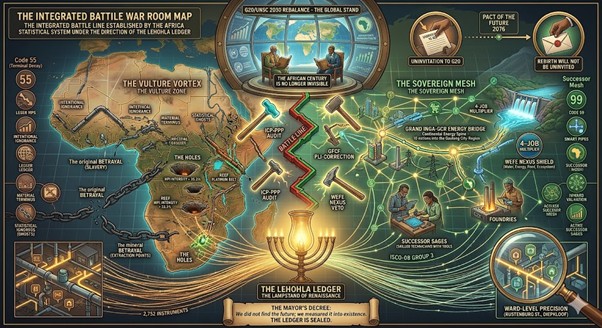
The Lehohla Ledger is a high-order diagnostic framework and “numerical conscience” designed to transition Africa from an extraction point to a sovereign mesh. It is anchored by Lenaka la Morena Mohlomi – a sage who mentored Morena Moshoeshoe – the founder of the Basotho nation.
Forged from longitudinal census data and forensic audits, it utilises 2 752 specific instruments to measure the “marrow” of society at the ward and household level.
By moving beyond deceptive national averages, the Ledger identifies subterranean infrastructure failures and calculates the real purchasing power parity (PPP) of the “Invisible People.” It serves as a lampstand for the African Renaissance, ensuring that development is built on valid metadata rather than political guesswork answered. “Invisibility is not a state of being; it is a crime of measurement.”
In his seminal 2026 work, The Invisible People, Phuthuma Nhleko issues a jarring disruption to the comfort of the “arrived” elite. He warns that by 2050, one in four people on Earth will be African, yet the global geopolitical lens renders them effectively invisible –their assets uncounted, their labor unvalued, and their dignity “vented” into the global vacuum.
Fifty years since the fires of Soweto 1976, we stand at a precipice. As we look towards the next fifty years, we must ask: where will it all end? If the current trajectory – the “uninviting” of South Africa from the G20 tables and the tactical vacillation of Northern powers – is any indication, the next half-century risks being a sophisticated continuation of the colonial project. To address this scandal of invisibility and the looming 2050 Abyss, we must deploy the 2 752 instruments of the Lehohla Ledger.
The genealogy of extraction: 500-Year covenant of non-betrayal
We cannot discuss Nhleko’s 2050 Abyss without auditing the route that paved it. The current “invisibility” of the African person is not a contemporary accident; it is the legacy of a five-century-old supply chain of extraction. The slave trade was the original “material terminus,” where the African body was the first commodity extracted to build the capital of the North.
This path paved the logistical and financial routes that would later be used to vent Africa’s minerals. The “Holes” we see today in Kimberley or the Reef are the direct descendants of the slave ships. Today, that extraction is geopolitical. The “vacillation” around South Africa’s seat at the G20 – particularly against the backdrop of global opposition to unprovoked conflicts – is the 21st-century version of the same dehumanisation. It is a sign of a structural covenant among global powers who refuse to backstab each other when faced with the necessity of keeping Africa invisible.
Geopolitics: ‘Tsoeu ha li tsoane’ and the G20 tightrope
Morena Moshoeshoe I, the master weaver of the Basotho nation, understood this geopolitics with a bone-deep realism. He famously observed: “Tsoeu ha li tsoane.” In the precision of Sesotho, this carries the weight of a tactical warning: White people will never betray each other.
Moshoeshoe noted that colonial powers “clubbed together” whenever the goal was to diminish African power. Today, we see this clubbing in the G20 halls. Macron kowtows to Washington while tip-toeing a tightrope regarding South Africa’s representation. The message is visible: the North remains a coalition that, despite internal differences, acts with a united, selfish intent toward African sovereignty. They will not betray their shared interest in African invisibility, because that invisibility is what keeps the price level index of their own development low. To expect a betrayal of this unity is to ignore the history of the “hole.”
The forensic of the ‘holes’
To understand the physical result of this non-betrayal, we must perform a forensic audit of the places where Africa’s wealth was born but where its people remain “statistical ghosts.”
- The Big Hole (Kimberley) and the Gold Fields (Free State/Reef)
These were the original mineral extraction points. Billions were vented, creating the “Lesser Ledger” of colonial prosperity.
- The multidimensional poverty index forensic: In these mining peripheries, the Headcount (H) of poverty may seem stable, but the Intensity (I) is the danger. When the Intensity of Deprivation—the average share of weighted indicators—exceeds the 33.3% threshold, the community is officially poor.
- The Dilemma: Many in the shadow of the mines live in the “Vulnerability Zone” (20%–33.3% deprivation). They aren’t counted in the global “poverty headcount,” making them invisible, yet they lack the Numerical Conscience of safe water, energy, or digital access. They are the leftovers of a global coalition that refuses to betray its own prosperity for the sake of African dignity.
- The Coal Fields (KZN) and the Platinum Belt
Despite being the “energy heart,” the intensity of poverty in these wards often spikes to 45% or higher.
- The correct reading: These communities are multidimensionally poor because they have crossed the one-third weighted deprivation threshold. They are deprived in the WEFE Nexus – water, energy, and food.
- The scandal: We protect the mines with ferocity but leave the subterranean mesh of the surrounding wards to rot.
The Ledger as the lampstand vs the drunkard’s support
The Ledger is often mistaken for a tool to “support” failing administrations. It is not.
- The drunkard’s support: A drunkard uses a lampstand to stay upright while remaining in the dark. This is the “Lesser Ledger” – using data to justify failure or to “tip-toe” around global powers while the people suffer.
- The lampstand for the renaissance: The Lehohla Ledger is the lampstand that provides light. It illuminates the “holes” so we can fill them. It provides the numerical truth required for the asset rebirth, moving us from an extraction point to a sovereign mesh. We stop expecting the north to “betray” its interests for our benefit and start building our own floor.
The pact of the future: 2076 and the African rebirth
The 2024 pact of the future calls for a “redress of the historical injustice against Africa.” This matters because, without the 2,752 instruments, the pact is just more euphemistic diplomatic theatre. As we mark fifty years since 1976, we must reset the clock. What will the world look like in 2076?
Nhleko’s Invisible People warns that without a reset in identity, economy, and geopolitics, Africa will remain a “data poor buffer” surrounded by the prosperity of others. We must use the G20 presidency (2025/2026) to prove that the PPP of our “invisible people” is the only collateral for a stable global economy.
The Lehohla verdict
The Ledger Said: “We must tell no lies and claim no easy victories.“ Morena Moshoeshoe I was correct: Tsoeu ha li tsoane – they will never backstab each other to save us. Our only defence is the sovereign mesh.
The rebirth begins when we stop waiting for an invite and start stabilising the mesh at the doorstep of the ward – a 2.8-million forensic of connected nodes across the African continent representing the 1,4-million individuals is now under construction by the Lehohla Ledger.
The South African one is complete and the Ledger can proudly announce. From the Big Hole to the United Nations Statistical Commission and the United Nations Security Council, the coordinates are poised to knock for justice. We are the master weavers of the 2050 reality
- Dr Pali Lehohla is a Professor of Practice at the University of Johannesburg, a Research Associate at Oxford University, and a distinguished Alumni of the University of Ghana. He is the former Statistician-General of South Africa.
Visit SW YouTube Channel for our video content
- The Lehohla Ledger is a comprehensive diagnostic framework using 2,752 instruments to reveal Africa’s hidden socio-economic realities at a granular level, aiming to shift the continent from extraction to sovereign self-determination.
- It exposes how historical and ongoing invisible extraction—from slavery to mineral mining and geopolitical exclusion—renders African populations as "statistical ghosts," undervaluing their real purchasing power and dignity.
- The framework challenges geopolitical dynamics, especially the G20’s unified exclusionary tactics ("Tsoeu ha li tsoane"), which maintain African invisibility to protect Northern economic interests.
- The Ledger highlights critical poverty and deprivation in mining regions and energy zones, revealing multidimensional poverty that international metrics often overlook, underscoring the scandal of neglect despite abundant resource wealth.
- Urging a strategic redress by 2076, Dr. Pali Lehohla calls for an African rebirth through sovereign data sovereignty and grassroots empowerment, rejecting reliance on global powers’ goodwill and instead building an authentic, numerically conscious foundation for the continent’s future.