The 2026 Investing in African Mining Indaba was not only about minerals, deals and policy debates. It also became a live demonstration of how Africa’s mining, energy and automotive sectors are beginning to converge. The event was held at the Cape Town International Convention Centre from Monday, February 9 to Thursday, February 12, 2026.
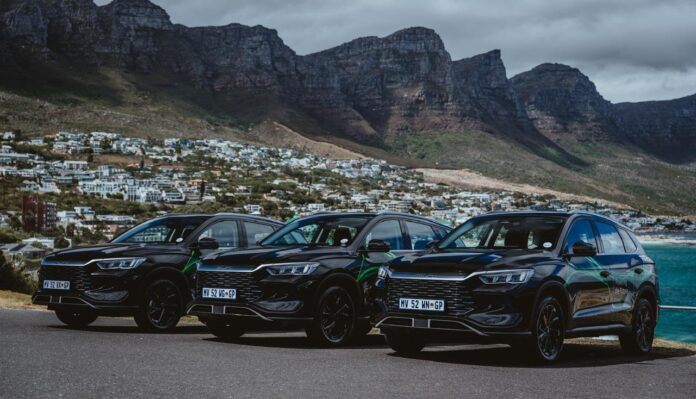
Chinese new-energy vehicle giant BYD South Africa, together with mobility solutions partner Drive Electric, served as Discovery Green’s official transport partner. It deployed a fleet of fully electric and plug-in hybrid vehicles to chauffeur delegates, policymakers and mining executives throughout the conference.
Instead of the usual internal combustion engine (ICE) shuttle fleet, VIPs moved between venues in a convoy of 10 BYD Sealion 5s, five Dolphin Surf models, two Shark 6 bakkies and two Sealion 6 SUVs. This offered a mix of executive, passenger and utility vehicles suited to the high-pressure logistics of Africa’s largest mining gathering.
But beyond the premium experience, the initiative spoke directly to deeper conversations that unfolded at the Indaba.
From Minerals to Mobility
Across panel discussions and industry engagements, automotive bodies such as the African Association of Automotive Manufacturers (AAAM) and the Automotive Industry Transformation Fund (AITF) emphasised the urgent need to link Africa’s mineral wealth to downstream industrialisation.
Copper, lithium, manganese and battery minerals—abundant across the continent—are critical inputs in electric vehicles and charging infrastructure. The message from industry leaders has been clear: Africa must move beyond exporting raw materials and instead build integrated automotive value chains under the AfCFTA Automotive Strategy.
In that context, BYD’s electric fleet was more than transport. It was a tangible illustration of what beneficiation and localisation could look like if mining outputs are channelled into battery manufacturing, wiring harnesses, copper components and EV assembly on African soil.
Real-World Execution
Dan Ginsberg, Executive Director of Discovery Green, said the project was about implementation rather than symbolism.
“This initiative is less about optics and more about proof of concept. We demonstrated that electric mobility can operate reliably in a high-demand, time-critical environment like Mining Indaba,” he said.
Steve Chang, Managing Director of BYD South Africa, added that mining, energy and mobility are “deeply interconnected”. Particularly as global supply chains pivot toward electrification.
Drive Electric handled fleet management, charging logistics and driver operations. It proved that EV deployment at scale is operationally viable in South Africa today.
A Scalable Industrial Blueprint
For the AITF and other transformation advocates, the bigger opportunity lies in scaling such deployments while aligning them with localisation and supplier development programmes. Event mobility, corporate fleets and mining transport could become early adoption platforms for electric vehicles assembled – and increasingly component-sourced—in Africa.
If copper from African mines can feed regional wiring harness production, and battery minerals can anchor gigafactory investments, initiatives like this may represent the first visible layer of a much larger industrial shift.
At Mining Indaba 2026, the future of mobility did not sit in a policy document. It quietly transported delegates between meetings powered by electrons. And perhaps more importantly, by a growing vision of African industrial integration.