


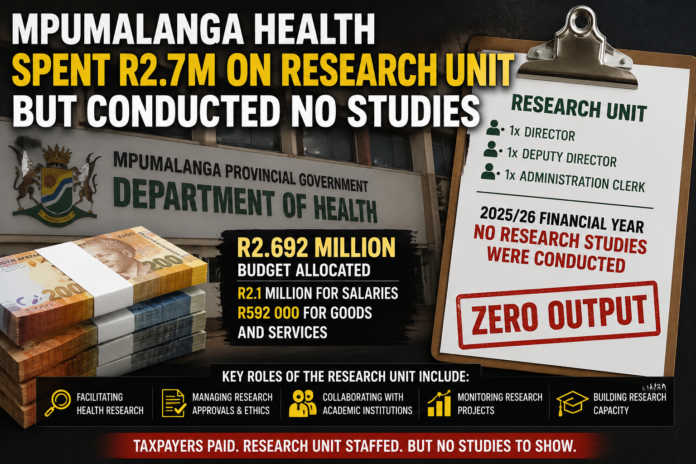
The Mpumalanga Department of Health paid three researchers a combined R2.1-million during the 2025/2026 financial year, but not a single research study emerged from the unit during the period.
The startling revelation is contained in the department’s own written responses to Parliament’s Portfolio Committee on Health, where officials admitted that despite maintaining a dedicated research unit and spending nearly R2.7-million on its operations, “no research studies were conducted during the 2025/2026 financial year”.
Nothing to show for it
In simple terms, taxpayers forked out millions to keep a research office running, yet the department has nothing in the form of a completed research study to show for an entire financial year.
The disclosure has raised fresh questions about accountability inside a department responsible for hospitals, clinics, emergency medical services, disease surveillance, maternal and child health programmes, HIV and TB interventions, and long-term health planning.
Ordinarily, a provincial health department of this size would be expected to produce multiple research projects, service-delivery evaluations, epidemiological studies and partnerships with universities to help guide policy and improve patient care. Instead, the department told Parliament that no studies were undertaken at all.
Big chunk of budget on salaries
The documents show that the department’s research unit consists of a director, deputy director and administration clerk, with an operational budget of R2.692-million. Of that amount, R2.1-million was spent on salaries, while R592,000 was allocated to goods and services.
The admission has sparked outrage from the Democratic Alliance, which has called on the Public Service Commission (PSC) to investigate what it describes as a wasteful use of public funds.
Mismatch between expenditure and performance
DA health spokesperson in the Mpumalanga Legislature, Bosman Grobler, said the figures revealed a troubling mismatch between expenditure and performance.
“This literally means that the DoH’s three staff members were paid R2.1 million in the last financial year for doing nothing,” said Grobler.
He argued that the lack of research was particularly concerning at a time when health authorities are expected to remain vigilant against disease outbreaks and emerging health threats.
“This is unacceptable, especially with outbreaks of the coronavirus, monkeypox, as well as the recent Hantavirus. The department should be on top of its research to ensure that the province is responsive to potential outbreaks and protects not only its citizens, but its medical personnel too.”
The department’s own submission describes the research unit as a key mechanism for generating and translating evidence into practice to improve healthcare outcomes.
Among its responsibilities are facilitating health research, managing research approvals, ensuring compliance with governance frameworks, promoting priority-driven research, collaborating with academic institutions, monitoring ongoing projects, promoting the use of research findings to strengthen service delivery and building research capacity through training.
Grobler argued that the absence of any research output raises questions about whether those responsibilities were fulfilled during the year under review.
DA calls for full investigation
“The DA wants the PSC to intervene and investigate this matter. We believe that there is a case to answer here,” he said.
The only research study cited by the department was an internal project conducted during the 2024/2025 financial year on the implementation of the Complaints, Compliments and Suggestions Guidelines.
According to the department, the findings led to training interventions for healthcare workers and quality assurance managers on complaint management and quality improvement plans.
No further studies were conducted during 2025/2026.
The department has, however, indicated that two research studies are planned for the current 2026/2027 financial year as part of efforts to strengthen service delivery, policy implementation and programme improvement.
The revelation is likely to invite further scrutiny from legislators over the value derived from the unit’s budget allocation and whether taxpayers are receiving an adequate return on the province’s investment in health research capacity.
- Mpumalanga Department of Health spent R2.1 million on salaries for three researchers in 2025/2026 but produced no research studies during that period.
- The research unit had an operational budget of R2.692 million but delivered no output despite responsibilities like health research facilitation, compliance, and collaboration with academia.
- The Democratic Alliance called for a Public Service Commission investigation into alleged wasteful spending and poor accountability amid ongoing health threats like coronavirus and monkeypox.
- The last research project cited was from 2024/2025 on complaints management, leading to staff training, with no studies done in 2025/2026; two studies are planned for 2026/2027.
- The lack of research output raises concerns about the department’s use of funds and its capacity to support evidence-based health policy and service delivery improvements.


