
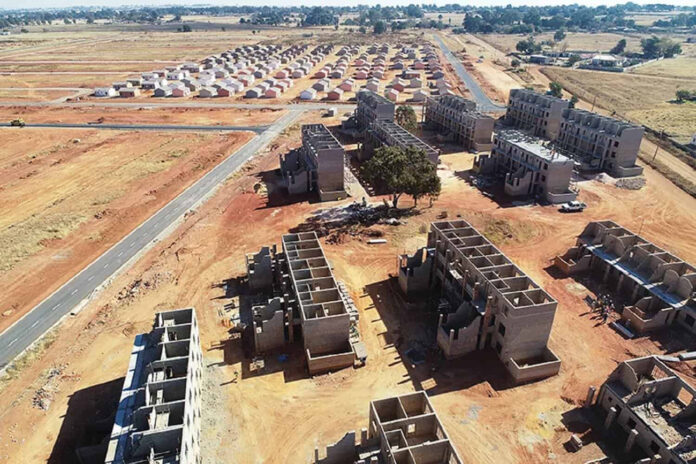
The collapse of Gauteng’s R11-billion Montrose City Mega Development housing project was driven by the municipality’s failure to fund and deliver critical bulk infrastructure – not by any misappropriation of billions of rands by the developer, according to a R164-million damages claim now before the Johannesburg High Court.
In the summons filed against the Rand West City Local Municipality in Randfontein, dated March 16, the developer, Resilient Rock (Pty) Ltd, and its funding partner Mega Projects Infrastructure Finance (Pty) Ltd, set out a detailed account of how the project stalled, alleging that key contractual obligations were not met by the local authority.
Funding constraints
“The first defendant [municipality] was responsible for the provision and/or funding of external engineering services required for the development,” the 93-page particulars of claim state.
These services – including sewer, water, electricity, stormwater systems and roads – were essential to unlock the large-scale housing development.
According to the developer (the plaintiff), progress was made despite these constraints, with infrastructure installed at its own cost.
“The Plaintiffs undertook and completed engineering services… at a value of approximately R74,391,435.00,” the summons reads.
Developer ‘played his part’
The developer completed installations totalling R74.3-million, including pipe jacking underneath the railway line for electricity access totalling R6.9-million, pipe jacking underneath the railway line for bulk sewer access totalling R6.9-million, and link roads and stormwater works of 16 metres to 20 metres wide on Montrose Extension 3 and 4 totalling R48 262 500.
Additions included an electrical bulk line from Mohlakeng to Montrose Substation totalling R2 087 250; electrical bulk line professional fees totalling R2 543 014.95; and a bulk water connection to the Montrose Project totalling R7 698 838.81.
Municipality pulls the plug
Regarding the damages suffered, the summons states: “The plaintiff has suffered damages arising from the termination of the agreement and, more particularly, the loss of profit that the plaintiff would have made on the development of 759 municipal-serviced stands under the Montrose City Mega Development in the sum of R90-million, which is calculated at 20% of the total development costs for the stands of R455-million.”
The turning point, according to the court papers, came when the municipality acknowledged it could not meet its financial obligations. “On or about 10 March 2022, the first defendant advised that it did not have the financial resources to fund the bulk services,” the summons states.
DBSA raises hopes
In response, a funding mechanism was pursued through the Development Bank of Southern Africa (DBSA), with a third party appointed to raise capital. “The Second Plaintiff was appointed… to source funding for the bulk infrastructure on behalf of the first defendant,” the papers state.
The developer says the process initially progressed, with DBSA acknowledging applications and moving the project forward. “DBSA confirmed receipt of the funding application of R228-million and later approved the project to proceed to due diligence,” the summons states.
Municipality ‘scuttles DBSA deal’
But the funding process ultimately collapsed – a failure the developer squarely attributes to the municipality. “The first defendant failed to provide the required documentation and/or to conclude the necessary agreements,” the summons alleges. “As a result of the first defendant’s breach, the agreement was terminated,” the papers add.
The developer is now seeking damages, including compensation for completed works and lost profits.
Developer cleared of unlawful activities
The claims in the summons are consistent with findings in a liquidation inquiry into the developer’s company, which previously examined the causes of the project’s collapse.
According to the report, the developer was “cleared of unlawful activities”, with no contraventions of company law identified. Instead, the liquidator pointed to infrastructure failures as the central issue, stating that the company “experienced severe difficulties due to the inability of the local city council to provide bulk services such as electricity, sewerage [and] water”.
Funds ‘not looted’
The report further found that this failure “resulted in it being unable to continue with the development”, directly linking the project’s collapse to municipal constraints rather than financial misconduct. It also challenged the widely circulated claim that an R10bn or R11bn budget had been looted, noting that actual government disbursements were significantly lower.
The developer’s position has also been strengthened by a separate legal battle that reached the Supreme Court of Appeal. In Resilient Rock (Pty) Ltd v Voltex (Pty) Ltd, a Bidvest Group owned company, the SCA upheld an appeal in favour of the developer-linked company, after the high court found that the creditor had failed to prove commercial insolvency. The ruling effectively set aside attempts to secure a final winding-up order on that basis, providing legal backing to the company’s stance that it was not insolvent in the manner alleged.
The municipality has 20 days from service of the summons to file a notice of intention to defend. Should it fail to do so, the developer may seek default judgment.
Visit SW YouTube Channel for our video content


