


South Africa’s Constitution guarantees every citizen the right to free, fair and regular elections.
It requires an electoral system that results, in general, in proportional representation and an electoral commission that is independent, impartial and functions without fear, favour or prejudice. Behind these simple principles lies a logistical undertaking of extraordinary scale, one that is easy to overlook until it is measured.
The electoral register is now closed and South Africa has 29.2-million registered voters spread unevenly across nine provinces.
The Northern Cape, our largest province by area, holds just 2.4% of the electorate, while Gauteng, our smallest province by area, holds 23.1%, the largest share of any province.
There are almost 24 000 voting stations with, at one extreme, 93 voting districts each having more than 6 000 voters; at the other, 19 201 voting districts have fewer than 1 000 voters each.
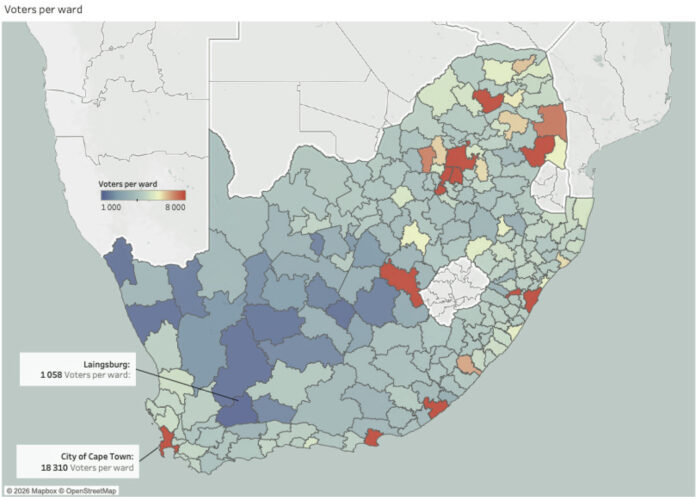
In Johannesburg, the Electoral Commission of South Africa (IEC) manages 862 voting districts averaging just 2km2 each, with roughly 2 806 voters apiece. In contrast, in Hantam, Northern Cape, there are only 23 voting districts, each covering almost 1 700km2, with an average of 643 registered voters.
The voting districts are combined into wards in each municipality and significant differences are found across the country.
Running a free and fair election across this terrain, from dense metros to some of the emptiest land in the country, is no small feat and it is worth appreciating the IEC’s work before turning to how the results have played out.
When our Constitution was negotiated, all major parties eventually accepted that a proportional system suited South Africa better than the first-past-the-post model that had underpinned apartheid rule.
Three decades on, that choice has produced one predictable consequence: a growing tendency towards hung legislatures where no one party gets more than 50% of the seats.
This is because proportionality means every vote cast has a good chance of translating into a seat and democracy allows voters and politicians to change allegiance freely.
South Africa leads the world in ensuring proportionality. The 2021 local government elections illustrate the pattern well. A record 324 parties and 1 550 candidates contested and turnout was a modest 46%.
Nearly half the contesting parties won no seat. Of the 1 550 independent candidates who stood in wards, only 51 succeeded. The ANC, DA, EFF and IFP dominated the results nationally but as can be seen in the figure below, the number of hung municipalities has increased over the past five elections.
From 2000 to 2021, isolated pockets in the Western Cape and Northern Cape two decades ago have given way to a far wider footprint stretching also across Gauteng, KwaZulu-Natal, the Eastern Cape and beyond.
Today, of our eight Category A metros, only Cape Town, Buffalo City and Mangaung have a single party in outright control; Johannesburg, eThekwini, Tshwane, Ekurhuleni and Nelson Mandela Bay are all hung councils, along with more than 70 other municipalities.
Hung councils are not automatically unstable.
eThekwini’s minority government after the 2000 elections, in which we served, achieved real stability because its executive committee drew members from the ANC, DA, IFP and Minority Front alike, disagreeing openly on matters such as the budget while cooperating on delivery.
However, in many larger municipalities, coalitions built around “kingmakers”, small parties trading their support for personal advantage, have turned councils inward, working against the Integrated Development Plans meant to guide service delivery for all.
If the results of the 2024 national and provincial elections were repeated at local level, our Category A metros would look much as they do now but the number of hung local municipalities would increase.
Coalition government is not a passing phase in South African politics. Instead, based on current trends, it is probably our future for many elections to come.
This is not, in itself, cause for alarm. Hung councils can govern well when parties commit to transparency and to serving residents rather than themselves. Before the polls, parties should publish coalition principles that voters can hold them to.
Hung councils should get a statutory extra month to conclude coalition agreements before electing speakers and mayors, so horse-trading does not crowd out good governance.
Except for positions such as the municipal manager, appointments should be legislated out of party bargaining altogether, with administrations continuing to run under professional heads while negotiations proceed. Budgets should stay tied to Integrated Development Plans, not coalition deals, and every agreement should be signed publicly.
Democracy is certainly under strain worldwide. More than 50 democracies are backsliding on at least one recognised measure, and unconstitutional transfers of power remain a live risk on our own continent, often fuelled by public frustration with corruption and self-serving leaders.
South Africa’s proportional system has served us well over 30 years of building a non-racial, non-sexist and united country but its continued success depends on how seriously voters, parties and communities participate in the coalitions it inevitably produces.
That is precisely why the municipal elections on November 4 deserve to be taken seriously. Now that we have had the chance to update the voters roll, our next real step will be to become informed about who the candidates and parties will be.
This opportunity comes soon as party lists and nomination of ward councillors must be done by August 28, 2026. On September 16, 2026, the lists will become available. Soon after, on September 21, special votes can be applied for.
Your vote will not simply decide who sits in council chambers; it will determine which parties must learn to share power, how transparently they do so, and whether the basic services residents depend on get delivered or get lost in the horse-trading.
•Dr Sutcliffe is co-director of City Insight, a firm that provides information and advice on development issues. He’s a former city manager of eThekwini Metro
•Bannister is co-Director of City Insight and a development consultant with experience in urban planning and policy development
•McGahey has over 20 years’ experience in planning and development and project management.
- South Africa has 29.2 million registered voters distributed unevenly across nine provinces, with Gauteng holding 23.1% and Northern Cape 2.4% of the electorate.
- There are nearly 24,000 voting stations, with voting districts varying from over 6,000 voters to fewer than 1,000 voters each, reflecting significant geographic diversity.
- The proportional representation electoral system in South Africa has led to an increasing number of hung councils, with only three of eight Category A metros under single party control following the 2021 local elections.
- The 2021 local elections featured 324 parties and 1,550 candidates with a 46% voter turnout, but nearly half the parties won no seats and only 51 independent candidates were successful.
- Coalition governments are expected to continue in South Africa, necessitating transparency, public coalition agreements, and statutory changes to improve governance and service delivery.


