South Africans are frustrated, and with good reason. Corruption scandals, violent crime, slow economic growth and persistent inequality have tested the patience of even the most loyal believers in the country’s democratic promise. Public debate has become sharper, more impatient and, at times, more unforgiving, threatening the “Rainbow Nation”.
That is not entirely a bad thing. Democracies need scrutiny. Governments must be held accountable. Citizens have every right to demand more and better from those entrusted with public power.
But amid this justified anger, a dangerous temptation is beginning to surface in the political discourse: the impulse not only to criticise the government of the day but also to dig up the very democratic foundations that made South Africa’s freedom possible. In recent months, calls for external intervention and international pressure have grown louder, with some citizens appealing to foreign governments over claims that are often poorly substantiated. The frustration behind such appeals is understandable. Yet inviting outside actors into domestic political disputes is a perilous path for any democracy. Many governments elsewhere would respond far more harshly to such actions, escalating tensions rather than containing them. South Africans must tread carefully.
This instinct, however emotionally driven, deserves serious caution.
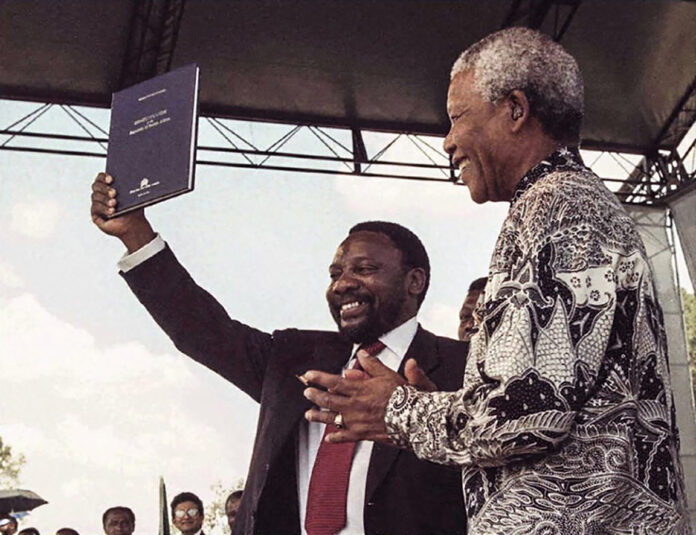
South Africa’s constitutional order did not emerge by accident. It was painstakingly constructed through negotiation, restraint, and an extraordinary commitment to principle by leaders who understood that a responsibility to the future must sometimes temper victory in politics.
The democratic system that emerged in 1994 remains one of the most remarkable political settlements of the modern era – a peaceful transition from institutionalised racial domination to universal suffrage and constitutional equality.
At the centre of that transition stood the ANC, the principal liberation movement that led the struggle against apartheid and ultimately negotiated the democratic settlement.
The situation was volatile, and things could have easily gone wrong, but tolerance and reconciliation prevailed. Thanks in large part to the ANC’s policies grounded in ubuntu.
That historical role does not exempt the party from criticism today. It should never. The ANC, like any governing party anywhere in the world, must answer for failures of governance, corruption within its ranks and the frustration many South Africans feel about the pace of economic transformation.
Yet criticism should not slide into historical amnesia.
There is a difference between demanding reform and dismantling the legitimacy of the democratic project itself. The former strengthens democracy; the latter risks weakening the very institutions that guarantee our freedoms.
Despite immense pressures over the past decade – internal factional battles, public scandals, economic headwinds, geopolitical upheavals and relentless political contestation – South Africa’s democratic architecture has largely held.
Courts have continued to function independently. Elections remain competitive and credible. Opposition parties campaign freely, and the country’s media institutions are among the most robust on the continent.
This resilience did not happen by accident. It reflects a continued – even if sometimes imperfect – commitment by the state and the governing party to operate within the constitutional framework rather than outside it.
In an age where democratic norms are diminishing in many parts of the world, that commitment should not be taken lightly.
Across several countries, governments have responded to political pressure with heavy-handed tactics – weakening judicial independence, restricting media freedom, and eroding constitutional guardrails.
South Africa, for all its challenges, has resisted that slide. This restraint matters.
It means that when corruption is exposed, institutions are capable of investigating it. When elections occur, they remain credible. When citizens challenge government decisions, they can do so within a functioning legal system. These are not small achievements. They are the pillars that sustain democratic life.
The task before South Africa, therefore, is not to demolish this democratic house but to repair and strengthen it.
Refurbishing the house of democracy is necessary. Digging up its foundations is reckless.
Renewal is essential. But reform must operate within the constitutional framework that protects freedom, equality, fundamental rights and human dignity. If we weaken those foundations in pursuit of short-term, narrow political victories, we may discover too late that the entire structure becomes unstable.
The ANC itself carries a particular responsibility in this regard. As the founding liberation movement of the democratic era, it cannot rely indefinitely on historical legitimacy alone.
History may explain its political prominence, but the future will judge it on competence, integrity and its ability to adapt to a changing society.
That responsibility extends beyond South Africa’s borders.
Across Southern Africa, several liberation movements once held the moral authority to rule. They face similar pressures of generational change, governance expectations and economic modernisation.
Parties such as Swapo in Namibia, Frelimo in Mozambique, MPLA in Angola and Zanu-PF in Zimbabwe confront variations of the same question: transforming themselves into modern governing institutions capable of meeting the economic and political expectations of a new generation.
The ANC has both the opportunity and the responsibility to ensure its ethos and noble principles are upheld throughout the region. This does not mean abandoning history. On the contrary, it means honouring that history by ensuring that the values fought for – freedom, equality and human dignity – remain living principles rather than ceremonial slogans.
For South Africans, the moment calls for a mature political posture, guided by a brave and pioneering vision. Citizens must continue to demand better leadership, cleaner governance and more effective economic policy. That pressure is healthy and necessary in any democracy.
But in the process, we should resist the temptation to tear down the democratic framework that makes such criticism possible in the first place.
South Africa’s democracy was built through sacrifice, statesmanship and extraordinary temperament. It is not perfect, and it requires constant renewal. But it remains the platform upon which every demand for justice, reform and accountability stands.
Reform the house, certainly. Strengthen its walls. Repair its cracks. But do not dig up the foundations. Because those foundations – built through struggle, negotiation and restraint – remain the platform upon which South Africa’s democratic future still stands.
- Tshuma is an author and sociopolitical commentator who writes on governance, democracy and regional integration in Southern Africa.
- South Africans are frustrated, and with good reason.
- Corruption scandals, violent crime, slow economic growth and persistent inequality have tested the patience of even the most loyal believers in the country’s democratic promise.
- Public debate has become sharper, more impatient and, at times, more unforgiving, threatening the “Rainbow Nation”.
- That is not entirely a bad thing.
- Democracies need scrutiny.