


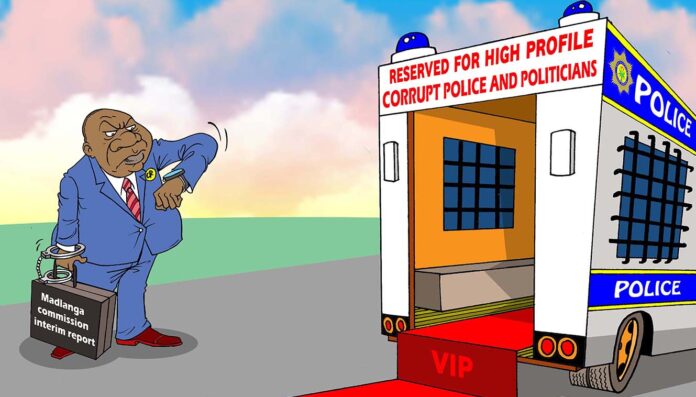
It was supposed to be an ordinary Sunday, on July 6 generally a slow news day, when KwaZulu-Natal police commissioner Lt-Gen Nhlanhla Mkhwanazi decided to call a press conference that would rattle the criminal justice system, exposing a deep-seated rot at its core.
Seven months before this moment, he revealed, Police Minister Senzo Mchunu had issued a letter authorising the disbandment of the political killings task team – a highly successful investigative unit responsible for cracking a series of cases involving high-profile murders in KwaZulu-Natal and other provinces.
The disbandment, Mkhwanazi asserted, was effected just as the crack unit had unmasked a drug cartel that involved politicians, top law enforcement officials, businesspeople and select members of the judiciary. It was a chilling revelation of how this cartel had effectively captured the core of the criminal justice system, up to the highest political level, allowing it to operate with impunity.
On May 14, he said, the same unit had arrested Vusimuzi “Cat” Matlala on three counts of attempted murder. Matlala was a beneficiary of a R360-million contract from the South African Police Service.
An analysis of electronic communication devices seized from the de facto syndicate leader revealed constant communication between Matlala and Brown Mogotsi, an associate of Mchunu’s. Mkhwanazi concluded that Matlala, through Mogotsi, was in essence funding the police minister’s political ambitions.
The country gasped in collective disbelief. President Cyril Ramaphosa was forced to act. He announced the formation of a commission of inquiry into the damaging allegations, to be chaired by retired Constitutional Court Justice Mbuyiseli Madlanga. He also placed Mchunu on special leave with immediate effect and appointed Firoz Cachalia to act in the portfolio. Testimony at the Madlanga commission has made for riveting viewing, as one by one, the implicated face a grilling that reveals the extent of their involvement in the rot.
On Thursday, Ramaphosa announced that he had received the Madlanga commission’s interim report and accepted its findings that there was a prima facie basis for a number of senior police officers and municipal officials to face possible suspensions, urgent investigations, and prosecutorial decisions. These include Maj-Gen Lesetja Senona; Maj-Gen Richard Shibiri; Brig Mbangwa Nkhwashu; Brig Rachel Matjeng; and Sergeant Fannie Nkosi – all of the SAPS.
In Ekurhuleni, the commission named suspended EMPD deputy chief of police commissioner Julius Mkhwanazi and former city manager Dr Imogen Mashazi as among those who should face possible criminal prosecution.
It should be noted that some of those named in the interim report are yet to testify before it. However, the report lays the basis for the police and the National Prosecuting Authority to act with urgency.
The criminal justice system is too important a state apparatus to be captured by greedy and corrupt officials who have no business calling themselves law enforcement officers or to be manipulated for the benefit of dodgy politicians.
- It was supposed to be an ordinary Sunday, on July 6 generally a slow news day, when KwaZulu-Natal police commissioner Lt-Gen Nhlanhla Mkhwanazi decided to call a press conference that would rattle the criminal justice system, exposing a deep-seated rot at its core.
- Seven months before this moment, he revealed, Police Minister Senzo Mchunu had issued a letter authorising the disbandment of the political killings task team – a highly successful investigative unit responsible for cracking a series of cases involving high-profile murders in KwaZulu-Natal and other provinces.
- The disbandment, Mkhwanazi asserted, was effected just as the crack unit had unmasked a drug cartel that involved politicians, top law enforcement officials, businesspeople and select members of the judiciary.
- It was a chilling revelation of how this cartel had effectively captured the core of the criminal justice system, up to the highest political level, allowing it to operate with impunity.
- On May 14, he said, the same unit had arrested Vusimuzi “Cat” Matlala on three counts of attempted murder.


