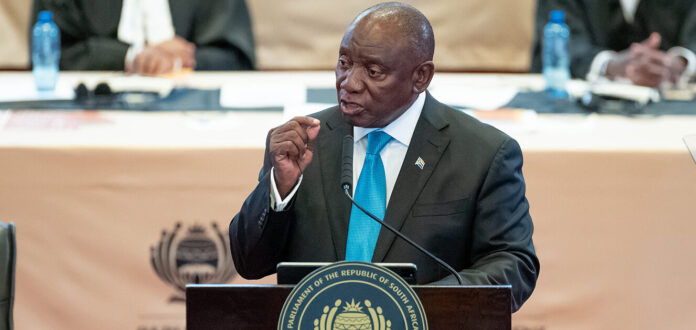
On Thursday night, President Cyril Ramaphosa delivered a State of the Nation Address (Sona), and for the first time in years, the speech was not dominated by the urgent management of crises – most notably, the load-shedding that has plagued the country – but by a narrative of stabilisation and long-term growth.
The president declared that South Africa is “leaving behind an era of decline and turning towards an era of prosperity and growth”. Yet, beneath the optimistic veneer of the government of national unity’s (GNU) first major policy outline lies a familiar challenge: the chasm between grand proposals and tangible delivery.
On economic revival, the president announced that Cabinet had approved a comprehensive implementation plan to drive growth and intensify a R1-trillion public investment in infrastructure over the next three years, aimed at transforming energy, water, transport, and digital infrastructure through innovative funding models and public-private partnerships.
To ensure these projects are not bogged down in litigation, the president proposed establishing specialised commercial courts to expedite dispute resolution.
However, while the macroeconomic picture is stabilising, the micro-reality for ordinary South Africans remains precarious. The administration correctly identified the immediate crisis point for millions: water. In response to protests over water cuts, he announced the creation of a National Water Crisis Committee, which he will personally chair, alongside R156-billion dedicated to water and sanitation infrastructure.
Yet, as political parties were quick to note, South Africa does not have a water scarcity problem – it has a municipal governance problem.
The establishment of another committee, without a concrete plan to fix the revenue diversion that plagues municipalities risks being merely a symbolic gesture.
Perhaps the most tangible intervention was reserved for the realm of law and order. Acknowledging the stranglehold of crime on communities and the economy, Ramaphosa announced the deployment of the South African National Defence Force to gang hotspots in the Western Cape and Gauteng, alongside the recruitment of 5 500 new police officers.
Ultimately, the 2026 Sona successfully painted a picture of a government that has moved from “crisis management to consolidation”.
The proposals for small business support, R2.5-billion for over 180 000 SMEs, and the review of the BBBEE framework aim to make growth more inclusive.
The president has laid out a coherent plan, but as the Organisation Undoing Tax Abuse aptly noted, “South Africa does not have a shortage of plans. We have a shortage of implementation.”
The true measure of this Sona will not be found in its rhetoric, but in whether the R1-trillion investment translates into a single functioning tap in Giyani or a secure job for a young person in the Western Cape.
Visit SW YouTube Channel for our video content