
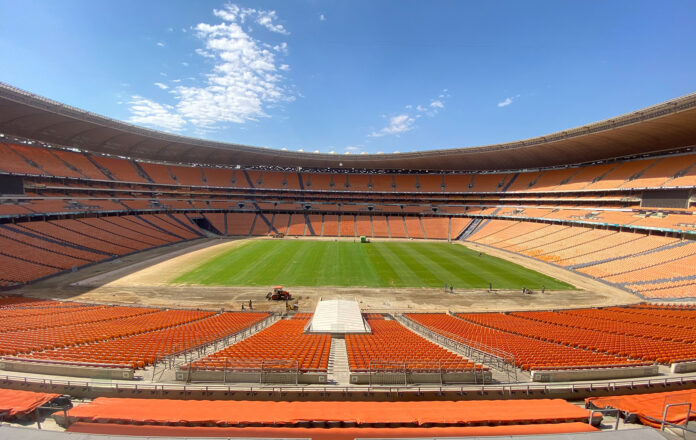
Now that the tickets for the Soweto derby, one of the continent’s biggest sporting spectacles have been sold out, the hard work and heavy lifting for the organisers starts.
The game may be in 13 days, on February 28, but the planning, implementation, and execution will need to be on point for the sake of South African football and, most importantly, for the safety of supporters.
The host team, Kaizer Chiefs, Stadium Management South Africa (SMSA), and law enforcement JMPD and the SAPS will have to be on the ball and ready to rumble. This is after there was a massive breach in security exactly a year ago.
Despite the stadium’s curtailed 87 000 capacity, for safety reasons, more than 100 000 spectators made their way inside the venue, raising serious safety concerns.
Many fans, especially those who swear by the skull and bones of the Buccaneers, will remember Patrick “Tito” Maswanganyi hoodwinking Chiefs goalkeeper with a cheeky, last-minute panenka penalty, but there were glaring operational challenges.
Slick bootleg and counterfeit merchants were nonchalantly conning unsuspecting patrons who were desperate to watch the match – some had travelled from far-flung provinces to come to the party. An additional 20 000 fans forced their way into the restricted sections, VIP, and media tribune.
But this time around, SMSA head honchos are talking a good game and seem up to the task.
SMSA CEO Bertie Grobbelaar has promised the fraudsters and troublemakers a tough day in the office. In fact, they have boldly declared that those without tickets are urged to watch the match from home and for safety reasons, supporters are advised not to gather near the stadium, as security will be on high alert.
The management company has spent a whopping R3.5-million on implementing a new ticketing technology called static mobile scanners. They say there will be three checkpoints to identify and block people with black-market tickets and those who attempt to gain access deceitfully.
And as part of rectifying the process, there will be a visual inspection at the first checkpoint. The second step will be a stop at the first static mobile scanner.
If the scan gives a red light, the ticket holder will be taken to a verification process to validate the ticket. The last scan will take place at the traditional stadium turnstiles, which will give fans entry into the venue if the tickets are legitimate. If the ticket is fake, the turnstiles will not open, and those fans will also be taken back to be authenticated.
The new system has been tested, and minor glitches were reported. It will be tested again in the Category A match between Pirates and Mamelodi Sundowns midweek, also scheduled to take place at FNB Stadium.
“What we wish to achieve is to stop fraudsters and chance-takers from coming to the stadium at all,” Grobbelaar told Sunday World recently.
“We did away with the system of till slips and tickets bought from garage stations and shop outlets. There’s no turning back on the era of digital ticketing
because the world is evolving in that direction,” he said.
“We now have fibre connectivity on all turnstiles. We also have a local server that is not dependent on cloud servers.
“We will also provide Wi-Fi hotspot connectivity and charging stations for those whose cellphone batteries are low.
“We will have functional devices, so we will be fully connected, and as time goes on, we will increase the number of scanners.”
Now, the fans must play their part and contribute to the expected razzmatazz by arriving early, hours before kick-off, so that a smooth procession from traffic outside the stadium to ticket check-points and into the venue can be efficiently administered.