


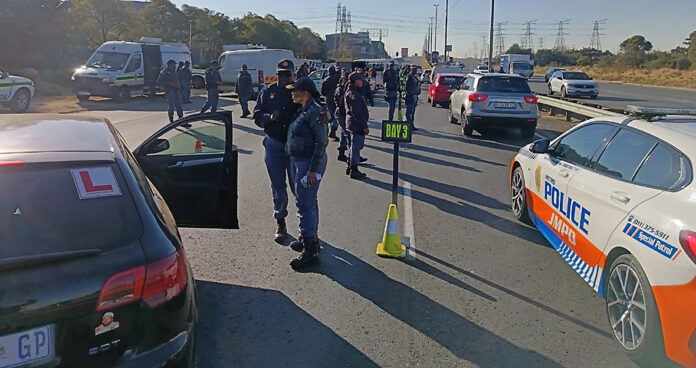
Crime remains one of the greatest challenges facing Gauteng. It robs families of their sense of safety, undermines economic growth, discourages investment and weakens public confidence in communities. As criminal networks become more sophisticated and organised, law enforcement agencies must become equally agile, coordinated and intelligence-driven in their response.
Law enforcement operations conducted across Gauteng last month provide encouraging evidence that a collaborative approach to policing is producing tangible results. The joint efforts of the Gauteng Traffic Police, the South African Police Service (SAPS), metropolitan police departments and municipal traffic authorities demonstrate what can be achieved when agencies work together with a common purpose.
One of the most significant breakthroughs has been in the fight against vehicle-related crime. Vehicle hijackings and theft remains among the province’s most persistent criminal threats, often serving as a gateway to other forms of organised crime. During coordinated operations across the province, the Gauteng Traffic Police arrested 107 suspects and recovered 57 stolen and hijacked vehicles.
These recoveries are far more than policing statistics. Every recovered vehicle represents a victim who may regain a valuable asset. More importantly, every vehicle removed from criminal syndicates weakens the tools often used to facilitate further criminal activities. With motor vehicles linked to more than 80% of crimes in Gauteng, as Premier Panyaza Lesufi has often noted, disrupting vehicle theft syndicates strikes at the heart of organised crime and demonstrates the value of intelligence-led policing.
Road safety has also remained a key priority. Across Gauteng, law enforcement agencies have intensified operations against drunken driving, illegal public transport activities and reckless driving behaviour that place lives at risk. Hundreds of motorists have been arrested for driving under the influence of alcohol and numerous vehicles operating without valid permits have been impounded.
The Johannesburg Metropolitan Police Department arrested more than 180 motorists for driving under the influence of alcohol, while the Tshwane Metropolitan Police Department impounded numerous vehicles operating without the necessary permits and licences.
Law enforcement agencies have also demonstrated determination in protecting essential public infrastructure. Cable theft and illegal electricity connections continue to disrupt communities, damage infrastructure and impose significant financial costs on municipalities and residents alike.
The progress made by Tshwane’s Cable Theft Unit in arresting suspects linked to cable theft and illegal reconnections demonstrates that law enforcement agencies are increasingly targeting crimes that undermine service delivery and community wellbeing.
Another encouraging development has been the successful disruption of criminals impersonating police officers. In a joint operation involving the Ekurhuleni and Tshwane Metropolitan Police Departments and the South African Police Service arrested eight suspects for being in possession of police uniforms, blue lights, unlicensed firearms and cloned vehicles.
Crimes of this nature erode public trust in legitimate law enforcement institutions while exposing communities to additional risks.
The fight against drugs has also intensified. Successful operations across the province have resulted in the seizure of Mandrax tablets and crystal methamphetamine. These interventions disrupt the illegal drug trade and contribute to safer communities. Drug trafficking remains a major driver of violent crime, gang activity and robbery.
Beyond combating serious crime, law enforcement agencies continue to play an important role in enforcing municipal by-laws that contribute to safe, orderly and functional cities. Addressing illegal activities, responding to community complaints and acting within the confines of the law to protect public spaces are all part of building communities where residents can live and work with dignity and confidence.
These successes demonstrate that the fight against crime requires collaboration between provincial traffic police, metropolitan police departments, the South African Police Service, prosecutors, municipalities and communities themselves.
Criminals do not operate in silos and neither can those tasked with combating their activities and operations.
Gauteng’s ongoing law enforcement successes provide encouraging evidence that when institutions work together with determination and purpose, they can protect communities, uphold the rule of law and build a province where residents feel safer to live, work and invest.
• Lebotha is a communicator in the Gauteng Office of the Premier
- Collaborative policing efforts across Gauteng have led to significant successes, including the arrest of 107 suspects and recovery of 57 stolen or hijacked vehicles, disrupting organised vehicle crime linked to over 80% of crimes in the province.
- Law enforcement intensified campaigns against road safety violations, notably arresting over 180 drunk drivers and impounding unlicensed vehicles to reduce reckless driving risks.
- Targeted operations have addressed crimes undermining public infrastructure, such as cable theft and illegal electricity connections, improving community service delivery.
- Joint policing efforts disrupted criminals impersonating police officers, arresting eight suspects with illegal uniforms, firearms, and cloned vehicles to restore public trust in law enforcement.
- Drug-related crimes were tackled through seizures of Mandrax and crystal methamphetamine, helping to curb violent crime and gang activity linked to drug trafficking.


