


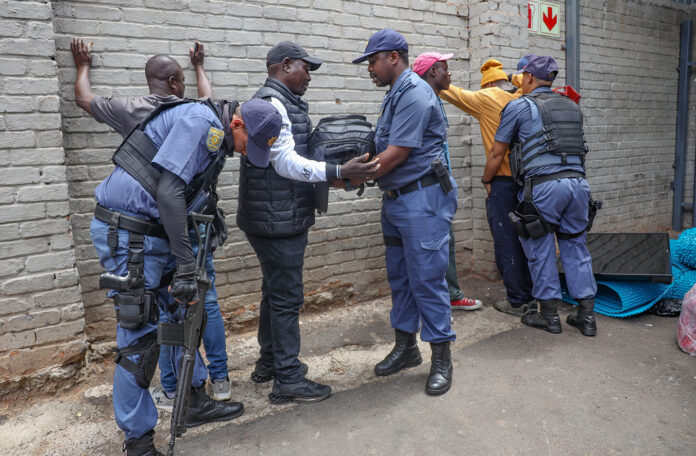
The latest crime statistics for Gauteng offer an important lesson in the fight against crime that policing works best when it is not left to the police alone.
The first quarter of the 2026/2027 financial year, covering April to June 2026, recorded encouraging reductions across several major crime categories. Contact crime declined by 3.0%, property-related crime fell by 2.7%, other serious crime decreased by 0.6%, while gender-based violence and femicide-related crimes declined by 9.1%, representing 209 fewer reported cases than during the same period of the previous financial year.
These figures should not be viewed simply as a statistical improvement. They point to the value of a coordinated approach involving law enforcement agencies, provincial and local government, communities, civil society and the business sector.
A stark reminder of the work still ahead
However, the recent cruel murders of five women in Kempton Park serve as a devastating reminder that the fight against violent crime is far from over. These senseless killings are not only a tragedy for the families and communities affected; they also undermine the significant efforts being made by SAPS and other law-enforcement agencies to make Gauteng safer.
Every life lost to violence is a painful setback and reinforces the need for continued vigilance, intelligence-led investigations, rapid intervention and stronger partnerships between law enforcement and communities.
The decline in overall crime statistics must never obscure the human cost of violent crime, particularly violence against women. These cases demand that the province redouble its efforts to ensure that perpetrators are brought to justice and that women and communities are protected.
A whole-of-government approach to crime prevention
The implementation of the Intergovernmental Relations (IGR) approach in Gauteng is particularly significant. Crime is rarely caused by a single factor and therefore cannot be effectively addressed by a single institution. Issues such as poor environmental design, inadequate access in townships and informal settlements, substance abuse, illegal liquor outlets, unemployment, social instability and community conflict all contribute to conditions in which crime can flourish.
At the operational level, the results of Operation Shanela 2 demonstrate what can be achieved when law-enforcement agencies combine resources and intelligence around common priorities. More than 38 000 arrests were made during the operation, including arrests for murder, robbery, assault, drug-related offences, driving under the influence, illegal firearms and liquor-related offences.
The recovery of 282 firearms, more than 5 900 rounds of ammunition, 144 stolen or hijacked vehicles and more than 434kg of various drugs further demonstrates that effective crime prevention requires both visible policing and targeted enforcement.
Importantly, these results do not represent the entirety of police activity. They are in addition to the day-to-day operational work undertaken across the province.
The decrease in crime must therefore be understood in the context of sustained and coordinated interventions rather than as the result of a single operation.
Communities remain a critical partner
The role of communities is equally important. Community Policing Forums and other approved community-based structures provide a critical link between residents and law enforcement. Communities know their neighbourhoods, understand local crime patterns and are often the first to identify emerging threats.
When residents report crime, share information and refuse to tolerate criminal activity, they strengthen the ability of law enforcement to act.
Business has a role to play
The partnership with the business sector is another important component. Initiatives such as Business Against Crime South Africa’s Eyes and Ears programme demonstrate how private-sector resources and information can complement traditional policing. Security infrastructure, information-sharing and cooperation between businesses and law enforcement can help close the gaps criminals seek to exploit.
The fight against crime also extends beyond arrests. Closing illegal liquor outlets, conducting compliance inspections, recovering stolen infrastructure materials and disrupting the markets that sustain criminal activity are all part of creating safer communities.
Encouraging progress against gender-based violence
The reduction in gender-based violence and femicide-related crimes is particularly encouraging. The work of Family Violence, Child Protection and Sexual Offences units, combined with awareness campaigns and partnerships with NGOs and communities, illustrates the importance of combining enforcement with prevention and victim support.
In addition, the increase in attempted murder, assault with intent to inflict grievous bodily harm and common assault remains deeply concerning. These offences can be precursors to more serious violence, including murder. The continued high murder rate reminds us that even where the trend is downward, the human cost remains unacceptable.
Understanding crime statistics in context
Similarly, the 8.3% increase in crimes detected because of police action shows that greater enforcement can initially produce higher reported figures in some categories. More detections of drug offences, driving under the influence and other crimes can reflect intensified policing rather than a deterioration in public safety.
This is why crime statistics must be interpreted carefully. A successful policing operation does not necessarily mean every category will immediately decline. Sometimes effective policing results in more arrests and detections precisely because law enforcement is becoming more active and intelligence driven.
Gauteng is also confronting significant pressures from public protests, including service-delivery protests and anti-illegal-immigration protests. Between April and June, law enforcement agencies policed 85 unrest incidents and 298 peaceful protests. Managing these events while maintaining the capacity to respond to ordinary crime requires substantial coordination and resources.
Building a safer Gauteng together
The decline in several major crime categories should be welcomed, but it should also strengthen the province’s resolve to deepen the partnerships that made that progress possible.
A safer Gauteng will not be created by police visibility alone. It will be built through intelligence-led policing, effective prosecution, community participation, responsible businesses, better urban planning, action against substance abuse and illegal liquor, improved infrastructure and a government that works across institutional boundaries.
The lesson from the first quarter of 2026/2027 is that coordinated law enforcement is not merely an operational advantage. It is becoming an essential model for preventing crime, disrupting criminal networks and building safer communities.
The fight against crime belongs to all of us. And when all parts of society pull in the same direction, the numbers can begin to move in the right direction too.
- Mhlanga is the spokesperson for the Gauteng Provincial Government. His views do not necessarily reflect those of Sunday World.
- In the first quarter of the 2026/2027 financial year, Gauteng saw declines in contact crime by 3.0%, property-related crime by 2.7%, other serious crime by 0.6%, and gender-based violence and femicide-related crimes by 9.1%.
- Operation Shanela 2 resulted in over 38,000 arrests, recovery of 282 firearms, 5,900 rounds of ammunition, 144 stolen vehicles, and over 434kg of drugs.
- The Gauteng Intergovernmental Relations (IGR) approach emphasizes that crime prevention requires coordinated efforts across government, law enforcement, communities, civil society, and business.
- From April to June 2026, law enforcement managed 85 unrest incidents and 298 peaceful protests in Gauteng.
- Increases in crimes detected due to police action, such as drug offences and driving under the influence, reflect intensified policing efforts rather than worsening public safety.


