


Engineers, members of the Council, distinguished engineers, researchers, students, and fellow farmers: good morning.
Thank you for the honour of addressing this gathering. I stand before you as chairperson of the Agricultural Development Agency (AGDA), but also as someone who has been involved in the agricultural sector for several years. AGDA is a member-based organisation that spans the agricultural value chain, from the smallholder in Blouberg to the commercial grain producer in the Free State, and the agribusinesses, financiers and off takers who connect them.
Let me begin with a picture.
On one side of a fence stands a centre pivot, GPS-guided and drawing water with precision. On the other side, a farmer waits for a tractor that was promised three weeks ago. Her planting window is closing. The rain she depends on is less predictable every year.
Both farmers are South African. Both are part of our agricultural economy. But only one of them is benefiting from engineering excellence.
Your theme today is Driving agricultural growth through engineering excellence. I want to add one word to it: inclusive. Because growth that reaches only one side of that fence is not the growth this country needs.
My message this morning is simple. Engineering excellence must be measured not only by what it makes possible, but by who it makes it possible for.
Why inclusion must be part of engineering excellence
South Africa has one of the most sophisticated commercial agricultural sectors on the continent. Our engineers helped build it. The irrigation schemes, the storage networks, the mechanisation that allows a single operation to farm thousands of hectares: that is your legacy, and it is a proud one.
But we also carry a second agricultural economy. It is made up of hundreds of thousands of smallholders and emerging farmers who farm with limited water, borrowed equipment, and almost no access to finance.
They hold land. They hold knowledge. Many hold extraordinary determination. What they do not hold is access to the technology that turns effort into output.
We often describe this as a finance problem, a land problem, or a skills problem. It is all of those. But it is also an engineering problem.
Too much of the technology on the market is designed for the farm that already succeeds. It is too large, too expensive, too dependent on specialist servicing, and too disconnected from the realities of a 5-hectare or 50-hectare operation.
At AGDA, our work is what we call manufacturing creditworthiness. We take farmers who are invisible to the financial system, and through profiling, training, mentorship, production support and market linkage, we make them bankable.
Our subsidiaries, AGDA Financial Services, AGDA Agrisure Brokers and AGDA Invest, then bring finance, insurance and investment to farmers who were previously excluded.
And what we have learned is this: every one of those steps depends on engineering.
A farmer cannot repay a loan if the borehole fails. She cannot be insured if her risk cannot be measured. She cannot supply a retailer if her produce spoils before it reaches the market.
Engineering is not adjacent to inclusion. It is the foundation of it.
So let me speak to three pillars where engineering and inclusion meet: resilience, efficiency, and climate-smart agriculture.
Building resilience where it matters most
The first pillar is resilience.
In the last few years, our farmers have faced drought, floods, load-shedding, collapsing rural roads, input price shocks and disease outbreaks, often in the same season. The commercial farmer can absorb some of these shocks. The emerging farmer usually cannot. One failed season can wipe out years of progress.
Resilience begins with water.
Across the former homeland areas, there are irrigation schemes that once worked and now stand idle. Canals are cracked, pumps are stolen or broken, and the land beside them lies dormant.
Rehabilitating that infrastructure is one of the fastest routes to growth available to this country. The engineering is not new. What is missing is the will, the coordination and the operating model to keep it working after the ribbon is cut.
Resilience also depends on energy.
A farmer whose irrigation and cold storage depend on an unreliable grid is a farmer at permanent risk. Solar-powered pumping, battery storage and decentralised energy for packhouses are no longer luxuries. They are risk management.
And resilience depends on shared infrastructure.
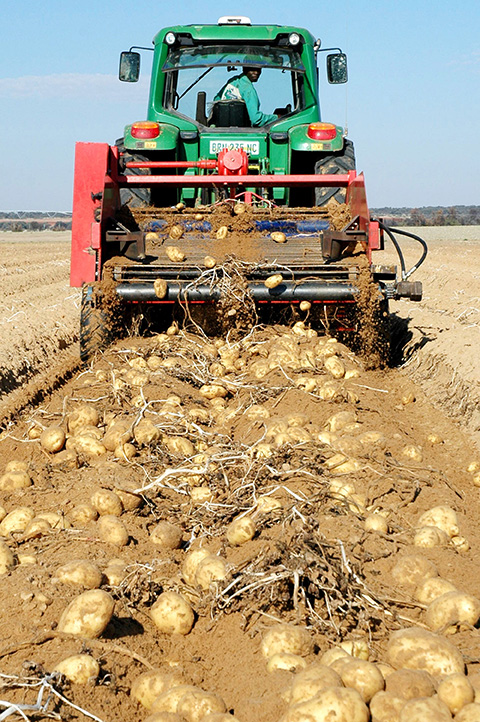
Let me give you an example from our own work. In Blouberg, Limpopo, AGDA is developing a potato service hub with local farmers. It is structured as a 100% black-owned special purpose vehicle, with AGDA acting as programme management office under a build-and-transfer model.
The hub gives smallholder potato growers collective access to mechanisation, storage, grading and packing that no individual farmer could afford alone.
We have combined that with a revolving production finance facility through AGDA Financial Services, backed by commitments from the Jobs Fund and Sedfa, and an offtake arrangement with a seedling supplier and buyer.
Engineering, finance and markets designed together. That is what resilience looks like at the margins of our sector.
We are applying similar thinking in our partnership with Sasol on the Iphepe Agri-Hub programme in Secunda and Sasolburg, where AGDA serves as implementing partner.
The lesson is consistent: shared service hubs are not just a development intervention. They are resilience infrastructure. And they need engineers who will design them to be owned, operated and maintained by the communities they serve.
Driving efficiency for farmers on thin margins
The second pillar is efficiency.
For a farmer on thin margins, efficiency is not about optimisation. It is about survival.
Start with mechanisation.
South Africa is full of tractors that were donated, delivered with ceremony, and then parked under a tree within two years. Not because farmers did not want them, but because the equipment was oversized for the land, there was no local technician, no spare parts supply, and no finance model for running costs.
Mechanisation fails when we engineer the machine but not the system around it.
The solution is to design equipment, servicing and finance together: equipment pools, contractor models where one well-equipped operator serves many farmers, and local technician networks trained to keep machines running.
I would challenge this Institute to lead on that thinking, because no one else is positioned to.
Then consider inputs.
Through our partnership with Winfield United and Pannar Seed, AGDA is supporting black grain farmers across four provinces this season, on more than 4,800 hectares in the Free State, Gauteng, North West and Mpumalanga, with a further 16 potato and vegetable farmers in Limpopo.
We track what each farmer planned to produce against what they actually produced. That gap between plan and actual is where efficiency lives.
Precision tools, soil mapping and variable-rate application can close it. The question for engineers is how to make precision work at 50 hectares, not only at 5,000.
Reducing post-harvest losses
Third, post-harvest loss.
Losses between the field and the market quietly erode farmer income. Better storage, cooling, drying and handling is often the quickest return on investment anywhere in the value chain.
It is also where our market linkage work meets your expertise: produce that cannot be kept cannot be sold on contract.
Making farmers visible through data
Finally, data.
This is where efficiency and inclusion meet most directly.
AGDA is building an integrated digital platform for farmer profiles, production tracking and reporting. Why? Because data makes a farmer visible.
A farmer with verified yield records, input histories and production plans can be assessed by a lender. Her risk can be priced by an insurer. Her output can be contracted by an offtaker.
That is why AGDA Agrisure Brokers and AGDA Financial Services care deeply about engineering data.
Sensors, yield monitors and farm records are not just efficiency tools. They are the raw material of creditworthiness.
Climate-smart agriculture as an economic imperative
The third pillar is climate-smart agriculture.
Climate change is not a future scenario for our farmers. It is already in their fields: shifting rainfall, hotter summers, more frequent hail and longer dry spells.
Too often, climate-smart agriculture is presented to small farmers as a compliance burden.
I want to argue the opposite.
For the farmer on the margin, climate-smart practice is the economic case.
Closing the equipment gap
Consider conservation agriculture.
No-till planting, residue retention and cover crops conserve moisture, rebuild soil and cut fuel and labour costs.
The agronomy is well established. The obstacle is equipment: no-till planters and residue-management tools sized and priced for smaller operations.
That is an engineering gap, and it is solvable.
Unlocking renewable energy opportunities
Consider renewable energy.
Solar irrigation, biogas from livestock and crop waste, and agrivoltaics that combine shade with power generation reduce costs and emissions at the same time.
For a livestock producer like our Deputy Chair, who has built an operation of hundreds of head of cattle and a poultry enterprise supplying a major processor, waste-to-energy is not a theory. It is a business opportunity waiting for the right engineering partner.
Protected agriculture for the next generation
Consider protected agriculture.
Tunnels, shade-net structures and hydroponic systems use a fraction of the water of open-field production and shield crops from heat and hail.
They are especially suited to young people entering agriculture on small parcels of land near towns.
The link between climate finance and engineering
And consider climate finance.
Significant global capital is looking for credible agricultural climate projects. Through AGDA Invest, we are working to mobilise blended capital for farmers who have historically been excluded.
But climate capital demands proof.
Carbon reductions, water savings and soil improvements must be measured, reported and verified.
Without engineers designing those measurement systems, the money simply does not flow to our farmers.
You are not only the builders of climate-smart agriculture. You are the gatekeepers of its financing.
A call for partnership
As Chairperson of AGDA, I did not come today only to describe a challenge. I came to propose a partnership.
AGDA brings what engineers often lack access to: organised farmers, live programmes, finance and insurance capability, and market linkages.
You bring what our farmers need most: the technical excellence to make their operations productive, resilient and sustainable.
So I would like to leave this Institute with three concrete proposals:
1. Develop right-sized technology standards
Together we can define what fit-for-purpose equipment for smallholder and emerging farmers should look like: in scale, cost, serviceability and local repair.
A standard like that would guide manufacturers, government procurement and development funders, and stop the cycle of donated machinery that never runs.
2. Use AGDA programmes as living laboratories
Blouberg, our grain partnership farms across four provinces, and our agri-hubs are real operations with real farmers and real data.
We invite your members, researchers and students to pilot solutions there and test them where they matter most.
3. Build the skills pipeline together
AGDA is supporting skills development initiatives across the country and enterprise support programmes with partners like Nedbank and Momentum.
We are deeply invested in developing young people in agriculture.
We would welcome SAIAE’s partnership in placing engineering students and graduates with our farmers, and in training the local technicians who keep irrigation, mechanisation and energy systems running long after the project ends.
Engineers design systems. Our farmers need systems designed with them, not just for them.
Removing the fence
As I conclude, let me return to the fence I described at the start.
On one side, the centre pivot. On the other, the farmer waiting for a tractor.
I do not believe that fence is permanent.
I believe engineers can remove it, not by taking anything away from the commercial farmer, but by extending the same excellence to the farmer next door.
When that happens, she plants on time. Her borehole runs on the sun. Her yield records earn her a loan. Her crop is insured. Her produce reaches the market fresh. And her children see a future in farming.
That is agricultural growth through engineering excellence.
And when it reaches every farmer, it becomes something greater: shared prosperity.
AGDA stands ready to partner with you.
Let us build it together.
I thank you.
- Dr Phosa is a former ANC treasurer-general and chairperson of the Agricultural Development Agency. This speech was delivered at an event of the South African Institute Of Agricultural Engineers in Upington on Wednesday.
- The Agricultural Development Agency (AGDA) supports inclusivity in agricultural engineering to benefit both commercial and smallholder farmers in South Africa.
- AGDA addresses engineering challenges by rehabilitating irrigation infrastructure, promoting solar-powered energy, and developing shared service hubs for smallholder farmers.
- Efficiency improvements focus on designing mechanisation and finance systems suited to small-scale farms, alongside precision agriculture and reducing post-harvest losses.
- Climate-smart agriculture practices promoted by AGDA include conservation agriculture, renewable energy use, protected agriculture, and leveraging climate finance requiring engineering solutions.
- AGDA proposes partnership with engineers to develop right-sized technology standards, use AGDA programs as testing sites, and co-develop skills and technician training pipelines.


