


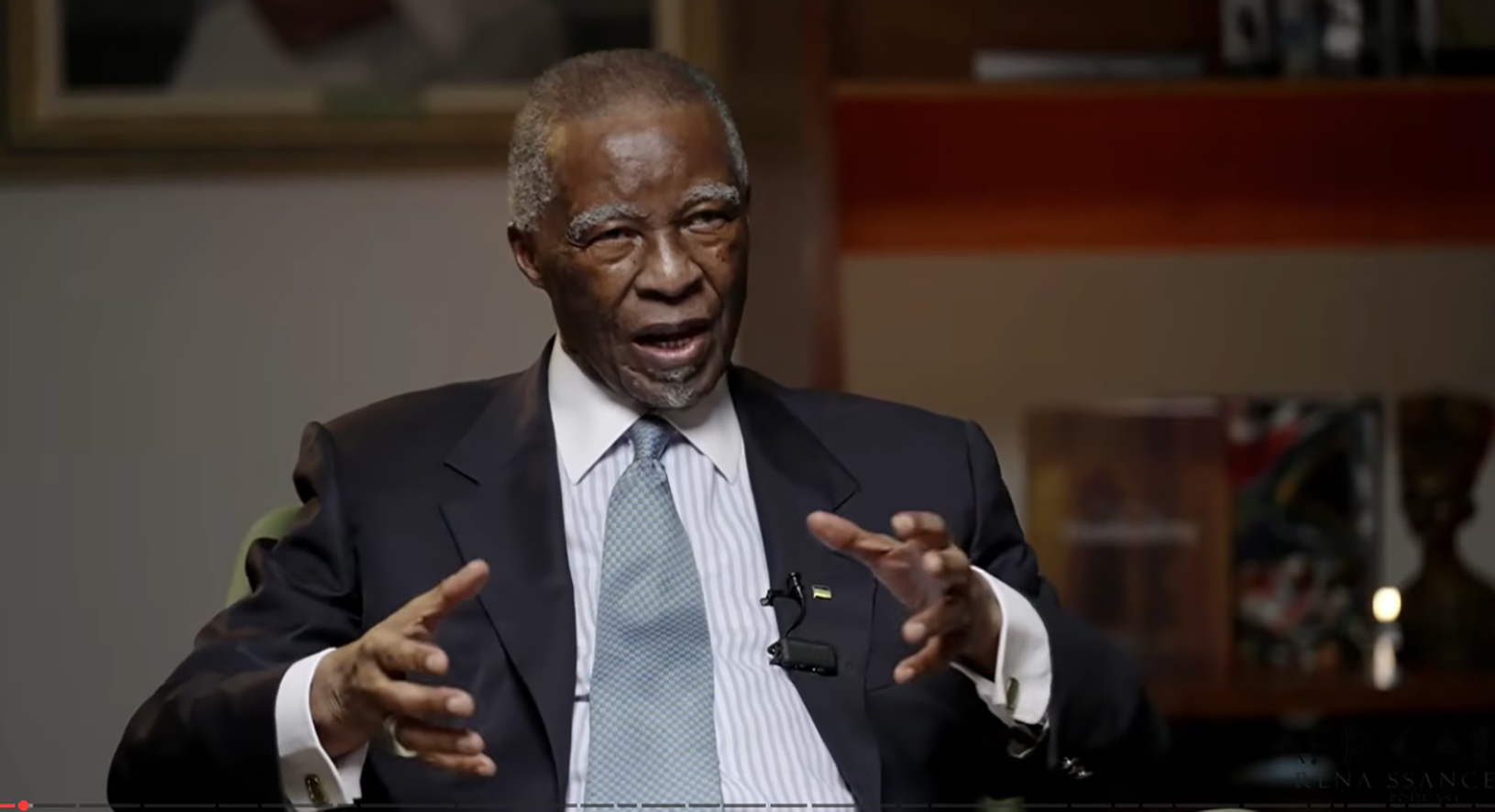
Nothing positive from 2018 till now. These are the words of our former president Thabo Mbeki when referring to President Cyril Ramaphosa and his tenure at the Union Buildings.
Being the wordsmith he is and instead of just calling for Ramaphosa to resign, Mbeki said that if the president indeed inferred that he should resign (as reported in a recent newspaper article, after the poor showing of the ANC in the local government elections), that he (Mbeki) would be inclined to agree with him.
If only he had left it there. Alas, he said there had been nothing positive since 2018, when Ramaphosa took the reins of government. He knows he is being disingenuous. He knows the statement is untrue, yet he said it anyway. Why?
Old spat
We know that he has harboured a dislike towards the president since the two competed for the top job in 1996. Mandela favoured Ramaphosa above Mbeki, if memory serves me right. But could it really be about such an old spat? Surely not!
Mbeki knows better than to blame one man for the ANC’s decline. As an author said: “It is intellectually lazy, organisationally dangerous and politically unfair to reduce the ANC’s historical crisis to the failures, real or perceived, of one man.”
Progress under Ramaphosa
But let’s turn our attention to the positives, or not, of Ramaphosa’s tenure thus far. He committed more than R1-trillion to public infrastructure over three years – the largest amount yet budgeted from the fiscus – to renew roads, ports, rail, energy and water systems. Government’s first infrastructure bond was more than two times oversubscribed.
He also established the Infrastructure Fund as a blended finance facility for infrastructure and for Infrastructure SA to coordinate a massive public build. He amended public-private partnership regulations to make it easier for the private sector to invest in infrastructure.
New public and private sector projects announced in 2024 were valued at R445-billion, the largest fixed investment in infrastructure since 2021.
Government finalised master plans in eight industries – clothing, poultry, sugar, automotive, furniture, steel, tourism and forestry – resulting in total investment commitments of R82.5-billion and the creation of 6 500 jobs.
It provided more than R2.5-billion in support to more than 180 000 small and medium enterprises, together with R1-billion in guarantees, building on the government-guaranteed bounce-back loan scheme introduced in 2022.
Around R15-billion has been invested in black-owned businesses under the Black Industrialist programme.
Passenger rail services have been restored on 35 out of 40 priority commuter rail corridors, with Prasa recording more than 100-million passenger trips in the 2025/26 financial year. Around 330 of 600 new, locally manufactured trains have been delivered.
South Africa grew international tourist arrivals to a record 10.5-million last year, supported by visa reforms and targeted tourism promotion.
On the macroeconomic front, government secured the country’s removal from the Financial Action Task Force grey list in October last year, after completing all 22 action items in the plan adopted when the country was greylisted in February 2023. South Africa also achieved its first sovereign credit rating upgrade by S&P Global in nearly two decades in November last year. Moody’s raised the country’s rating outlook from stable to positive in May this year.
Early this year, the economy recorded four-consecutive quarters of growth, government achieved two-consecutive primary budget surpluses and inflation had fallen to its lowest level in 20 years, enabling lower interest rates.
Through the National Energy Crisis Committee, the country moved from
330 days of load shedding in 2023 to more than 500-consecutive days without load shedding by the end of September this year. Eskom’s Energy Availability Factor reached 75% in July this year and the power utility reported a profit of R30.3-billion for 2025/26.
He appointed new leadership at the Hawks, which has restored credibility and stability, led to action against corruption and established the National Prosecuting Authority’s Investigating Directorate Against Corruption to prosecute those involved in state capture and other significant corruption cases. I could go on.
Instead, I remind Mbeki about what he said to Nelson Mandela when Mandela wanted to pronounce on government matters from his retirement home. Perhaps he should listen to his own advice.
• Dr Van Heerden is a senior research fellow at the Centre for African Diplomacy and Leadership at UJ
- Nothing positive from 2018 till now.
- These are the words of our former president Thabo Mbeki when referring to President Cyril Ramaphosa and his tenure at the Union Buildings.
- Being the wordsmith he is and instead of just calling for Ramaphosa to resign, Mbeki said that if the president indeed inferred that he should resign (as reported in a recent newspaper article, after the poor showing of the ANC in the local government elections), that he (Mbeki) would be inclined to agree with him.
- If only he had left it there.
- Alas, he said there had been nothing positive since 2018, when Ramaphosa took the reins of government.


