


Probably the first thing I was taught to memorise as a child was my address. I can recall every address I have lived at. Addresses are important and can generate powerful emotions.
For years, our newspapers and social media were abuzz with passionate debates about renaming streets.
Those debates seem to have faded but we have unfinished work, certainly from a public health perspective.
The original focus was part of the democratic process. Understandably, we should not be expected to commemorate people or institutions associated with oppression indefinitely. Names carry history; changing them can be a legitimate act of transformation.
But there is another street-name problem that receives far less attention: the challenges faced by people whose homes have never had a usable address.
A 2025 paper in the South African Journal of Science cites an estimated national backlog of about five million addresses.
The authors describe the enduring consequences of apartheid-era exclusion, compounded by informal settlement growth.
I can hear you thinking: Really? With all the unfixed potholes and other municipal service delivery failures, why do you want to prioritise streets with no names?
It might sound like an administrative inconvenience but, as with so many small systems failures, it could mean the difference between life and death.
If I have a heart attack at home, my family can give the ambulance dispatcher a street number and street name.
Now imagine doing this when your address amounts to the third house after the spaza shop, behind the church, near the big blue container.
Yes, there are workarounds. You can WhatsApp a location pin or ask the ambulance crew to call when they reach the taxi rank.
A location pin can be useful. It cannot, on its own, ensure that dispatchers can use the information, identify an accessible route or reach someone whose phone has gone dead.
The test is whether the service can reliably find the household when it matters.
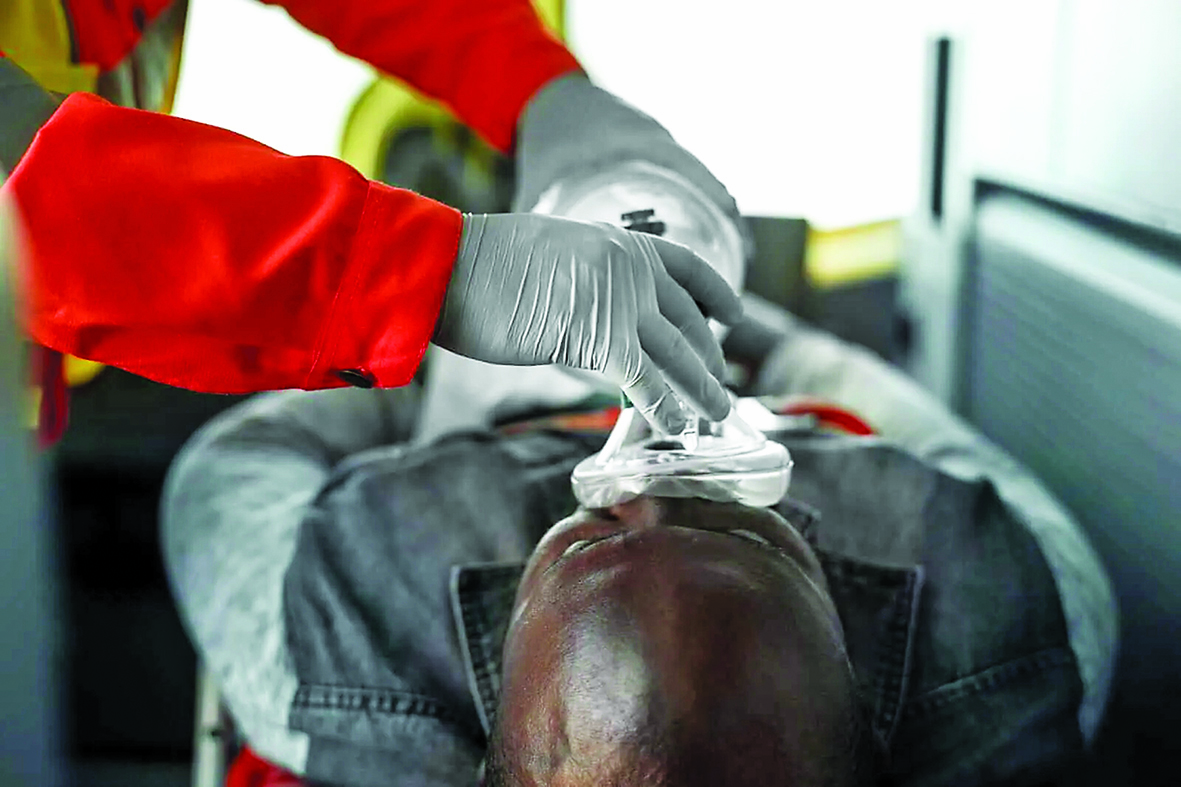
When someone suffers a cardiac arrest, minutes matter. A Swedish study of more than 20 000-witnessed cardiac arrests found that survival at 30 days was about 20% when crews arrived within six minutes, compared with about 9% when they took 10 minutes or longer.
A Cape Town study examining 929 cardiac arrests outside hospital in 2018 reported response times of 10 minutes for private emergency medical services, compared with 20 minutes and 39 seconds for the public service — more than twice as long.
The study does not tell us how much of that difference arose from location, ambulance availability or difficulty finding patients. But I would argue that having a usable address can, in such emergencies, be a matter of life and death.
Being findable, though, is only part of the problem. Somebody must also be able to reach you safely.
On August 29 this year, two Gauteng emergency medical service workers transporting a patient on the N1 near Pretoria came under fire after their ambulance was reportedly spiked.
The crew escaped injury and the patient was transferred to another ambulance.
Naming a street will not prevent such violence. But both problems expose the same dependence: healthcare needs safe, accessible public spaces to reach the patient.
Those of us with a recognised address and private medical cover should resist treating this as somebody else’s problem. We travel beyond our own suburbs for work or to visit family.
The consequences also extend beyond emergencies.
In public health, there is a major focus on last-mile solutions — the final stretch between having a service available and getting it to the person who needs it.
How do we get medication from the clinic to an elderly patient unable to get there?
Sometimes the missing link is a community health worker, sometimes a delivery service and sometimes something as ordinary as a house number.
As more services move online, the absence of last-mile solutions can deepen inequalities. Without a usable address, even a service available at the touch of a screen may remain out of reach.
We talk a lot about the digital divide. We should also recognise the address divide.
Please add this to the questions you ask prospective ward councillors when they come calling for your vote: What is your plan to close the address divide?
This is not rocket science. Municipalities should work with residents to identify households without usable addresses and publish funded plans with clear deadlines, named officials responsible for delivery and progress reported by ward.
Where street numbering is not yet practical, household identifiers linked to mapped locations could provide a starting point.
Tools exist. One example is what3words, whose free app and online map identify every 3m2x3m2 on Earth with a unique combination of three words. It can help pinpoint a home even where streets have no names.
But the technology becomes useful public infrastructure only when residents know their identifier and emergency services can receive, interpret and act on it.
Giving a place a digital address is a start; ensuring help can reach it is the real test.
Critically, this is about systems. Success should be measured by whether emergency services can find each home, with records kept current as settlements change.
Residents should demand clear answers: How many households lack usable addresses? How many will be included this year? Who will answer if deadlines are missed?
There is nothing trivial about ensuring that people living along our streets can be found.
Much of good government consists of ordinary systems working so reliably that we stop noticing them — a house number, an accurate map, a functioning streetlight or a road an ambulance can use.
• Dr Wolvaardt is the founder of the Foundation for Professional Development and has recently stepped down as managing director.
- South Africa faces a national backlog of about five million addresses, largely due to apartheid-era exclusion and informal settlement growth.
- Having a usable address is critical for emergency services, as delays in response times significantly reduce survival rates, particularly in cases like cardiac arrest.
- Emergency medical workers sometimes face dangers reaching patients, exemplified by an August 29 attack on EMS workers on the N1 near Pretoria.
- The lack of usable addresses affects public health beyond emergencies, hindering the delivery of medications and services, which contributes to inequality.
- Solutions like publishing funded municipal plans and using tools such as the what3words app can help identify households without addresses and improve emergency response.


