


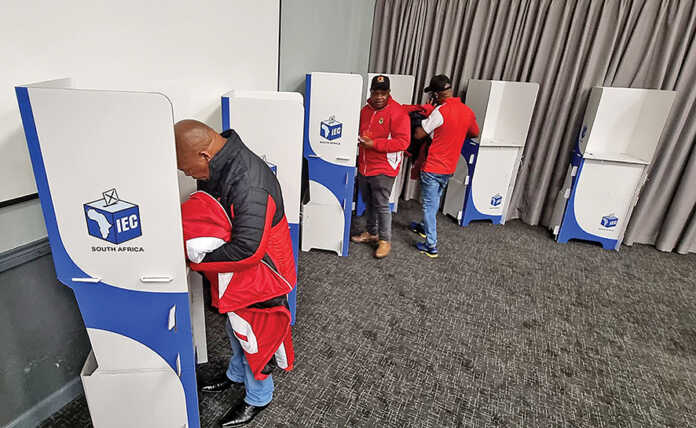
As South Africa approaches what I consider to be a watershed, 2026 Local Government Elections, much of the public debate has centred on polling, more than 136 000 candidates vying for 10 526 council seats and the anticipated growth of municipal coalitions.
If South Africa is to work, local government must not only work, as the revised White Paper advocates but work well. With Brand Local Government in crisis, the fundamental question is whether we are looking beyond the electoral contest to understand what drives public dissatisfaction and how citizens experience local democracy.
Community Perceptions of Local Government Survey
In May 2026, driven by academic curiosity, I approached colleagues at the Thabo Mbeki Foundation and the FW de Klerk Foundation, together with community radio station KC 107.7 in Paarl and Sunday World, to explore these questions.
This collaboration gave rise to the Community Perceptions of Local Government Survey, which gathered responses from 1 986 people across South Africa’s nine provinces, with particular interest in understanding the experiences of young people.
Our approach was informed by the Knowledge, Attitudes and Practices (KAP) framework, extended to include support for democracy. We examined what citizens know about local government, their attitudes towards democratic institutions, their participation in civic life and their support for democratic governance.
We also explored access to information and the role of community media in civic engagement. The preliminary findings are sobering but not surprising.
The findings
Overall, 59% of respondents reported negative experiences of municipal services, while 55% expressed negative attitudes towards democratic institutions. Some 68% disagreed that their municipality responded quickly to complaints.
A further 66% expressed concern about the transparency of public spending, while 64% felt that community input did not influence municipal planning decisions.
The findings on youth participation are equally revealing.
Among respondents aged 35 and older, 82% were registered to vote, compared with only 39% of those aged 18 to 24. Younger unregistered respondents more frequently cited insufficient information about voter registration, while older unregistered respondents more often reported political disinterest.
Civic knowledge
The survey further found a positive association between civic knowledge and participation. Respondents with greater knowledge of local governance tended to participate more actively.
This reinforces the importance of helping citizens understand municipal budgets, ward committees, integrated development planning and the mechanisms available to hold elected representatives accountable.
These findings also need to be considered against South Africa’s wider inequality challenge.
Oxfam report on inequality
Oxfam South Africa’s report, Hoarded Wealth, Dignity Denied: Confronting South Africa’s Extreme Wealth and Inequality Emergency, argues that extreme inequality is not simply about the gap between rich and poor. It also concerns the unequal distribution of wealth, opportunities and power.
The report warns that inequality can undermine participatory democracy when large sections of society feel excluded from economic progress and decision-making. Our survey thus adds an important dimension to this debate.
When citizens feel that their municipalities do not respond to complaints or that their input has little influence on planning, we must ask what meaningful participation looks like in practice. This question is particularly relevant in communities where visible prosperity exists alongside poverty and unequal access to opportunities.
Local government cannot resolve every structural inequality. However, it remains a critical sphere through which communities access basic services, participate in development planning and hold public representatives accountable.
Responsive local government cannot eliminate inequality on its own, but it can help create the conditions for more inclusive development and strengthen public confidence in democratic institutions.
The media’s role
The media also have a role to play in enabling informed civic participation.
Social media was the most frequently reported information source among respondents, used by 68%, followed by friends and family at 41% and community radio at 36%.
The survey found a positive association between community radio engagement and civic participation, although community radio engagement was not significantly associated with voter registration.
These findings highlight the importance of accessible, credible and locally relevant information that helps citizens understand their rights, engage with local issues and identify opportunities to participate.
Ongoing research
The preliminary findings are not intended to offer a definitive verdict on local government. Rather, they provide an evidence-based starting point for further investigation and public debate.
We are continuing with an in-depth analysis of the data, together with our colleagues at the Interdisciplinary Centre for Digital Futures (ICDF) at the University of the Free State, to examine relationships between civic knowledge, democratic attitudes, participation, institutional trust and access to information across different communities and demographic groups.
As the analysis progresses, we intend to engage South Africans in a broader conversation about local governance, civic behaviour and the factors that shape citizens’ relationship with local government over the next 5 years. The acid test of local democracy is not only who wins an election but what happens between elections.
- Dr Harlan Cloete is a Research Fellow in Local Governance and Public Leadership at the Centre for Gender and Africa Studies, University of the Free State and Chief Executive Officer of the Athlone Institute Paarl. His latest book, ‘101 Local Governance Lessons: from the Great Governance ZA Podcast’, was published by UJ Press in September 2026. The book is available in open-access digital formats and paperback.
- As South Africa approaches what I consider to be a watershed, 2026 Local Government Elections, much of the public debate has centred on polling, more than 136 000 candidates vying for 10 526 council seats and the anticipated growth of municipal coalitions.
- If South Africa is to work, local government must not only work, as the revised White Paper advocates but work well.
- With Brand Local Government in crisis, the fundamental question is whether we are looking beyond the electoral contest to understand what drives public dissatisfaction and how citizens experience local democracy.
- Community Perceptions of Local Government Survey In May 2026, driven by academic curiosity, I approached colleagues at the Thabo Mbeki Foundation and the FW de Klerk Foundation, together with community radio station KC 107.7 in Paarl and Sunday World, to explore these questions.
- This collaboration gave rise to the Community Perceptions of Local Government Survey, which gathered responses from 1 986 people across South Africa’s nine provinces, with particular interest in understanding the experiences of young people.


