


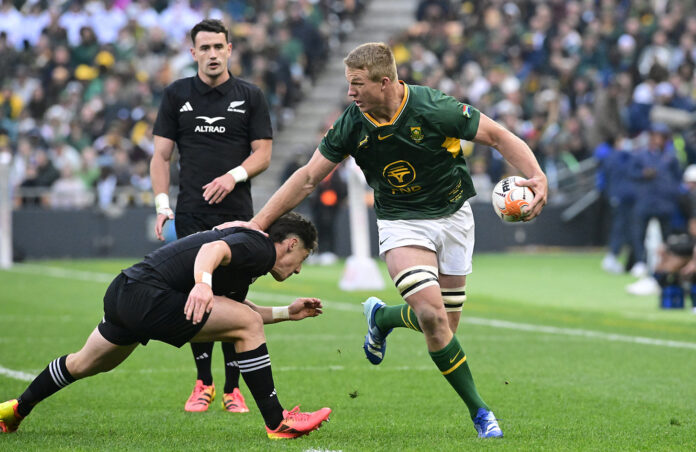
The orderly and decorous manner in which the sold-out Springboks versus All Blacks Test match at FNB Stadium was organised has left some of us, bona fide diski followers and reporters, a little embarrassed.
It has left us asking ourselves why the same cannot happen when the 90 000 or so fans come to watch Kaizer Chiefs and Orlando Pirates when the Soweto derby rolls into town.
I have never been fond of rugby. The few times I went to a rugby match in my salad days as a sports reporter in the early 2000s, I thoroughly enjoyed the white-on-white violence as they battered one another in those scrums.
Fast forward to 25 years later, they have diligently brought in some brawny Alkebulan brothers to join in on the scuffles. To be fair, the sport has thoroughly progressed and transformed and on the field, it is reflective of Nelson Mandela’s Rainbow Nation notion.
The soccer supporters who attended the Boks match at FNB Stadium, came back smitten. They were impressed and visibly charmed with how the supporters of the oval diski behaved themselves and how each facet in the organisation of the match went as smooth as butter.
In the past two years, diski fans have seen the Soweto derby and matches at Orlando Stadium descend into life-threatening chaos and disaster. With every derby since February last year, the risks and danger are escalating at an alarming rate.
But it is just business as usual for the PSL, the two clubs Orlando Pirates and Kaizer Chiefs, while everything is left to Stadium Management South Africa (SMSA) to answer the questions.
The SMSA seems to be the only party that has bothered to communicate something and address the looming danger.
In the past couple of seasons, the appetite for the derby has grown immensely; the demand for tickets and to be part of the spectacle is higher than a backstreet junkie’s. This has resulted in the derby becoming a death trap and a ticking time bomb.
The problem starts on the highways where chance-takers without tickets cause a traffic jam and bottleneck. I covered the 2010 World Cup and without a legit ticket, you could not even see the stadium. People left their homes early to catch buses at designated schools, parks and other park-andride spaces.
In any environment, the default is chaos but order is enforced through rules so that lawfulness prevails.
Shifting the responsibility to fans and the SMSA won’t solve the problem because fans will always try tricks for a benefit, no matter how much education is given to them. Fans and people, especially, don’t naturally just follow rules — the first point of call for most is to make a system ungovernable.
There cannot be one blanket solution to the diski problems.
Orderly behaviour is of great importance. You cannot leave your home without a legal parking ticket and match-day ticket, with the hope of scoring one from the dexterous bootleggers outside the stadium — that in itself is behaving in a shambolic manner. It will cause delays in the processing of people into the venue. It also results in apprehension when those people do not get their way and try to force their entry into the stadiums.
People should start arriving very early and practising sitting according to their ticket numbers. It is logical, systematic and beautiful to see when it is properly carried out — like at the recent rugby match when there was not even one supporter sitting in either the aisles or stairways.
If we can address the issues, we will not need to beef up security, or ensure additional police and metro cops; everything would flow smoothly. As diski fans, we need to take a good look at ourselves in the mirror.
- The Springboks versus All Blacks Test match at FNB Stadium was organised in an orderly and decorous manner, impressing soccer supporters who attended.
- Recent Soweto derbies between Kaizer Chiefs and Orlando Pirates have descended into life-threatening chaos and escalating risks.
- The Premier Soccer League (PSL), Kaizer Chiefs, and Orlando Pirates have not adequately addressed the growing dangers, leaving Stadium Management South Africa (SMSA) as the main communicator.
- Problems at the derbies often begin with fans without tickets causing traffic jams and bottlenecks on highways leading to the stadium.
- Proper organisation, such as arriving early with legal tickets and sitting according to ticket numbers, can improve order and reduce the need for increased security measures.


