


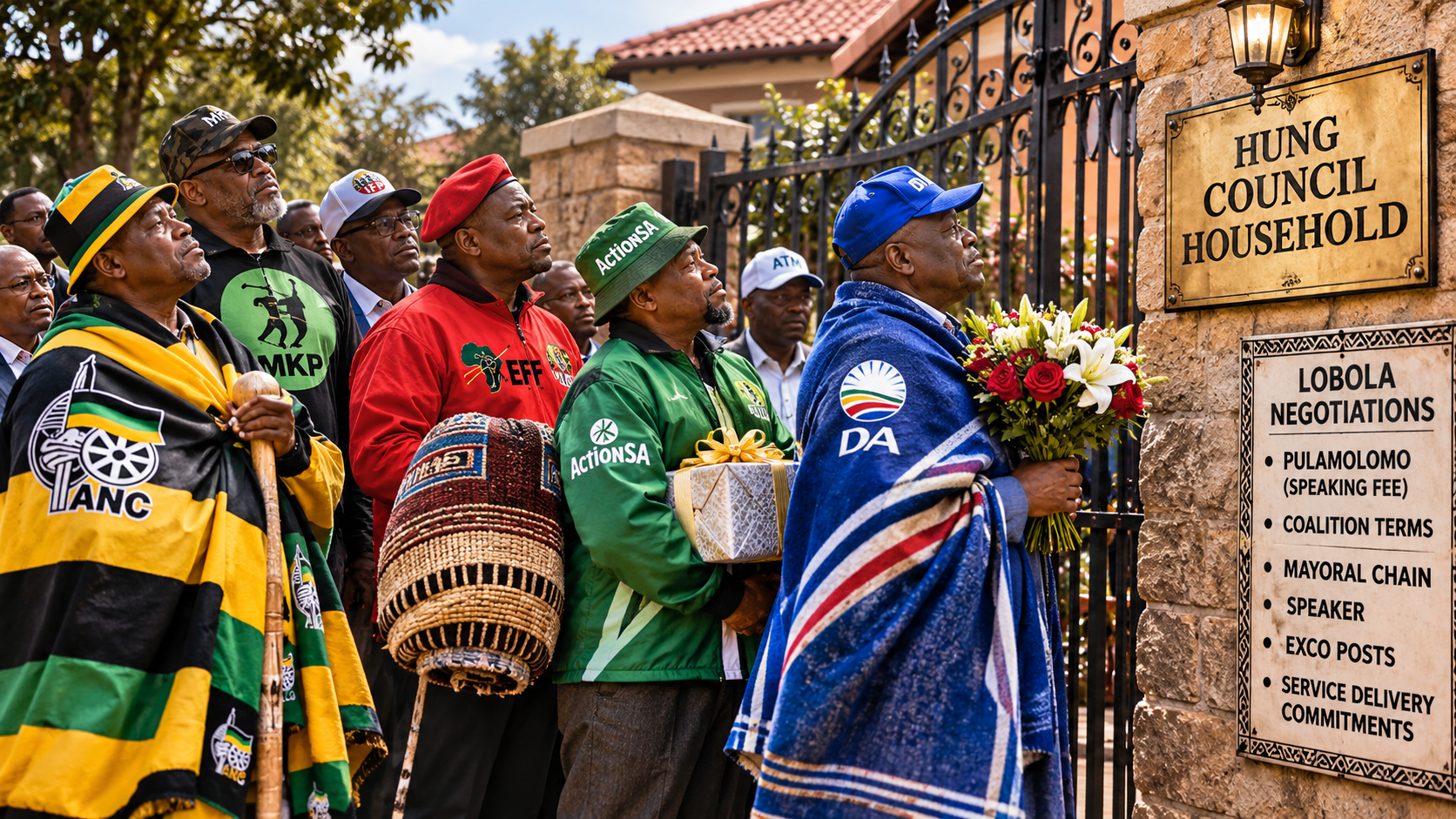
Ululations! Ululations! Ululations! The uncles have been dispatched. The cattle have been counted. The envelopes are ready. But the political makoti is proving difficult to marry.
Welcome to South Africa’s political dowry wars, where election victories no longer guarantee political power; electoral votes have become bargaining cattle, and coalition negotiations increasingly resemble a traditional lobola ceremony.
The recent local government elections have produced political suitors carrying impressive electoral results, only to discover that winning votes merely gets them to the gate.
READ: ANC activists fear West Rand could go ‘right wing’ in coalition talks
Paying pulamolomo at the political gate
The real negotiations begin with pulamolomo, the customary speaking fee that allows the visiting uncles to state their intentions.
Those familiar with traditional negotiations know that the bride’s family may keep the visitors waiting outside, sometimes for hours, before inviting them into the house.
And paying pulamolomo does not mean the bride is yours. It merely buys you an audience.
South Africans witnessed a political version of this in 2024, when the ANC lost its parliamentary majority and political parties had to negotiate the formation of the government of national unity.
The political uncles arrived with their demands, conditions and carefully calculated concessions. Some wanted cabinet positions, others policy guarantees, and everyone wanted to know what they would receive in return.
Two years later, the negotiations have become even more complicated.
Guessing who hides beneath the blanket
In Gauteng, Helen Zille and Herman Mashaba are performing what resembles the traditional African ritual in which three women, their heads covered, are presented before the visiting uncles. Is makoti the mayoral chain? The office of the Speaker? MMC?
The visitors are then challenged to identify the makoti they have come to marry.
In some families, the clever uncles would have secretly arranged with the bride and her mother how to identify the correct woman. Without that understanding, the visitors risk pointing at the wrong makoti and embarrassing themselves before the entire family.
Now consider the political theatre unfolding between Zille and Mashaba.
The DA emerged as the largest party in Johannesburg but without enough seats to govern alone. ActionSA possesses votes that could help determine who wears the mayoral chain.
Mashaba has proposed that both he and Zille withdraw from the Johannesburg mayoral contest, allowing the DA to nominate another candidate whom ActionSA could support.
In our lobola analogy, Mashaba is effectively telling the visiting uncles that the bride they came looking for is not the one they will be allowed to take home.
Zille, meanwhile, represents a political family that believes its electoral performance gives it a strong claim to the marriage.
The makoti is covered. The uncles are whispering. Nobody wants to point at the wrong woman.
And while the political families haggle over Johannesburg, Tshwane and Ekurhuleni are also part of the negotiations.
Bargaining for positions instead of policy
This is where South Africa’s democracy has entered a new phase of political lobbying.
For decades, American Democrats and Republicans have negotiated across party lines to secure enough votes to pass legislation. They exchange policy concessions, amend bills and seek common ground without necessarily entering permanent political partnerships.
South Africa’s coalition negotiations, however, frequently begin with a different question.
Who gets the mayoral chain? Who becomes the speaker? Who controls which municipality?
READ: Mashaba ‘willing to talk with everyone’ about coalitions, as ActionSA gains ground in Gauteng
Instead of negotiating primarily over policies, political parties often find themselves negotiating over positions.
What lobola teaches about real compromise
Yet lobola teaches us something profound about compromise.
The visiting uncles cannot simply dictate terms because they have brought cattle. Neither can the receiving family make endless demands without risking the collapse of negotiations.
Both families must recognise that a successful marriage requires agreement, respect and a future beyond the ceremony.
Our political leaders should learn the same lesson.
Johannesburg residents need reliable water, functioning roads, refuse collection and accountable government. They cannot eat mayoral chains or drink promises from political manifestos.
The ANC, DA, EFF, MKP and ActionSA must learn that supporting a sensible proposal from an opponent does not amount to political betrayal.
The true test of democratic maturity is not how loudly politicians disagree, but how effectively they negotiate when agreement serves the public.
Marrying public service over political power
For now, the political uncles are still at the gates, checking their envelopes and calculating their next move.
Some may have paid pulamolomo. Others are still arguing about which makoti should emerge from behind the blanket.
But the voters, who are effectively the families awaiting this political marriage, deserve more than a ceremony of endless demands.
Because when the lobola negotiations are finally concluded, South Africans do not want to discover that their politicians have married positions instead of public service.
- Ululations!
- Ululations!
- Ululations!
- The uncles have been dispatched.
- The cattle have been counted.


