


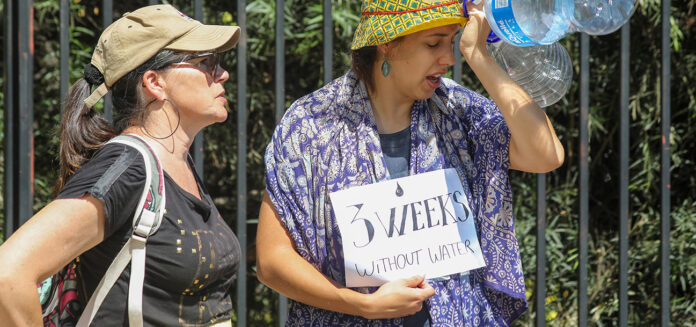
As water shortages intensify across Johannesburg and Gauteng, public frustration is understandable. What is less understandable and far more dangerous is the growing tendency to misdirect blame, sometimes in favour of scoring political points.
Recent political statements disputing the fact that Johannesburg “uses double the international average of water per person per day”, which supposedly therefore means Rand Water is failing, are misleading and miss the point.
Bulk supply is not household consumption
Rand Water does not supply water to households. It supplies bulk water to municipalities. When Rand Water refers to “high consumption”, it is not talking about how long residents shower or how often they water gardens. It is referring to the volume of water abstracted by municipalities from the bulk supply system. This distinction is critical but routinely ignored as the build-up to the local government elections intensifies.
The hard numbers tell a different story
Every metropolitan municipality receives water under a legally defined bulk water licence, which limits how much water it may abstract per day. Current data shows that some of Gauteng’s metros are exceeding those limits by a wide margin.
City of Johannesburg (CoJ)
Licensed allocation: 1,356 ML/day
Current average abstraction: 1,720 ML/day
City of Tshwane (CoT)
Licensed allocation: 667 ML/day
Current average abstraction: 861 ML/day
City of Ekurhuleni (CoE)
Licensed allocation: 1,022 ML/day
Current abstraction: 1,019 ML/day
These figures matter because exceeding licensed abstraction levels places enormous strain on a system that is already operating close to its design limits.
Once the water enters the city, responsibility shifts
The moment water is delivered into municipal reservoirs, Rand Water’s role ends. From that point onwards, metropolitan municipalities are responsible for:
Distribution to households and businesses;
Maintaining aging and often failing pipe networks;
Managing pressure and preventing bursts; and
Addressing leaks, theft, and illegal connections.
When Rand Water uses the term “water consumption”, it also refers to water lost through inefficiencies – mostly leaks.
In some metropolitan systems, non-revenue water losses exceed 35%. That is treated, pumped, and paid-for water that never reaches a tap.
This is a governance problem, not a supply failure
We all know by now that South Africa is a water-scarce country. Gauteng is approaching the limits of what its current system can sustainably deliver. That reality demands honest accountability, not political deflection. Rand Water has consistently warned that over-abstraction by municipalities is unsustainable.
The uncomfortable truth is this:
Water security will not be restored until municipalities bring abstraction back to within licensed limits and aggressively reduce losses.
The conversation South Africa actually needs
Instead of scapegoating the bulk supplier, the public debate on this state of affairs would be served better by focusing on:
Enforcing licensed abstraction limits;
Accelerating pipe replacement and maintenance;
Reducing non-revenue water losses; and
Strengthening municipal demand management
Attacking Rand Water may score a few political points for a party’s campaign, but it does nothing to keep the taps running. Water scarcity is a shared challenge. Misplaced blame only deepens the crisis.
Qinga-Vika is MD of VQ Communications & Consulting
- As water shortages intensify across Johannesburg and Gauteng, public frustration is understandable.
- What is less understandable and far more dangerous is the growing tendency to misdirect blame, sometimes in favour of scoring political points.
- Recent political statements disputing the fact that Johannesburg “uses double the international average of water per person per day”, which supposedly therefore means Rand Water is failing, are misleading and miss the point.
- Bulk supply is not household consumption Rand Water does not supply water to households.
- It supplies bulk water to municipalities.


