


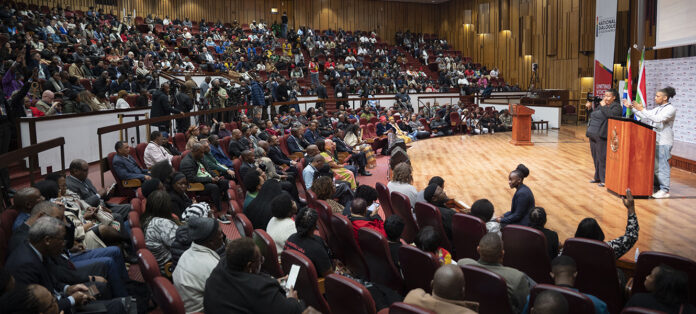
Set to feature prominently in the public discourse this year is the so-called National Dialogue, a superfluous event if ever there was one. The dialogue is bound to be no more than an opportunity for a fed-up citizenry to vent. It is a giant PR exercise from which nothing concrete will eventuate.
Why do I say so? Well, for the simple reason that South Africa has a duly elected Parliament and a Government of National Unity (GNU), which are legally entitled to run their respective affairs. Neither structure will take instruction from an unelected National Dialogue.
Let us make comparisons with the original Convention for a Democratic South Africa (Codesa), which I had the privilege of covering in the run-up to our inaugural democratic elections in 1994.
On December 21, 1991, various political parties and organisations gathered at the World Trade Centre in Kempton Park for the beginning of multi-party negotiations in what came to be known as Codesa. On the agenda for that meeting was the adoption of a Declaration of Intent that anchored all subsequent negotiations. It committed participants to most of the values that today find expression in our Constitution, such as bringing about “an undivided South Africa, with one nation sharing a common citizenship, patriotism and loyalty”, working to heal the divisions of the past, striving to improve the quality of South Africans’ lives, and setting in motion a process of writing the country’s interim constitution and ensuring that this constitution is the supreme law of the country.
The adoption of that Declaration of Intent by all the parties at that gathering gave it huge legitimacy, thus ensuring that it was binding on all parties and organisations that participated in the process.
However, without a commitment from President FW de Klerk’s government to bind itself by agreements reached in that forum, Codesa would have been a colossal waste of time.
The last paragraph of the Declaration stated: “We, the South African government, declare ourselves to be bound by agreements we reach together with other participants in Codesa in accordance with the standing rules and hereby commit ourselves to the implementation thereof within our capacity, powers and authority.”
It was that last part of the Declaration of Intent that encouraged the different parties to participate in the process, confident that any agreements that they reached would be implemented.
De Klerk could give that commitment because his party had a majority in the House of Assembly. In the last all-white elections of 1989, the NP had obtained 52,70% of the vote, against the Conservative Party’s 26,83% and the Democratic Party’s 15,12%.
He knew that, on its own, his party would have the numbers to pass legislation giving effect to agreements flowing from the Codesa talks.
Today, however, President Cyril Ramaphosa leads an ANC that managed only 40% of the vote in the last election and leads a GNU made up of disparate parties, some of which are opposed to the National Dialogue. How will he ensure that the GNU accepts and implements the outcome of the National Dialogue? How will he ensure that Parliament approves and implements whatever agreement eventuates from that expensive talk shop?
That is why I associate myself fully with the millions of South Africans who have grave reservations about the wisdom and utility of the proposed National Dialogue. Like them, I hold the view that it will be a colossal waste of people’s time and the state’s meagre resources, which may lead to more anger being unleashed against Ramaphosa’s government. The more I think about it, the more I see the proposed National Dialogue process as a big public relations exercise to mollify South Africans and to get them to feel heard.
Nothing that I have read or heard so far has given any indication of the possible status of the outcome of the National Dialogue process. Will it be a document to be stored in file 13, never to be looked at again, or will it merely be referred to in passing from time to time, whenever the masses raise discontent about the country’s governance? Until such time that question can be answered with confidence, the whole National Dialogue process is nothing but a poor PR exercise that is likely to backfire badly.
- A former newspaper editor, Dr Nyatsumba is a turnaround strategy expert, a business rescue practitioner and a chartered director. This article is based on his recent “Dr Kaizer’s Perspective”.
- The upcoming National Dialogue in South Africa is criticized as a futile public relations exercise unlikely to yield tangible outcomes.
- Unlike the meaningful 1991 Codesa talks, which had binding agreements backed by a majority government, the National Dialogue lacks legal authority and commitment from the government.
- President Cyril Ramaphosa’s ANC currently holds only 40% of the vote and leads a fragile coalition, raising doubts about the implementation of any outcomes from the Dialogue.
- The author doubts that Parliament or the Government of National Unity will heed or enforce the Dialogue’s results, risking wasted resources and public frustration.
- The overall sentiment is that the National Dialogue is largely symbolic and may exacerbate public anger rather than solve pressing governance issues.


