


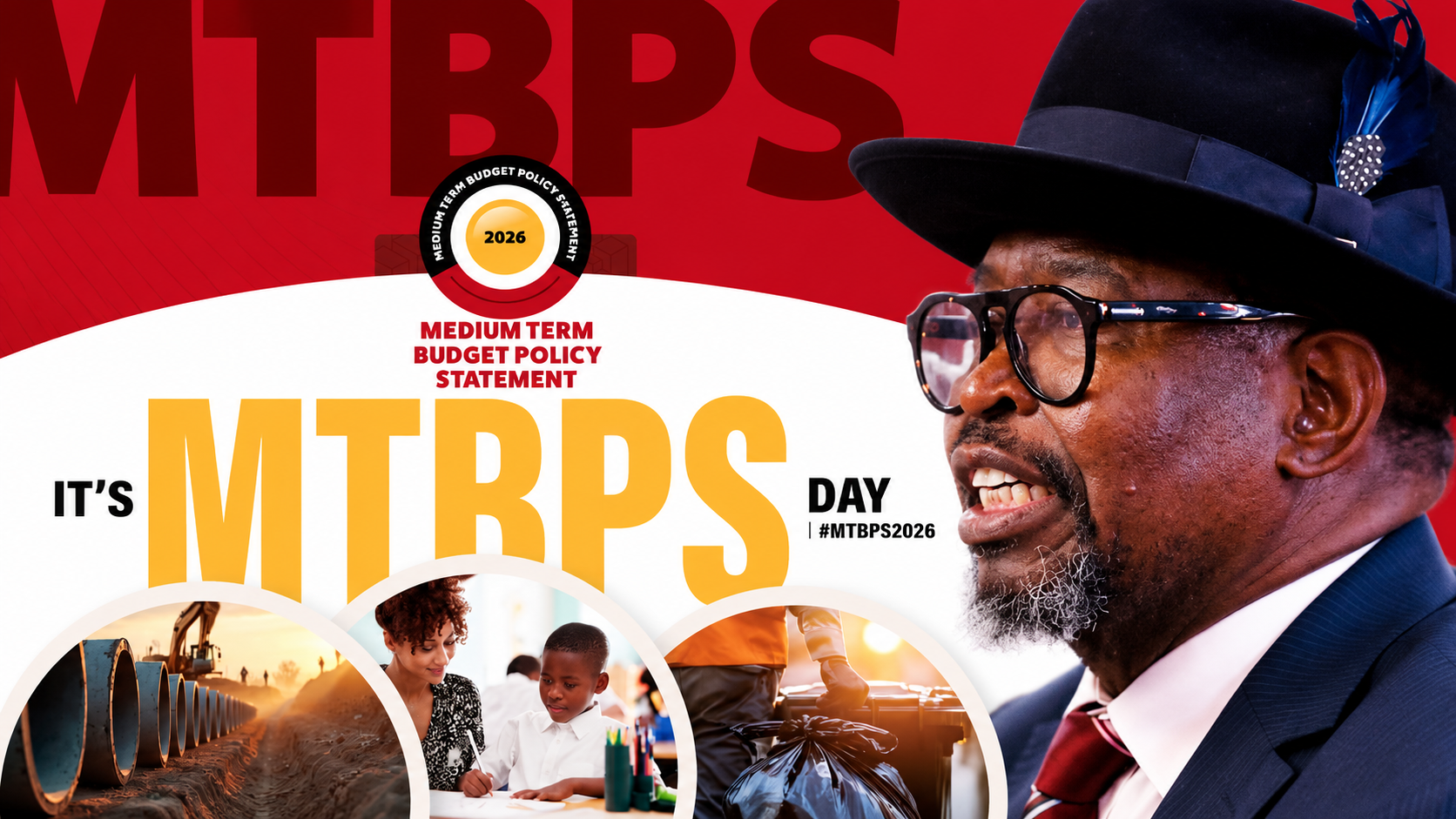
As South Africans wait for Finance Minister Enoch Godongwana to table his medium-term budget on Wednesday afternoon, parliamentarians have warned municipalities against celebrating 100% expenditure while communities remain without functioning taps, toilets and roads.
The Select Committee on Appropriations has challenged what amounts to a box-ticking exercise in municipal financial reporting, insisting that spending every cent of a government allocation does not necessarily constitute service delivery.
The warning comes ahead of Godongwana’s Medium-Term Budget Policy Statement (MTBPS), scheduled for 2pm in Parliament’s Good Hope Chamber in Cape Town.
The minister is expected to outline government’s revised economic outlook, spending priorities and fiscal framework for the next three years.
However, Parliament’s latest intervention raises a fundamental question about the billions allocated to municipalities: what good is spending money if communities have nothing to show for it?
Parliament challenges spending culture
The committee, chaired by Tidimalo Legwase, warned on Tuesday that municipal performance could no longer be measured exclusively through expenditure percentages.
Instead, municipalities would have to demonstrate completed infrastructure, functioning services and measurable improvements in residents’ living conditions.
The warning followed a briefing by Phokwane Local Municipality in the Northern Cape on its conditional grant expenditure.
The municipality received R23.427-million through the Municipal Infrastructure Grant during the 2025/26 financial year but spent only R16.782-million, approximately 72% of its allocation.
This left about R6.645-million unspent despite substantial infrastructure backlogs and deteriorating municipal services.
Municipal officials blamed delays in contractors occupying construction sites while appointment terms and conditions were being negotiated.
The committee acknowledged Phokwane’s ageing infrastructure, poor revenue collection, significant service delivery backlogs and substantial debt to Eskom.
However, Legwase rejected these difficulties as sufficient justification for continued underperformance.
“Section 195 of the Constitution says public resources must be used efficiently, economically and effectively,” said Legwase.
“Spending 72% is not efficient. Building a pump station at 95% for two years is not effective. Claiming 100% progress while Sakhile, a residential area, floods is not accountable,” she added.
Full budgets, empty taps
The committee’s criticism extended beyond Phokwane’s underspending to the broader practice of presenting financial expenditure as evidence of successful government performance.
Parliament warned that it would no longer accept reports claiming 100% project progress while communities continued experiencing raw sewage, gravel roads and unreliable water supplies.
The distinction exposes a significant weakness in expenditure-based reporting.
A municipality can exhaust its infrastructure allocation without necessarily completing projects on time, maintaining infrastructure or delivering services that residents can use.
Legwase insisted that the effectiveness of public spending must ultimately be measured through its impact on communities.
“This committee is not here to sympathise with ageing infrastructure – we are here to ensure that every rand appropriated by Parliament delivers a tap that runs, a toilet that flushes and a street that is passable,” she said.
Her warning also carried potential financial consequences for municipalities unable to implement their funded projects.
“If Phokwane cannot spend, we will recommend that Treasury gives the money to a municipality that can,” she said.
Unspent millions under scrutiny
The intervention comes amid broader concerns over municipalities struggling to spend infrastructure allocations despite persistent service delivery challenges.
Previously, Sunday World reported that 10 municipalities in North West had sought permission to carry over unspent conditional grant allocations into subsequent financial periods.
READ MORE: Ten North West municipalities ask to carry over unspent grants
In KwaZulu-Natal, another municipality lost R255-million in unspent infrastructure grant funding, highlighting the financial consequences of failing to implement funded projects.
READ MORE: KwaZulu-Natal municipality loses R255m in unspent infrastructure grant
These developments underscore the dilemma confronting National Treasury as it balances competing demands for public resources against municipalities’ capacity to spend their allocations effectively.
The committee’s latest warning also comes as government continues pursuing major municipal infrastructure interventions, including a R16.3-billion loan from the BRICS New Development Bank to support improvements in struggling metropolitan municipalities.
Parliament’s Standing Committee on Public Accounts has also scrutinised municipal accountability against the backdrop of government’s R205-billion infrastructure funding interventions.
The question confronting policymakers is therefore no longer simply how much money municipalities receive, but whether those allocations translate into reliable services.
Accountability beyond the balance sheet
Legwase said the committee’s oversight responsibilities were grounded in legislation requiring Parliament to scrutinise public expenditure.
These included the Money Bills Amendment Procedure and Related Matters Act, alongside reporting provisions contained in the Public Finance Management Act and Municipal Finance Management Act.
She explained that parliamentary scrutiny did not replace the responsibilities of municipal executives, councils or provincial legislatures.
Instead, the committee sought to establish whether funds appropriated through the national budget achieved their intended objectives.
As Godongwana prepares to present government’s revised spending framework, the committee’s message places municipal accountability firmly within the national budget debate.
For residents confronting dry taps, overflowing sewage and impassable streets, a municipality’s claim of 100% expenditure offers little consolation when essential services remain dysfunctional.
RELATED
BRICS bank gives SA R16.3bn loan to overhaul ailing metro municipalities
Scopa keeps eye on municipalities as minister injects R205bn for infrastructure
- As South Africans wait for Finance Minister Enoch Godongwana to table his medium-term budget on Wednesday afternoon, parliamentarians have warned municipalities against celebrating 100% expenditure while communities remain without functioning taps, toilets and roads.
- The Select Committee on Appropriations has challenged what amounts to a box-ticking exercise in municipal financial reporting, insisting that spending every cent of a government allocation does not necessarily constitute service delivery.
- The warning comes ahead of Godongwana’s Medium-Term Budget Policy Statement (MTBPS), scheduled for 2pm in Parliament’s Good Hope Chamber in Cape Town.
- The minister is expected to outline government’s revised economic outlook, spending priorities and fiscal framework for the next three years.
- However, Parliament’s latest intervention raises a fundamental question about the billions allocated to municipalities: what good is spending money if communities have nothing to show for it?


