


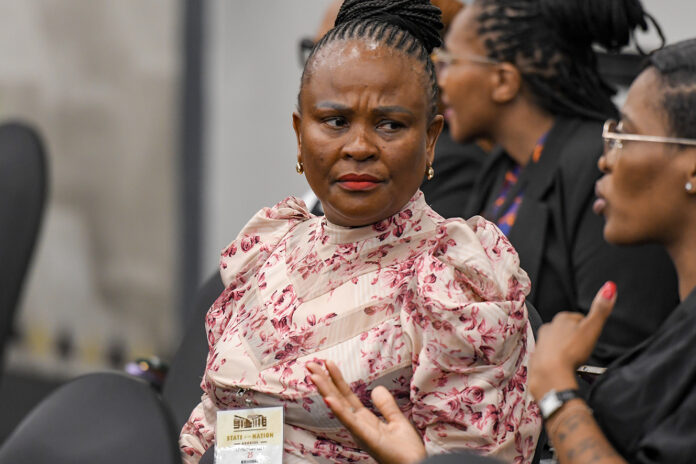
Impeached former public protector Busisiwe Mkhwebane believes the disclosure of a romantic relationship between her successor and Parliament’s top administrative official raises a potential conflict of interest, given their intersecting roles.
Mkhwebane said Public Protector Kholeka Gcaleka’s disclosure that she was in a relationship with Secretary to Parliament Xolile George could have far-reaching implications beyond a single complaint, particularly given the routine interaction between Parliament and the Office of the Public Protector.
“It touches on fundamental principles of institutional integrity, conflict of interest, transparency, and the safeguards embedded in South Africa’s constitutional framework to protect the independence and impartiality of Chapter 9 institutions,” she told Sunday World.
Mkhwebane, now an MK Party provincial chairperson in Mpumalanga, is currently in a legal battle to compel the Office of the Public Protector to pay a R10-million gratuity she claims she is entitled to. However, the Chapter 9 institution argued that she has no legal
basis to receive the gratuity payment, as she was impeached in 2022 before her term expired.
Gcaleka disclosed the relationship after recusing herself from probing a complaint laid by the DA over an 88% rise in George’s salary. Mkhwebane insisted that the romantic nature of the relationship fundamentally undermined the principles of constitutional governance.
“While recusal in specific matters is commendable, the governance architecture demands more: proactive, transparent disclosure; structural firewalls; and vigilance against perceptions of bias,” she said.
However, Parliament spokesperson Moloto Mothapo was adamant that George and Gcaleka had not broken any law by not disclosing their three-year romantic liaison.
Mothapo said the allegations relating to the Office of the Secretary to Parliament are already subject to an established committee-led oversight process. He informed Sunday World that this process serves as the proper platform for discussing and deliberating on any significant issues.
“Parliament will not entertain personal slander, speculation, or reflections directed at officials, particularly where such commentary descends into intrusion on private personal relationships.”
Mkhwebane, however, cited possible compromise of independence on both sides as a result of the romantic affair.
“Personal relationships are private by default, and adults in consensual relationships deserve privacy. However, when individuals hold senior constitutional or parliamentary offices whose functions intersect, the relationship is no longer purely private if it gives rise to a reasonable perception of conflict of interest or compromised independence.”
In its complaint lodged with the office of the Public Protector and other bodies on February 5, 2026, the DA took issue with George’s salary increase of more than 88% since 2022, as well as the alleged misappropriation of funds linked to the 2023 Brics Summit at Emperor’s Palace.
In her letter to the DA, Gcaleka confirmed her recusal.
DA chief whip George Michalakis said while the exact nature of the relationship was not his concern, the fact that Gcaleka had recused herself showed it was serious enough to trigger conflict-of-interest provisions.
He argued that the Public Protector is the head of a Chapter 9 institution that may in future investigate matters involving Parliament, where George serves as the accounting officer.
“This means he therefore has an ethical obligation to disclose such a possible conflict,” Michalakis added.
Public Protector acting spokesperson Ndile Msoki emphasised that the office had acted strictly within the law, adding that Gcaleka had properly managed any perceived conflict.
“Adv Gcaleka has proactively recused herself from any involvement in the handling of the complaint or in any decisions arising from it,” he said, adding that the DA complaint was now overseen by Deputy Public Protector Adv Dinkie Dube.
Msoki emphasised that the recusal was a safeguard designed to protect the credibility of the institution.
He said this step was taken to prevent any perception that the Public Protector’s impartiality could be compromised, comparing it to the legal principle that allows a judge to withdraw from a case where there may be potential bias or a conflict of interest.
- Impeached former public protector Busisiwe Mkhwebane believes the disclosure of a romantic relationship between her successor and Parliament’s top administrative official raises a potential conflict of interest, given their intersecting roles.
- Mkhwebane said Public Protector Kholeka Gcaleka’s disclosure that she was in a relationship with Secretary to Parliament Xolile George could have far-reaching implications beyond a single complaint, particularly given the routine interaction between Parliament and the Office of the Public Protector.
- “It touches on fundamental principles of institutional integrity, conflict of interest, transparency, and the safeguards embedded in South Africa’s constitutional framework to protect the independence and impartiality of Chapter 9 institutions,” she told Sunday World.
- Mkhwebane, now an MK Party provincial chairperson in Mpumalanga, is currently in a legal battle to compel the Office of the Public Protector to pay a R10-million gratuity she claims she is entitled to.
- However, the Chapter 9 institution argued that she has no legal basis to receive the gratuity payment, as she was impeached in 2022 before her term expired.


