


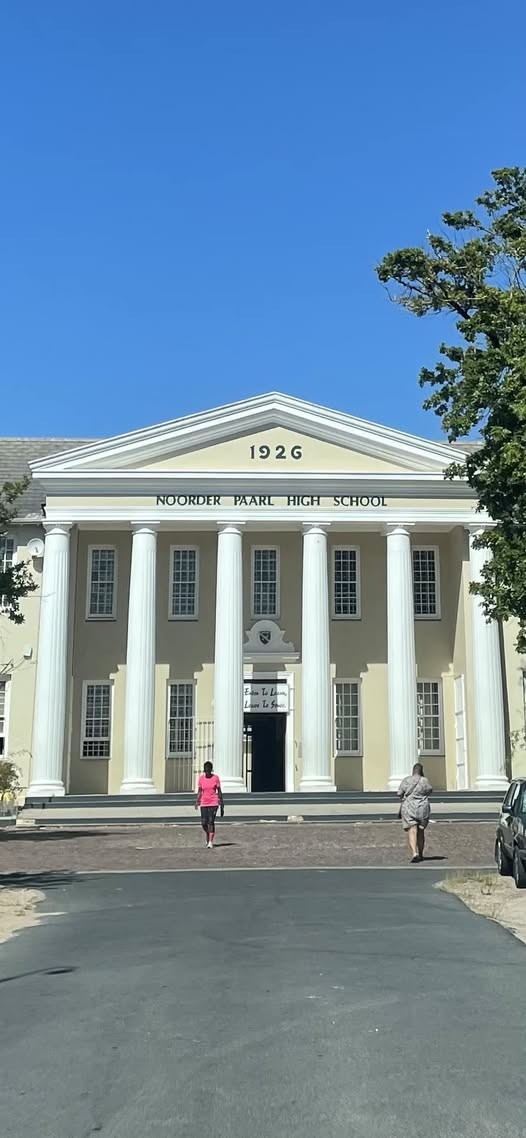
In 1974, when the Group Areas Act forced Noorder Paarl High School to vacate its historic home in exchange for asbestos-sheeted classrooms east of the Berg River, the principal likened the exodus to “being spectators at your own funeral”.
Barely a month later, a storm tore the roofs from the new buildings, forcing the school back to its original Athlone Institute campus. Many in the community saw more than a storm; they saw the hand of God preserving an institution that apartheid sought to uproot.
Whether viewed as providence or remarkable coincidence, the outcome ensured that Noorder Paarl High School remained on the Athlone Institute campus, where it stands today as a towering testament to the resilience and determination of generations who refused to let their educational heritage be erased.
Roots of an educational vision
That story captures something profound about Athlone Institute Paarl. By the late nineteenth century, the churches had assumed primary responsibility for educating the descendants of enslaved people. Beginning with church schools and a teacher-training apprenticeship system, they laid the foundations for what would become Athlone Institute Paarl.
The church leaders of Paarl recognised the urgent need for quality secondary education for the coloured community at a time when government refused to provide such opportunities. Instead, it displayed a callous disregard for the educational aspirations of the community. Rather than accepting this injustice, the churches acted.
Through the collective efforts of St Stephen’s Anglican Church, Holy Trinity Anglican Church, Immanuel Uniting Reformed Church, Zion Uniting Reformed Church and Bethel Congregational Church, together with forty parishioners who mortgaged their properties as surety for a loan, that vision became a reality.
When the Athlone Institute opened in 1926, Reverend William Lloyd captured the significance of that achievement when he declared: “The coloured people of the district of Paarl can now boast of a complete system of education from Sub A to St. X, including the training of teachers. No other district in the Union can boast of such educational advantages.”
From training college to community institution
The Institute entered a new phase in 1953 when government assumed responsibility for the original school buildings for the newly established Noorder Paarl High School, while the teacher education programme became known as Athlone Training College, which attracted students from across South Africa.
When the college closed in 1993 as part of the restructuring of teacher education, the story did not end. Its buildings became the home of the Frank Pietersen Music Centre, ensuring that the campus continued to nurture learning, creativity and opportunity.
Building an ecosystem of hope
Over the past century, the Institute has done far more than educate learners. It has become the seedbed of an ecosystem of community institutions and innovation. The Frank Pietersen Music Centre (1970) has nurtured generations of musicians. Community broadcaster KC 107.7 is the much-loved and trusted voice of the people (1996). The Bursary Fund (1998) has opened doors to higher education. Athlone House of Strength (2006) supports women and children affected by abuse, while the Centre for Hope and Healing (2016) restores lives impacted by substance dependency.
The Noorder Paarl High School Foundation Trust continues to preserve the school’s heritage while investing in its future. Collectively, these institutions demonstrate that when communities invest in education, leadership and social development, the benefits multiply across generations.
The challenges of a second century
However, I would be doing this institution a disservice if our centenary became nothing more than an exercise in nostalgia. Many of the challenges facing coloured (black) youth today mirror those confronted by our founders a century ago. Youth unemployment remains unacceptably high.
Nowhere is this more evident than in Paarl. Thirty years into democracy, many schools and communities in the eastern parts of Paarl still lack facilities that others take for granted. Overcrowded classrooms leave dedicated teachers managing numbers rather than nurturing potential, while educational and sporting opportunities remain unevenly distributed.
And this is not about creating division. It is about creating fairness. Paarl is situated within one of South Africa’s wealthiest regions. We are surrounded by successful businesses, world-class educational institutions and remarkable philanthropic capacity. The resources exist. The real question is whether we have the collective will to ensure that every child benefits from them.
Learning from the founders
That is exactly how Athlone Institute Paarl was born. Five churches, with limited financial resources but extraordinary vision, refused to accept educational exclusion as inevitable. They built partnerships that changed lives for generations.
I see my responsibility as helping to build the principled partnerships our second century demands. We must strengthen educational opportunity, expand social support, advocate on behalf of young people, and ensure that no child’s future is determined by the circumstances into which they were born.
My history teacher, JJ Williams, often reminded us that “the children are the flowers and the reason for our fight”. I have never forgotten those words. The founders of Athlone Institute did not wait for perfect conditions. They built hope where others saw obstacles.
A call to action
The church has an impeccable track record of being at the forefront of the struggle for justice and ensuring that the God-given potential of every person is realised. That is the mission of Athlone Institute: not only to speak out against injustice, but also to advocate, to lobby and to agitate so that every person in the greater Paarl Valley can find their place in the sun.
This is the high calling before us: to build partnerships that unlock the potential of our people. That responsibility belongs not only to Athlone Institute, but to every one of us who believes that education remains the surest pathway to dignity, opportunity and hope.
Here is our hand. Let us partner to unlock the potential of all our people.
- Dr Harlan Cloete is the CEO of Athlone Institute Paarl and a Research Fellow in Local Governance and Public Leadership at the Centre for Gender and Africa Studies, University of the Free State.
- In 1974, Noorder Paarl High School was forced to move due to the Group Areas Act, but a storm soon after damaged the new buildings, returning the school to the Athlone Institute campus where it remains today.
- Athlone Institute Paarl was founded by five churches and community members in 1926 to provide quality secondary education for the coloured community when government refused to do so.
- The institute evolved to include Noorder Paarl High School and Athlone Training College, with the latter closing in 1993 and its facilities becoming the Frank Pietersen Music Centre.
- Over the past century, Athlone Institute has developed community institutions such as the Frank Pietersen Music Centre, KC 107.7 community broadcaster, the Bursary Fund, Athlone House of Strength, and the Centre for Hope and Healing.
- Despite progress, challenges like youth unemployment and inadequate educational facilities persist in Paarl, prompting a call for principled partnerships to expand opportunities and social support.


