South Africa has formally acceded to the Establishment Agreement of the African Export-Import Bank (Afreximbank), unlocking a R130-billion (US$8-billion) country programme aimed at accelerating local mineral processing, easing energy constraints and driving factory-led industrial growth.
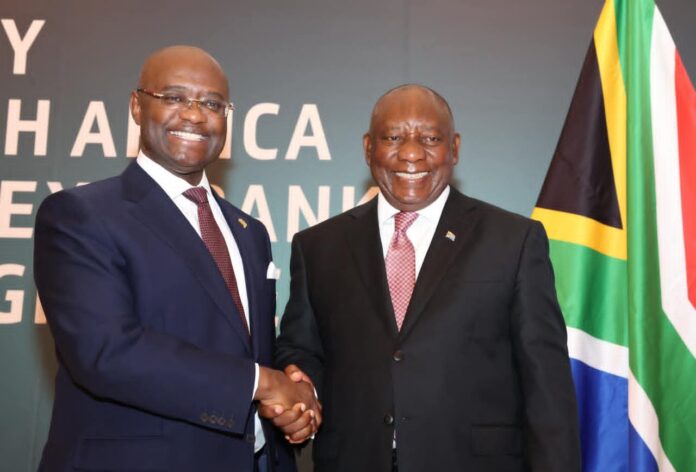
The accession was signed on Thursday at the Westcliff Hotel in Johannesburg. There, President Cyril Ramaphosa addressed government leaders, financiers and business executives. The ceremony marked South Africa’s transition to Class A shareholder status in the pan-African multilateral bank.
The programme is designed to reverse a long-standing pattern in which South Africa exports raw minerals while other economies capture the bulk of the value through processing and manufacturing.
Large-scale investment package
Addressing the ceremony, Afreximbank President and Chairman of the Board of Directors George Elombi said the bank and the Department of Trade, Industry and Competition (DTIC) had assembled a large-scale investment package to shift South Africa decisively toward value-added production.
“I am therefore pleased that together with the South African Department of Trade, Industry and Competition (DTIC), under the leadership of Hon. Minister Parks Tau, we have put together what we consider an important package of US$8-billion for South Africa,” Elombi said.
“The country programme is aligned with South Africa’s national development plan 2030 and national industrial and trade priorities and will target key strategic areas.”
Elombi said the heart of the programme is local beneficiation.
“Heavy investments in the local processing of natural resources, thereby helping retain value within our economies. To create jobs, generate wealth for our people, and expand the revenue base for the South African government,” he said.
“In particular, we will prioritise mineral processing, expansion of automotive manufacturing and development. And expansion of industrial parks and special industrial zones.”
Energy infrastructure
He said energy infrastructure, a critical constraint on industrial growth, forms a central pillar of the programme.
“We plan to invest in the development of critical infrastructure. This includes energy generation and transmission, which are vital for industrial production,” Elombi said.
Ramaphosa said South Africa’s accession marks a strategic shift in how the country positions itself within Africa’s economic future.
“Today we mark a major milestone in our quest to realise the economic integration of our continent. South Africa’s accession to the Africa Export-Import Bank affirms our commitment to African industrial development. And to deepening trade, investment and development across the continent,” Ramaphosa said.
He said the South Africa-Afreximbank Country Programme will be operationalised with a finance package supporting projects across the trade and industrial cluster.
“Once finalised, the South Africa-Afreximbank Country Programme will be operationalised with a finance package that will initially support a range of strategic projects across the trade and industrial cluster,” Ramaphosa said.
“The programme will inject capital into priority industrial projects. And export diversification, infrastructure development and transformation initiatives.”
Ramaphosa linked the energy focus to South Africa’s broader industrial strategy.
Decarbonisation and digitisation
“South Africa’s industrialisation path is anchored by three mutually-reinforcing pillars. These are decarbonisation, diversification and digitisation,” he said.
“We are pursuing an energy transition that balances climate imperatives with developmental realities. That builds new industrial capabilities and creates new jobs.”
Elombi said the partnership reflects a deliberate continental shift away from dependence on external goodwill.
“The fate of our economy, the destiny of the African people, can no longer be tied to the benevolence of others. Today, we assume full responsibility for our economic destiny,” he said.
“We are here first and foremost as Africans, before we are bankers. Our interests cannot be any different from those of our brothers and sisters here in South Africa and other parts of the continent. We will do whatever it takes to support the government and the private sector.”
- South Africa has formally acceded to the Establishment Agreement of the African Export-Import Bank (Afreximbank), unlocking a R130-billion (US$8-billion) country programme aimed at accelerating local mineral processing, easing energy constraints and driving factory-led industrial growth.
- The accession was signed on Thursday at the Westcliff Hotel in Johannesburg.
- There, President Cyril Ramaphosa addressed government leaders, financiers and business executives.
- The ceremony marked South Africa’s transition to Class A shareholder status in the pan-African multilateral bank.
- The programme is designed to reverse a long-standing pattern in which South Africa exports raw minerals while other economies capture the bulk of the value through processing and manufacturing.